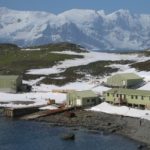
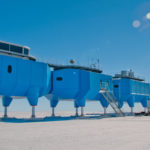
Rothera operates a fully equipped surgery.
New polar ship takes to water once again
26 March, 2019
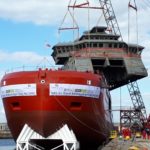
New polar ship takes to the water once again
26 March, 2019
New polar ship takes to the water once again
13 March, 2019
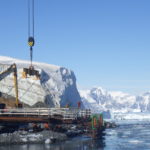
A major milestone has been reached in the construction of a new wharf at Rothera Research Station. The first of 20 steel frames, forming the skeleten of the new structure, has been lowered into place in a piece of precision engineering.
Read more on Construction of new wharf begins as first frame is lowered into place
9 November, 2018 Matthew Southworth
Plant operator and enthusiastic environmentalist Matt Southworth finds his dream of working in Antarctica coming true!
Rothera operates a fully equipped surgery.
19 July, 2018
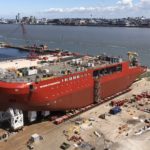
BIRKENHEAD. The superstructure of the new polar research ship for Britain, the RRS Sir David Attenborough, is now on top of the hull. Following the launch of the RRS Sir …
Read more on Update – new polar ship superstructure lifted onto hull
16 July, 2018
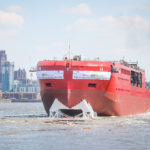
The majestic red hull of the RRS Sir David Attenborough glided in the River Mersey on Saturday 14 July. The launch button was pressed by the naturalist and broadcaster Sir …
Read more on Launch of RRS Sir David Attenborough – in pictures
11 July, 2018
RRS Sir David Attenborough hull launch into River Mersey 14 July Update 20 July 2018 – watch video of launch A major milestone in the build of the UK’s state-of-the-art …
17 November, 2017 Daan Aldenberg
One misty day last week (November 2017), the RRS James Clark Ross arrived at Bird Island in the Southern Atlantic Ocean. On board was Daan Aldenberg, from BAM International, partner …
27 October, 2017
The RRS Sir David Attenborough (SDA) just got another step closer to completion as the Hamburg Ship Model Basin (HSVA) investigated the aerodynamic performance of Britain’s new polar research vessel using a computer generated ‘virtual wind tunnel’
Read more on The RRS Sir David Attenborough in the virtual wind tunnel
29 September, 2017
Rolls-Royce is marking a major milestone on the journey towards the completion of Britain’s new polar research vessel the RRS Sir David Attenborough being built by Merseyside shipyard Cammell Laird.
Read more on Milestone in construction of RRS Sir David Attenborough
18 August, 2017
A major feat of engineering takes place this week (21 August) as the “stern section” of the new polar research ship for Britain, the RRS Sir David Attenborough, is transported …
25 July, 2017 Jerry Gillham
In this blog Jerry Gillham, station leader at King Edward Point Research Station, describes how his team have tackled an unusual cooking challenge. With no dedicated chef at King Edward …
Read more on Cooking up a storm at King Edward Point Research Station
Read more about what the Aurora Innovation Centre can offer.
Boats, cargo, helideck and hangar
20 April, 2017 Paul Fox
Paul Fox, Senior Responsible Officer for RRS Sir David Attenborough, has written a guest blog for a behind-the-scenes look at NERC’s commission of a new polar research ship for Britain and the associated Antarctic infrastructure modernisation programme.
Read more on Guest blog. RRS Sir David Attenborough: The story so far
6 March, 2017 Ben Rowe
This is Part 2 of a guest blog written by Ramboll engineer Ben Rowe, who was embedded with the British Antarctic Survey for 11 weeks to advise and assist with …
Read more on Guest blog: How to move an Antarctic research station #2
3 March, 2017 Ben Rowe
This is Part 1 of a guest blog written by Ramboll engineer Ben Rowe, who was embedded with the British Antarctic Survey for 11 weeks to advise and assist with …
Read more on Guest blog: How to move an Antarctic research station #1
2 February, 2017
British Antarctic Survey (BAS) has successfully relocated Halley VI Research Station to its new home on the Brunt Ice Shelf. Operational teams have spent the past 13 weeks moving each …
Read more on Halley VI Research Station – relocation success
16 January, 2017
British Antarctic Survey (BAS) has decided not to winter at Halley VI Research Station for safety reasons. The station, which is located on the floating Brunt Ice Shelf in Antarctica, …
Read more on Halley Research Station Antarctica to close for winter
24 November, 2016 Yvonne Firing
Follow ORCHESTRA project scientist Yvonne Firing’s amazing fieldwork blog from the Southern Ocean here. On the 2016/2017 Drake Passage cruise on the RRS James Clark Ross, we sail south from …
17 October, 2016
Keel-laying ceremony at Cammell Laird
Read more on New polar ship reaches first construction milestone
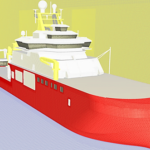
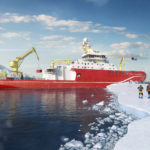
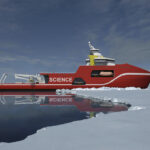
The RRS Sir David Attenborough, commissioned by NERC, built by Cammell Laird for operation by British Antarctic Survey, is one of the most advanced polar research vessels in the world.
20 June, 2016
The medical evacuation from the US South Pole station via British Antarctic Survey’s Rothera Research Station has been completed successfully. A Twin Otter arrived in Punta Arenas, Chile in the …
6 May, 2016
UK’s £200m Polar Research Ship to be named after Sir David Attenborough, days before the broadcaster’s 90th birthday “Boaty McBoatface” to live on as the name of the ship’s high-tech …
Read more on UK’s £200m Polar Research Ship named in honour of Sir David Attenborough
31 March, 2016 Susie Grant
The ship’s science labs have all been packed up and cleaned, kit boxes stowed in the container, cargo paperwork finished and cruise reports written. The SO-AntEco team is ready to …
25 March, 2016 Hilary Blagbrough
Oh look it’s snowing/raining and getting dark… it must be time for the Night Shift. I’m Hilary, the night shift leader on the SO-AntEco scientific cruise to the South Orkney …
23 March, 2016 Susie Grant
Last week was UK Science Week, and we asked schools and anyone else who had burning questions about the Antarctic deep sea to send them to us here on the …
Read more on SHIP BLOG: Science Week questions answered from the Southern Ocean
5 March, 2016 Oliver Ashford
New ‘buoy’ at sea Oliver Ashford – a PhD student from Oxford University – is the youngest member of the SO-AntEco research cruise onboard the RRS James Clark Ross. He’s working with …
23 February, 2016 Jerry Gillham
Bird Island Research Station has a small staff team; no more than 10 in summer and just four over winter. We have no doctor on station though all staff receives …
19 February, 2016 Jamie Coleman
Life on the sub Antarctic Island of South Georgia working for BAS is an amazing experience. South Georgia has the perfect combination of spectacular landscape and incredible wildlife. We have millions …
Read more on Life on the sub Antarctic island of South Georgia
15 February, 2016 Huw Griffiths
As the days count down towards departure the dreams about forgetting my passport at the airport become more frequent. My office in Cambridge is a long way from the Antarctic …
12 February, 2016 Alex Taylor
Despite being one of BAS’s smallest stations, I would argue that Signy is one of the most remote. Situated in the South Orkney Islands, at a relatively northerly 60 degrees …
5 February, 2016 Athena Dinar
“I feel like I’m home” says BBC weather forecaster Peter Gibbs as he sets foot on the Brunt Ice Shelf. It’s an emotional moment for him; the last time he …
26 January, 2016 Tom Jordan
Wrapping up I have started several of my blog posts saying I am writing in various odd/unusual/uncomfortable locations…the back of a Twin Otter, or in a mountain tent high on …
19 January, 2016 Athena Dinar
Antarctica is extraordinary. It is a continent of superlatives – breathtaking, beautiful, hostile, awe-inspiring and life-changing. A trip to the ice always gets under my skin. It somehow puts my …
15 January, 2016 Tom Jordan
One week on from departing Rothera into the field and the first leg of the PolarGAP survey at FD83 is almost over, I get to sit back, relax a bit …
23 November, 2015
The contract for the UK’s new polar research ship was signed NERC’s Chief Operating Office Paul Fox and Cammell Laird Chief Executive, John Syvret CBE on Friday 19 November 2015 …
20 November, 2015 Thomas Welsh
New summer season starts at Halley
Discover the UK’s national capability to support science from the air
6 November, 2015 Ashly Fusiarski
“Goodbyes” get harder each time so I avoid them by saying “See you later” as if I’m just going to the shop. The journey South is long and for me …
Shallow UW Camera System can work to depth up to 1000m, showing a black and white live low resolution video stream and can take colour high resolution stills. The system consists …
The RRS James Clark Ross has a purpose build scientific mooring winch, which is capable of deploying mooring of up to 4000m length of 14mm rope diameter. The winch has a …
shipborne science
BAS has developed aerogravity systems that can be mounted in its geophysical survey aircraft, or in a UAV. Over 100,000 km of gravity data has been collected since such systems …
The radar system is composed of a complex waveform generator, signal processor, data handler and data store. It includes a high power transmitter (up to 66dBm or 4kW), a low …
Two of the four BAS Twin Otters are equipped with a full remote sensing capability, providing scientists with data on land, ice and sea. This includes VNIR & SWIR hyperspectral …
Enabling ice observation programmes
Specialist team for specialist work
Delivering the Antarctic infrastructure modernisation programme
Operational support for UK polar research is managed by our Operations teams. The team covers a wide range of activities from managing Arctic and Antarctic Research stations, operating polar ships …
27 May, 2015
FREE Public Event – Work in a cold climate: designing for the most extreme place on Earth London Festival of Architecture 2015 Thursday 18 June 2015, 18:30 – 20:00 The …
Airborne instrument capability
SAOZ measures sunlight scattered from the overhead sky in a way that allows us to calculate how much of the atmospheric gases ozone and nitrogen dioxide the light has passed through …
The microwave radiometer enables us to gain a better understanding of the chemistry and physics of the polar middle atmosphere, 35–90km above the ground, and how it affects climate. For example, …
The riometer at Halley measures the radiowave noise at 30MHz coming from the Galaxy. Typically there is a gentle variation of the noise during each day as the Earth turns …
Search coil magnetometer Several kinds of natural waves in the ultra-low-frequency (ULF) range are generated in Earth’s space environment (the magnetosphere, bounded by Earth’s magnetic field as it extends into …
The Halley VLF receiver listens to very-low frequency radio waves as part of a network of receivers located all over the polar regions. The data gathered by this network is used by …
Bomem The Bomem has been operating at Halley periodically since 2002. It’s a spectrometer: an instrument that splits light into its component colours. It is designed to look specifically at …
At Halley, balloon launches take place every day at 11am. A device called a radiosonde hangs beneath the helium-filled balloon and measures temperature, pressure and humidity. From GPS we can …
Studying winds, waves, and tides in the upper atmosphere across the polar regions.
Met tower Meteorological scientists at Halley have been measuring the weather in great detail and with ever more sophisticated gadgets since the station first opened over 50 years ago. Instruments …
Rothera Research Station ARIES Dome
MF Radar Info to be added Skiymet Radar Info to be added
Hardware for general use 4 x public use PC workstations with minimum i5 processor, 8GB RAM and 19″ screen Principle Scientist cabin: i5 PC with 24″ screen Local area network …
Offices, social and recreational faclilities
The runway at Rothera is 900 metres long (2,950 ft) and is made of crushed rock. To the west of the runway lies the aircraft hangar, which houses the Dash-7 and three Twin …
26 March, 2015
WWF’s Earth Hour is a global annual event where hundreds of millions of people switch off their lights for one hour to show they care about the planet.
The Twin Otter is a high-wing, twin-engine, turbo-prop aircraft. They are used all over the world and are known for their rugged construction, reliability and short take-off and landing performance. …
The De Havilland Canada Dash-7 (DHC-7) is a key element of our aircraft capability. This four-engined aircraft with a worldwide reputation for reliability, economy and performance made its first flight …
Specialised observatory with a suite of instruments to measure the air and snow chemistry around Halley.
Supporting near-shore marine biology
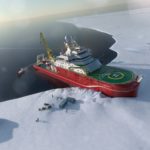
One of the world’s most advanced polar research vessels
Used mainly for transporting staff and cargo to research stations. On charter when not in Antarctica
Visit Ny-Ålesund in the high Arctic, Svalbard
Supporting deep-field science missions
Refuelling and meteorology facility to support deep-field science parties
Signy Research Station is one of Britain’s smallest stations, and is only occupied in summer. The island’s abundant wildlife and greenery make it an ideal outdoor laboratory. Research at Signy …
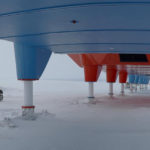
Halley VI Research Station, Brunt Ice Shelf, Antarctica
King Edward Point is primarily a marine and fisheries research station. Owned by the Government of South Georgia and the South Sandwich Islands (GSGSSI) and operated by British Antarctic Survey …
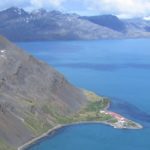
Bird Island Research Station is an important centre for research into bird and seal biology. Lying off the north-west tip of South Georgia, Bird Island is one of the richest …
The largest British Antarctic facility is a centre for biological research and a hub for supporting deep-field science.
28 May, 2014
We caught up with Bird Island Research Station Leader Adam Bradley who was living and working on the island when the BBC crew came to film Deadly Pole to Pole. …
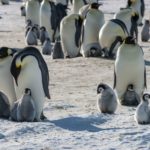
27 May, 2014
Deadly Pole to Pole at Bird Island Tune in to CBBC today at 5:25pm to see adventurer Steve Backshall on Bird Island as part of the BBC’s Deadly Pole to …
25 April, 2014
New polar research ship for UK Chancellor of the Exchequer, the Rt Hon George Osborne MP announced this week (Friday 25 April 2014) that the Government has earmarked more than …
19 July, 2005
A futuristic design by Faber Maunsell and Hugh Broughton Architects has won the competition for the new British Antarctic Survey (BAS) Halley Research Station. In a very close-run contest, three …
Read more on PRESS RELEASE: Futuristic design wins competition for new Antarctic Research Station
29 June, 2004
Operational Note – Media Briefing 10.30 am 29 June 2004, Royal Institute of British Architects 66 Portland Place, London. A major international competition to design a new scientific research station …
Read more on PRESS RELEASE: Design Competition for new Antarctic Research Station – Launch
23 July, 2003
Press Statement – 23 July 2003 It is with the deepest sorrow that British Antarctic Survey (BAS) reports the death of a marine biologist at Rothera Research Station on the …