Join Climate scientist and mathematician at British Antarctic Survey Dr Emily Shuckburgh and award-winning designer, author and illustrator Chris Haughton (A Bit Lost, Oh No George! and Shh! We Have …
The British Antarctic Survey, along with the University of Leeds and Royal Holloway, University of London, invites you for its second Polar Governance Workshop: Polar Governance in Action: balancing multiple interests …
Professor Dame Jane Francis, Director of British Antarctic Survey is giving the Annual WiSETI (Women in Science, Engineering and Technology Initiative) Lecture at the 2018 Cambridge Science Festival. She will …
The British Antarctic Survey (BAS) and Cambridge Conservation Initiative (CCI) are convening a series of workshops in 2017-18 on Science-Policy Challenges in Polar Conservation and Management. Each of the workshops …
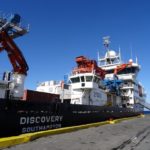
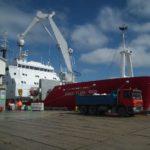
Boats, cargo, helideck and hangar
Fossil Festival A5 2017 Do you have what it takes to be a polar explorer? Think the poles are just dead, icy wastes? Think again! Join the British Antarctic Survey, …
The behaviour of the westerly wind belt (see Figure 1a) over the Southern Ocean during cold glacial periods has been debated for many years. These winds matter because explanations of …
In the south of the Weddell Sea lies the Ronne and Filchner Ice Shelves. During the coldest part of the last glacial period about 25,000 years ago, the ice in …
To assess the wider impact of global climate changes on the environment we are investigating intervals of deep geological time that provide clues about the evolution and sensitivity of organisms …
We aim to detect patterns and mechanisms of late glacial and Holocene climate change and to place recent human impacts on the Earth’s climate system in the context of long …
By exploiting advances in ice sheet modelling, and new Antarctic-wide datasets, this project aims to predict how far and how fast the observed ocean-driven thinning of floating ice shelves will …
Ice cores take a long time to collect. The 3.4 km- ice core drilled at Dome Concordia (Antarctica) took 5 years to collect and encloses the oldest ice drilled so …
The research of the ice sheet modelling group focuses on integrating observational data with dynamical models that describe how the ice flows in order to improve our representation of how …
During the Last Interglacial (129-116 thousand years ago, ka) CO2 and global temperature were both higher than they were before human industrialisation. By examining Last Interglacial climate, we thus gain …
The Antarctic Peninsula and West Antarctica have warmed dramatically in recent decades, with some climate records indicating that these are among the most rapidly warming regions on Earth. The Antarctic …
The biggest uncertainty in predictions of sea-level rise is what the contribution will be from the great ice sheets on Antarctica and Greenland as climate warms. Improving knowledge on the …
In order to assess the impact of anthropogenic carbon dioxide (CO2) on the oceans today we are investigating the effect of decreasing upper ocean pH on calcifying zooplankton. Pteropods, …
Why does global biodiversity show such a steep increase just as climates were deteriorating?
The biggest uncertainty in predictions of sea-level rise is what the contribution will be from the great ice sheets on Antarctica and Greenland as climate warms. The West Antarctic Ice …
Ocean temperature has been identified as a key driver of current ice sheet retreat in the Amundsen Sea sector of the West Antarctic Ice Sheet (WAIS), yet its long-term history …
A strategic framework to connect science and society