



Digital Innovation Team
The Digital Innovation Team is a group of software engineers integrating the digital infrastructure from internal and external groups and service providers, to aid better research, operational and innovation usage.
We achieve this with some guiding principles in mind:
- Engineering adaptable, future-proof digital solutions
- Avoiding “Not invented here” syndrome, which see’s external innovations ignored
- Baking in software sustainability principles at our heart
- Focusing on supporting existing research infrastructure teams to deliver cutting edge research and innovation-led projects
AI for smart conservation
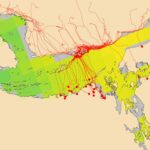
In the AI for smart conservation project, BAS are collaborating with local ecologists and conservation agencies to develop decision-making tools informed by sea ice forecasts. By combining satellite observations, GPS …
AMOP – Autonomous Marine Operations Planning
AMOP is developing Artificial Intelligence methods that aim to optimise the efficiency of Antarctic field operations, while maximising science delivery
CANARI
Extreme weather events can have substantial impacts. For instance: the extensive UK flooding during the stormy winters of 2013/14 and 2015/16 resulted in £3 billion of damage to property and …
DI4EDS
Environmental research relies on digital infrastructure (hardware, software and methods) to provide services that help researchers answer questions about the environment around us, and innovators to work out ways that …
Digital Twins of the Polar Regions
Digital Twinning is next generation technology for data fusion and computer modelling enabling us to rapidly get answers to “what-if” questions. Digital Twins (DTs) are already in operation in industry …
IceNet
IceNet is a probabilistic, deep learning sea ice forecasting system developed by an international team and led by British Antarctic Survey and The Alan Turing Institute [Andersson et al., 2021]. …QUASAR
QUASAR uses AI to improve Antarctic sea ice measurements from satellites, making climate data more reliable for scientists tracking changes in polar regions.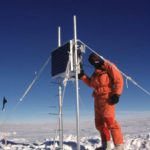
LPM Network
Access data from the Low Power Magnetometer (LPM) networkAI sea ice forecasts for Arctic conservation: A case study predicting the timing of caribou sea ice migrations
28 May, 2025 by Ellen Bowler, James Byrne, Scott Hosking, Jeremy Wilkinson, Martin Rogers, Rachel Cavanagh, Tom Andersson
Every autumn on the south coast of Victoria Island (Nunavut, Canada), endangered Dolphin and Union (DU) caribou (Rangifer tarandus groenlandicus x pearyi) wait for sea ice to form before continuing…Calculations of extreme sea level rise scenarios are strongly dependent on ice sheet model resolution
28 January, 2025 by Rosie Williams, James Byrne, Scott Hosking, Robert Arthern
The West Antarctic Ice Sheet (WAIS) is losing ice and its annual contribution to sea level is increasing. The future behaviour of WAIS will impact societies worldwide, yet deep uncertainty…Contributions to the development of the next-generation NERC Environmental Data Service: Building Interoperability – a NERC Data Commons RoadMap
1 November, 2024 by Alexander Tate, Alice Fremand, Helen Peat, James Byrne, Petra ten Hoopen
This is a final report from the work undertaken by the NERC Environmental Data Service (EDS) funded by the UKRI Digital Research Programme grant: EDS UKRI DRI Phase 1b. The…WAVI.jl: Ice Sheet Modelling in Julia
14 March, 2024 by Alexander Bradley, Rosie Williams, David Bett, James Byrne, Robert Arthern
Ice sheet models are used to improve our understanding of the past, present, and future evolution of ice sheets. To do so, they solve the equations describing the flow of…
Seasonal Arctic sea ice forecasting with probabilistic deep learning
26 August, 2021 by Dani Jones, Emily Shuckburgh, James Byrne, Scott Hosking, Jeremy Wilkinson, Tony Phillips, Tom Andersson
Anthropogenic warming has led to an unprecedented year-round reduction in Arctic sea ice extent. This has far-reaching consequences for indigenous and local communities, polar ecosystems, and global climate, motivating the…Read more on Seasonal Arctic sea ice forecasting with probabilistic deep learning