Genetics Leader IMP 3

The British Antarctic Survey (BAS) are building a new unique science facility at our UK Cambridge headquarters.
The new BAS Controlled Environment Facility (CEF) is an advanced research centre dedicated to studying polar ecosystems. This state-of-the-art facility will provide essential resources for understanding how life has adapted to extreme cold and how it is being affected by environmental changes.
The new BAS CEF will support world-class collaborative research, addressing critical gaps in knowledge. It will enable scientists to explore pressing questions about polar biodiversity, including the resilience of key species, the impacts of pollutants, and the potential for biotechnological innovations that could contribute to Net Zero goals.
A unique research facility
The BAS CEF is the only low temperature biological storage and experimental facility in the UK, and complements two other similar facilities worldwide, one in Germany at the Alfred Wegener Institute, and one in Hobart, Australia.
The facility will include large storage units at +4°C and -20°C, combined with three controlled cold (0°C) environment experimental rooms and a polar marine aquarium operating between -2°C and 0°C. This advanced facility will greatly enhance the UK’s capacity for biological research in polar regions.
Examples of such include analyses of individual proteins, cells, microbiomes and genomes, through to animal responses to warming, heatwaves, acidification, and ocean freshening, analyses of pollutants, viral infections and microplastics and development of novel cold-adapted biotechnological innovations.
Answering important science questions
Research in the new CEF will focus on answering important science questions to advance understanding about polar ecosystems.
Can life in the polar regions adapt to the rapid rate of environmental change at the poles? How do environmental hazards impact life in the polar regions? What level of change will destabilise high latitude ecosystems on land and in the sea? How can polar resources be used to build a more resilient planet? How can polar innovation be used to provide enhanced understanding of fundamental biology underpinning other areas of science?
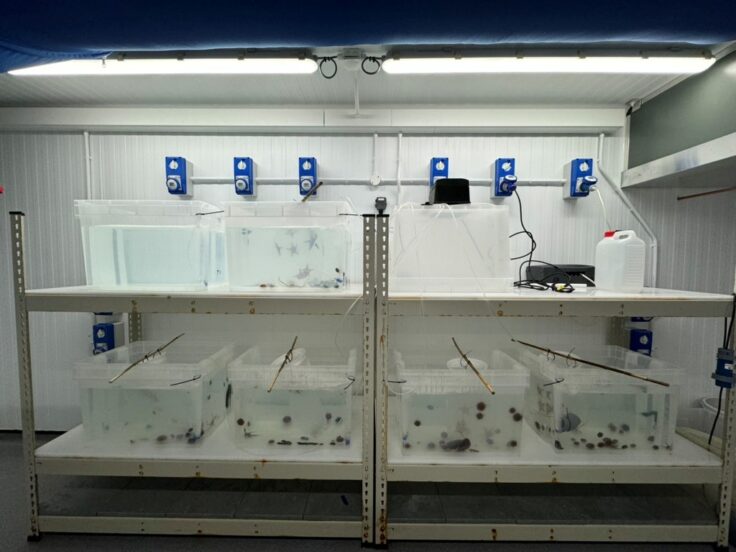
An experimental set-up in the current BAS CEF. Photo by Gert-Jan Jeunen.
Advancing accessibility: key features of the new CEF
FLEXIBILITY
A key feature of this CEF is its flexibility. It not only provides preserved material from the field for high tech analysis, but also allows experiments to be carried out in precisely controlled conditions. This reproducibility is crucial when studying species with less than a 3°C range in their natural environment. Such precision and consistency over prolonged periods cannot be delivered remotely in field operations.
IMPROVING EDI
The facility will enhance access to material and support for researchers not able to travel to polar environments because of disabilities, caring responsibilities, societal commitments, and/or the extended time commitments away from normal job functions and family.
The new CEF allows access to polar material for these sectors and has a controlled environment experimental room supporting access for a range of disabilities, including wheelchair access.
The facility also provides essential facilities for early career researchers to be trained as the next generation of polar scientists.
RERDUCING CARBON FOOTPRINT
Most of the research carried out in the current facility to date is not possible on the RRS Sir David Attenborough, at research stations or in other aquaria. This work has a smaller carbon footprint cost than solely shipboard or station-based projects, therefore helps to drive forward our Net Zero aspirations.
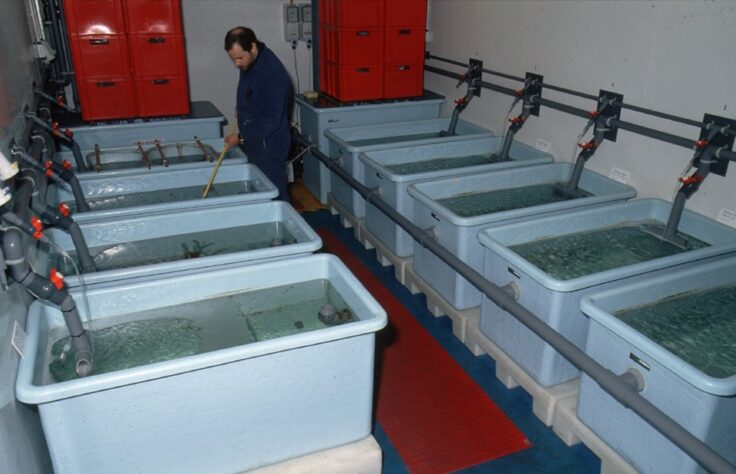
The marine aquarium at BAS Cambridge in 1995, holding marine animals brought back from Antarctica. Photo by Chris Gilbert.
Importance for UK polar research to date
Marine animals collected from Antarctic waters have been maintained in aquarium facilities in Antarctica and the UK by the British Antarctic Survey (BAS) since 1973.
The current BAS CEF has supported UK research in polar biodiversity for over four decades and has provided material for, and experimental support for, over 1,000 projects and over 2,500 published papers.
Funding for the facility has been provided by the Natural Environment Research Council (NERC).
A selection of published papers involving the BAS Controlled Environment Facility and Marine Aquarium:
Keiron P.P. Fraser, Lloyd S. Peck, Melody S. Clark, Andrew Clarke. A comparative study of tissue protein synthesis rates in an Antarctic, Harpagifer antarcticus and a temperate, Lipophrys pholis teleost (2024). https://doi.org/10.1016/j.cbpa.2024.111650
Nicholas J. Barrett, Elizabeth M. Harper and Lloyd S. Peck. The impact of acute low salinity stress on Antarctic echinoderms (2024). https://doi.org/10.1098/rspb.2024.1038
Simon A. Morley, Amanda E. Bates, Melody S. Clark, Elaine Fitzcharles, Rebecca Smith, Rose E. Stainthorp and Lloyd S. Peck. Testing the Resilience, Physiological Plasticity and Mechanisms Underlying Upper Temperature Limits of Antarctic Marine Ectotherms (2024). https://doi.org/10.3390/biology13040224
Keiron P. P. Fraser, Lloyd S. Peck, Melody S. Clark, Andrew Clarke and Simeon L. Hill. Life in the freezer: protein metabolism in Antarctic fish (2022). https://doi.org/10.1098/rsos.211272
Leyre Villota Nieva, Lloyd S. Peck, Melody S. Clark. Variable heat shock response in Antarctic biofouling serpulid worms (2021). https://www.sciencedirect.com/science/article/pii/S1355814523002444
Victoria A. Sleight, Benjamin Marie, Daniel J. Jackson, Elisabeth A. Dyrynda, Arul Marie & Melody S. Clark. An Antarctic molluscan biomineralisation tool-kit (2016). https://www.nature.com/articles/srep36978
Simon A. Morley, Coleen C. Suckling, Melody S. Clark, Emma L. Cross, Lloyd S. Peck (2016). Long-term effects of altered pH and temperature on the feeding energetics of the Antarctic sea urchin, Sterechinus neumayeri. https://doi.org/10.1080/14888386.2016.1174956
Victoria A. Sleight, Michael A.S. Thorne, Lloyd S. Peck, Melody S. Clark. Transcriptomic response to shell damage in the Antarctic clam, Laternula elliptica: Time scales and spatial localisation (2015). https://www.sciencedirect.com/science/article/pii/S1874778715000100
Coleen C. Suckling, Melody S. Clark, Joelle Richard, Simon A. Morley, Michael A. S. Thorne, Elizabeth M. Harper, Lloyd S. Peck (2014). Adult acclimation to combined temperature and pH stressors significantly enhances reproductive outcomes compared to short-term exposures. https://doi.org/10.1111/1365-2656.12316
Melody S. Clark, Keiron P. P. Fraser & Lloyd S. Peck. Lack of an HSP70 heat shock response in two Antarctic marine invertebrates (2008). https://link.springer.com/article/10.1007/s00300-008-0447-7
Lloyd S. Peck, Dawn K. Powell & Paul A. Tyler. Very slow development in two Antarctic bivalve molluscs, the infaunal clam Laternula elliptica and the scallop Adamussium colbecki (2006). https://link.springer.com/article/10.1007/s00227-006-0428-8
David A. Bowden, Andrew Clarke, Lloyd S. Peck, David K. A. Barnes (2006). Antarctic sessile marine benthos: colonisation and growth on artificial substrata over three years. https://www.int-res.com/articles/feature/m316p001.pdf
Robertson, A. El-Haj, A. Clarke, L. Peck & E. Taylor. The effects of temperature on metabolic rate and protein synthesis following a meal in the isopod Glyptonotus antarcticus Eights (1852) (2001). https://link.springer.com/article/10.1007/s003000100268
Genetics Leader IMP 3
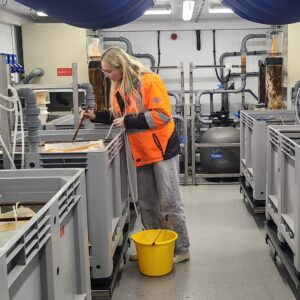
Marine Aquarium Technician
This project studies how Antarctic aquatic ectotherms — animals whose body temperature depends on their environment — survive in freezing waters.
Dynamic Live Cell Imaging investigated how Antarctic marine organisms, particularly fish, function at temperatures below 0°C
Cambridge researchers are set to explore the uncharted depths of life in the extreme cold, with findings that could reshape our understanding of biology and pave the way for future scientific breakthroughs.
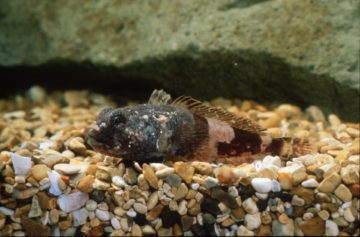
The British Antarctic Survey (BAS) will build a new unique science facility at its UK Cambridge headquarters, enabling scientists to understand how organisms that live in cold polar environments evolved and the impact of environmental change on these special ecosystems.