
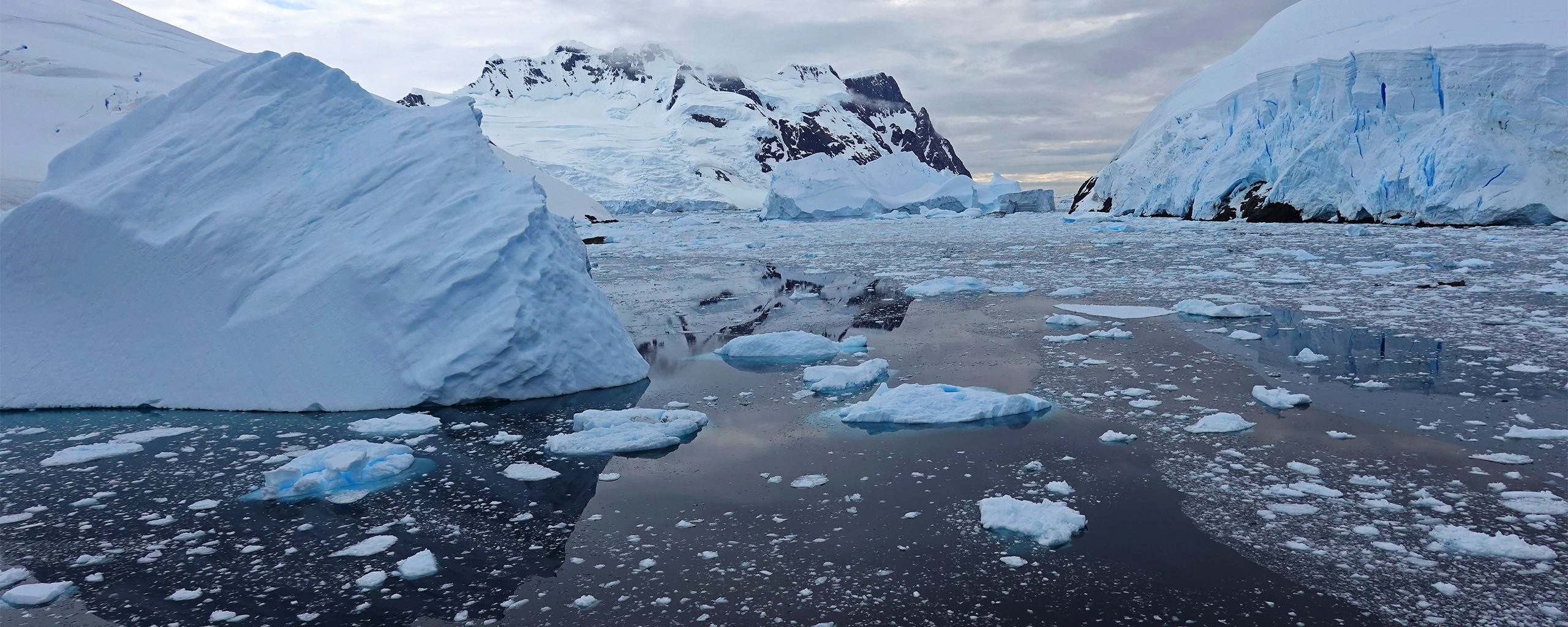
Antarctic Lakes
1 January, 2012 by Dominic Hodgson
The Antarctic continent, including its ice shelves, has an area of 13.8 million km2, about half the size of North America and 1.3 times the size of Europe. It is…Showing 1850 items
1 January, 2012 by Dominic Hodgson
The Antarctic continent, including its ice shelves, has an area of 13.8 million km2, about half the size of North America and 1.3 times the size of Europe. It is…1 January, 2011 by David Pearce
One of the most remarkable discoveries resulting from the robotic and remote sensing exploration of space is the inferred presence of bodies of liquid water under ice deposits on other…Read more on Subglacial environments and the search for life beyond the Earth
1 January, 2011
We review the Quaternary geology of the North Sea area, summarising evidence for extents, configurations and timing of former glacial activity, focusing attention on key sites across the basin, and…Read more on The Pleistocene glaciations of the North Sea Basin
1 January, 2011 by Lloyd Peck
Broadcast spawning invertebrates in the Antarctic encounter a very arduous and unforgiving environment, where consistently low temperatures, high seawater viscosities and at times high flow conditions undermine successful sperm-egg interactions.…1 January, 2011 by Andy Smith, Andrew Tait, Dominic Hodgson, David Pearce, Ed King, Hugh Corr, Keith Makinson, Linda Capper, Rachel Clarke, Richard Hindmarsh, Richard Hindmarsh
The direct measurement and sampling of Ellsworth Subglacial Lake is a multidisciplinary investigation of life in extreme environments and West Antarctic ice sheet history. The project's aims are (1) to…Read more on Probe technology for the direct measurement and sampling of Ellsworth Subglacial Lake
1 January, 2011 by Andy Smith, Andrew Tait, Dominic Hodgson, David Pearce, Ed King, Hugh Corr, Keith Makinson, Linda Capper, Rachel Clarke, Richard Hindmarsh, Richard Hindmarsh
Ellsworth Subglacial Lake, first observed in airborne radio echo sounding data acquired in 1978, is located within a long, deep subglacial trough within the Ellsworth Subglacial Highlands of West Antarctica.…1 January, 2011 by Gareth Marshall, John Turner
The polar regions have experienced some remarkable environmental changes in recent decades, such as the Antarctic ozone hole, the loss of large amounts of sea ice from the Arctic Ocean…1 January, 2010
Plants, both above- and belowground, offer diverse habitats for microbial colonization and growth. Plant-microbe interactions lie at the heart of plant performance and ecology. Plants provide various growth substrates and…1 January, 2010 by Melody Clark
Many organisms have evolved the ability to enter into and revive from a dormant state. They can survive for long periods in this state (often even months to years), yet…1 January, 2010 by Keith Nicholls, Michael Meredith, Sally Thorpe
Miniature electronic data recorders and transmitters have revolutionized the way we study animals over the past decades, particularly marine animals at sea. But, very recently, animal-borne instruments have also been…Read more on Biologging in the global ocean observing system
1 January, 2010 by Keith Nicholls, Michael Meredith, Sally Thorpe
In recent years, the international “Southern Elephant seals as Oceanographic Samplers” (SEaOS) project has deployed miniaturized conductivity-temperature-depth satellite-relayed data loggers (CTD-SRDL) on elephant seals 1) to study their winter foraging…1 January, 2010 by Melody Clark
The field of Genomics has essentially been fuelled by medical research with developments in human gene therapy, such as the Human Genome Project. This major international undertaking resulted in a…1 January, 2010 by Martin Collins, Mark Belchier
Patagonian toothfish (Dissostichus eleginoides) is a large notothenioid fish that supports valuable fisheries throughout the Southern Ocean. D. eleginoides are found on the southern shelves and slopes of South America…Read more on The Patagonian toothfish: biology, ecology and fishery
1 January, 2010 by Peter Convey
This chapter is concerned with the life-history features of terrestrial invertebrates inhabiting the cold regions of the world. It predominantly focuses on the Antarctic continent and the Arctic elements of…Read more on Life history adaptations to polar and alpine environments
1 January, 2010 by Jennifer Jackson
At present, there are 15 species of baleen whales that belong to the monophyletic suborder Mysticeti. The family-level designations of Balaenidae (right and bowhead whales) and Neobalaenidae (pygmy right whales)…1 January, 2010 by Peter Ward
Plankton are the main food source in the majority of marine ecosystems and have a crucial role in climate change through primary production and the export of carbon to the…Read more on A global continuous plankton recorder programme
1 January, 2010 by Michael Meredith
By connecting the ocean basins and the upper and lower limbs of the ocean overturning circulation, the Southern Ocean plays a critical role in the global ocean circulation, biogeochemical cycles…1 January, 2010 by Geraint Tarling
Early feeding studies on Meganyctiphanes norvegica described the morphology of the feeding appendages and the actual process of food uptake and digestion. Insights into diurnal, seasonal and ontogenetic pattern in…Read more on Food and feeding in northern krill (Meganyctiphanes norvegica sars)
1 January, 2010 by Michael Thorne, Roger Worland, Melody Clark
Arthropods have evolved a number of different adaptations to survive extreme environmental temperatures including, in some regions, over-wintering temperatures well below 0°C. One of the less common adaptations to surviving…Read more on Cryoprotective dehydration: clues from an insect
25 March, 2009 by Jamie Oliver, Kevin Hughes
Science has always been at the centre of human endeavour in Antarctica. It is just over 50 years since the International Geophysical Year (1957-58) established many of the long-term research…Read more on Understanding Antarctica – 50 years of British Scientific Monitoring (1959-2009)
1 January, 2009 by Robert Larter
Seismic stratigraphic studies and scientific drilling of the Antarctic continental margin have yielded clues to the evolution of Cenozoic climates, depositional paleoenvironments and paleoceanographic conditions. This paper draws on studies…1 January, 2009 by Peter Fretwell
The results of a field spectroscopy campaign that aimed to provide ground truth data for validation of NDVI-based vegetation maps of the region around the British Antarctic Survey Rothera Research…Read more on Field reflectance spectroscopy of sparse vegetation cover on the Antarctic peninsula
1 January, 2009 by Claus-Dieter Hillenbrand, Robert Larter
This chapter explores the Middle Miocene to Pliocene terrestrial and marine records of Antarctica and the Southern Ocean. The structure of the chapter makes a clear distinction between terrestrial and…Read more on Middle Miocene to Pliocene history of Antarctica and the Southern Ocean
1 January, 2009 by Eric Wolff
Continental margin drill core and seismic data indicate that between 3.0 and 2.5 Ma, high-latitude climate cooling drove both the West and East Antarctic Ice Sheets towards their present expanded…1 January, 2009
The oceanic southern margin of Gondwana, from southern South America through South Africa, West Antarctica, New Zealand (in its pre break-up position), and Victoria Land to Eastern Australia is one…Read more on The tectonic context of the Early Palaeozoic southern margin of Gondwana
1 January, 2009 by Michael Meredith, Zhaomin Wang
The oceans play a key role in climate regulation especially in part buffering (neutralising) the effects of increasing levels of greenhouse gases in the atmosphere and rising global temperatures. This…1 January, 2009 by David Vaughan
Ice sheets of Greenland and Antarctica are uniquely arresting and captivating features of the Earth’s natural environment. The hyperbole attached to their description, their sheer size and remoteness from the…Read more on Ice sheets: indicators and instruments of climate change
1 January, 2008 by Alistair Crame
The evolution of Antarctic climate from a Cretaceous greenhouse into the Neogene icehouse is captured within a rich record of fossil leaves, wood, pollen, and flowers from the Antarctic Peninsula…Read more on 100 million years of Antarctic climate evolution: evidence from fossil plants
1 January, 2008
Preservation of ecosystem structure is the guiding principle by which the Commission for the Conservation of Antarctic Marine Living Resources (CCAMLR) endeavors to manage the harvests of living resources of…Read more on Reconciling fisheries with conservation: three examples from the Southern Ocean
1 January, 2008 by Dominic Hodgson
1 January, 2008 by Philip Leat
The distribution and geochemical relationships of the Early Jurassic Ferrar large igneous province (LIP) are examined and it is concluded that they support the lateral flow model for the emplacement…Read more on On the long-distance transport of Ferrar magmas
1 January, 2008
Release of stored magnetic energy via particle acceleration is a characteristic feature of astrophysical plasmas. Magnetic reconnection is one of the primary candidate mechanisms for releasing non-potential energy from magnetized…Read more on Fluctuating electric field particle acceleration at a magnetic field null point
1 January, 2008 by Peter Convey
1 December, 2007
In this paper we present a summary of palaeoclimate modelling activities carried out for the mid Pliocene, and demonstrate how a combined data and modelling approach has led to significant…Read more on The mid Pliocene Warm Period : a test-bed for integrating data and models
1 January, 2007 by Gareth Chisham, Mervyn Freeman
In this paper we review some recent work investigating the turbulent structure of the ionospheric plasma velocity in the polar and auroral regions. The studies make use of spatially distributed…1 January, 2007 by Andrew Clarke, Eugene Murphy, Nadine Johnston
The Antarctic biota has evolved over the last 100 million years in increasingly isolated and cold conditions. As a result, Antarctic species, from micro-organisms to vertebrates, have adapted to life…Read more on Antarctic ecology: from genes to ecosystems. Part 2: Evolution, diversity and function
1 January, 2007 by Fausto Ferraccioli
During the summer season 2005-06 a major scientific collaboration between the British Antarctic Survey (BAS) and the Italian Programma Nazionale di Ricerche in Antartide (PNRA) carried out airborne geophysical investigations…1 January, 2007 by Fausto Ferraccioli
The Wilkes Subglacial Basin (WSB) is the major morphological feature recognized in the hinterland of the Transantarctic Mountains. The origin of this basin remains contentious and relatively poorly understood due…1 January, 2007 by Fausto Ferraccioli
Cenozoic magmatic rocks of the Transantarctic Mountains provide an important window on the tectonic and magmatic processes of the West Antarctic Rift System. Previous aeromagnetic investigations in northern Victoria Land…