Update from Thwaites Glacier: when science doesn’t go your way
Researchers from the British Antarctic Survey (BAS) and South Korea (KOPRI) have concluded a highly ambitious field operation at Thwaites Glacier, West Antarctica, after instruments deployed during hot-water drilling became lodged within the ice during the final stage of the mission.
The international team was working to install long-term oceanographic instruments beneath Thwaites Glacier, one of the most remote, rapidly changing and unstable glaciers in Antarctica. The instruments were designed to provide the first sustained measurements of ocean conditions beneath the glacier’s fast-moving main trunk — data that are critical for improving predictions of future ice loss and global sea-level rise.
Thwaites Glacier plays a key role in the stability of the West Antarctic Ice Sheet. Significant retreat could accelerate ice flow into the ocean, potentially contributing metres of global sea-level rise over the coming centuries. Understanding how relatively warm ocean waters interact with the base of the glacier is therefore a major scientific priority.
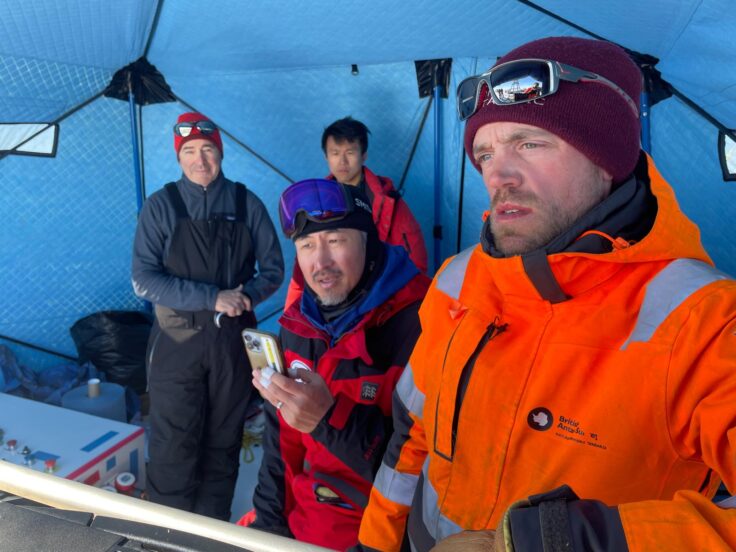
The team of scientists, engineers and field guides spent more than a week camped on the glacier establishing a complex hot-water drilling system. Using water heated to around 80°C, they successfully drilled a borehole approximately 1,000m (3,300 ft) through the ice, just 30cm in diameter. The borehole needed to be continuously maintained, as it would begin to refreeze within roughly 48 hours.
Despite strong winds, crevasses, shifting ice and equipment challenges, the team succeeded in deploying a suite of instruments temporarily through the borehole.
These instruments collected the first-ever measurements from beneath the glacier’s main trunk, revealing turbulent ocean conditions and relatively warm water capable of driving substantial melting at the ice base.
“Failure is always an option when you are pushing at the limits of scientific exploration,” said Peter Davis, BAS oceanographer and member of the drilling team. “We know heat beneath Thwaites Glacier is driving ice loss. These observations are an important step forward, even though we are disappointed the full deployment could not be achieved.”
Final deployment cut short
During the final phase of the operation, the team attempted to lower a mooring system that was intended to remain beneath the glacier for one to two years, transmitting data back via satellite. Partway through the descent, the instruments became stuck within the borehole, likely due to refreezing ice or deformation of the hole caused by the glacier’s rapid movement – over 9m (30 ft) per day in places.
With a worsening weather forecast, a limited supply of hot water, and the need to demobilise before the research vessel Araon departed Antarctica, there was no opportunity to attempt a second borehole. The instruments were ultimately lost within the ice.
“Fieldwork in Antarctica always comes with risk,” said Dr Keith Makinson, BAS oceanographer and drilling engineer. “You have a very small window in which everything has to come together. While this outcome is deeply disappointing, the data we did recover are scientifically valuable and will help shape future efforts.”
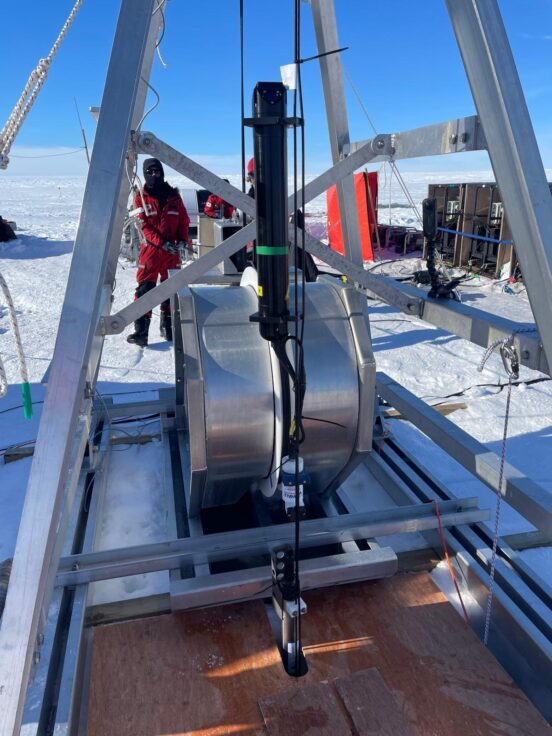
Looking ahead
This was the team’s second attempt to access the underside of Thwaites Glacier, following an earlier expedition in 2022 that was unable to reach the site due to severe sea-ice conditions. The progress made this season — including successful drilling and short-term measurements — represents a significant advance and provides vital technical and scientific lessons for future missions.
Chief scientist Professor Won Sang Lee of South Korea emphasised the importance of perseverance: “This is not the end. The data show that this is exactly the right place to study, despite the challenges. What we have learned here strengthens the case for returning.”
BAS and KOPRI will now analyse the data collected during the operation and incorporate the findings into ongoing research on ice–ocean interactions at Thwaites Glacier. Planning is already under way to apply these lessons to future field campaigns aimed at improving understanding of one of the most critical regions of the Antarctic ice sheet.
The hot water drilling team comprised Peter Davis, Keith Makinson, Yixi Zheng, Scott Polfrey, Paul Anker and Taff Raymond from BAS and Jisung Na, Jinksuk Kim, Seunghwan Oh and Won Sang Lee from KOPRI.