Polar Scientific Innovation Lead


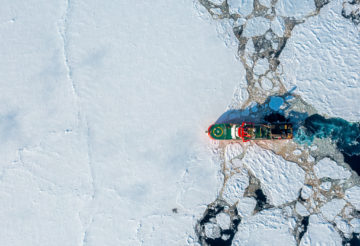
PolarRoute is a decision support tool for planning ship routes through ice-covered waters. Its strength is combining large volumes of environmental data with a model of how a specific vessel responds to those conditions. PolarRoute is one of the Logist AI decision support tools developed by British Antarctic Survey (BAS).
PolarRoute builds a detailed digital model of the environment from satellite, forecasts and models of sea ice, wind, waves and currents. It combines this with the vessel’s response characteristics: how its speed and fuel use change in open water, in different ice conditions, and in wind and waves. It then generates candidate routes that meet the user’s constraints, such as:
PolarRoute does not choose the route. Planners use their experience of polar operations to pick the option that works best in the real world.
We are developing PolarRoute long-term for the crew on board the RRS Sir David Attenborough. It also supplies the routes that our itinerary planning tool, VOLT, uses to plan fleet movements.
Lower emissions. The shortest route in polar waters often crosses more ice, and breaking through ice costs time and fuel. Our models predict that typical PolarRoute routes could cut carbon emissions by 4% compared with the fastest route, and we are developing ways to test this at sea. The RRS Sir David Attenborough emits more than 10,000 tonnes of CO2 equivalent a year, so one journey’s saving could equal a household’s annual energy use.
Faster replanning. Polar conditions change quickly. PolarRoute produces new routes far fast, so planners can respond when ice or weather shifts.
Planning future ships. Because PolarRoute models how a vessel performs, planners can test how a different hull design or ice class would change routes and emissions.
Polar Scientific Innovation Lead

AI Team Lead

AI Researcher in Optimisation and Planning

Research Software Engineering Lead

Innovation Community Officer

Machine Learning Research Scientist

Research Software Engineer

Fontend Developer/Geospatail

Head of MAGIC
Senior Research Software Engineer
Reaching net zero, as a country or a business, requires new measures, technology and innovations. Digital twins are an example of this; they can be a powerful tool to drive innovation and efficiency.
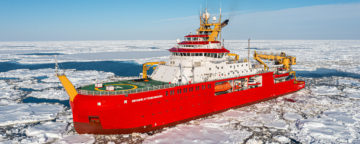
Logist develops decision support tools that use environmental data to help experts make the best routing and planning decisions.