
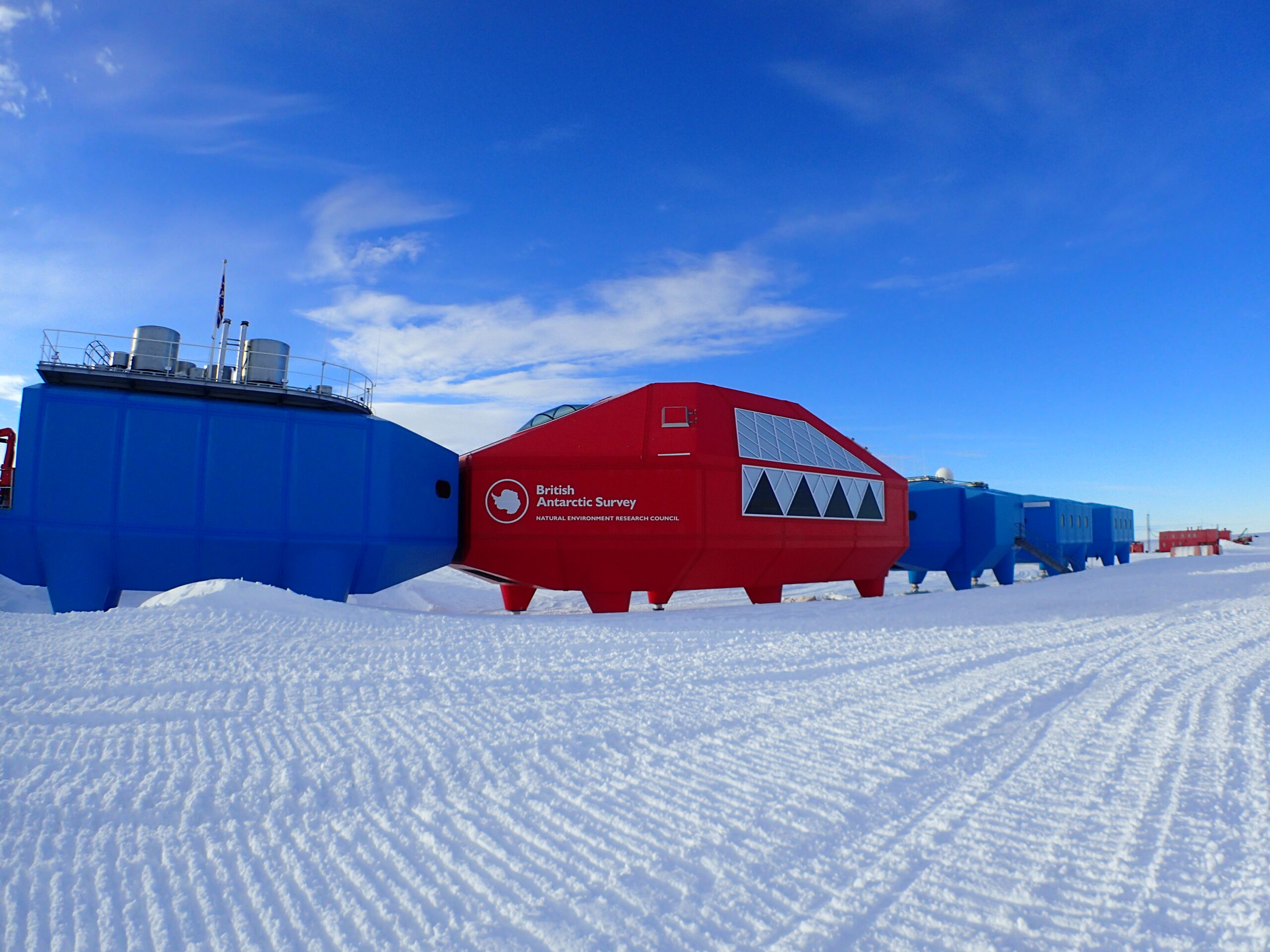
Six thousand miles from home, on a shelf of ice that moves, cracks and occasionally breaks away, British scientists have been keeping watch for seventy years. What they’ve found has mattered to everyone.
There are easier places to do science: places with roads. A reliable internet connection, a shop, a hospital. A way home if something goes wrong.
Halley Research Station has none of these things. It sits on the Brunt Ice Shelf in Antarctica: a floating platform of ice above the Weddell Sea, where the wind can erase footprints in minutes, the sun disappears for months and the nearest solid land is a distant memory.
The station was supposed to be built on land. In January 1956, the first British team sailed as far south as they could and did not find any, so they stopped on the ice. They unloaded timber, fuel, food, scientific instruments and something that might charitably be called optimism onto a flat white world with nothing on the horizon. Then they built a few wooden huts, set up their equipment and got to work.
Seventy years later, that improvised beginning has become one of the great stories of British polar science.
Halley is where scientists discovered the hole in the ozone layer. It is where researchers monitor space weather that can disrupt satellites, GPS and communications. It is where glaciologists study a moving ice shelf to understand what Antarctica’s future might mean for the rest of the world.
More than anything, Halley is a story about people keeping science alive in a place that seems determined to make that impossible.
A station at the end of the world
To understand Halley, you have to start with the ice. The Brunt Ice Shelf is not still. It moves slowly towards the sea, cracks open, calves icebergs and buries whatever people build on top of it. Few people know better than Jonathan Shanklin, Emeritus Fellow at British Antarctic Survey who first visited Halley in the 1980s and has stayed in four generations of the station, from Halley III to Halley VI. He remembers the emptiness most of all.
“People think the Fens are flat,” he says. “But there are trees, there are features on the horizon. At Halley, there is absolutely nothing.”
In summer, there is constant daylight. In winter, darkness. There are no mountains frame the view and no landmarks help you orient yourself. But from the beginning, Halley was scientifically precious.
Established for the International Geophysical Year of 1957-58 – a global effort to understand the Earth system before satellites could watch the planet from orbit – and named after the astronomer who calculated the orbit of the comet that bears his name, it began collecting measurements of the atmosphere, ozone and space weather from day one. Those measurements became Halley’s quiet superpower.
The most important thing about a scientific record is not always how dramatic it looks at the time. Sometimes its value lies in the fact that someone started it, someone else continued it and generation after generation refused to let it stop. That was true of the ozone hole; it is still true of Halley today.
The station the ice kept swallowing
Halley has never had the luxury of staying the same. The first station was built from wooden huts on the surface of the ice, but at Halley a building changes the wind, the wind drops snow, the snow piles up and the building sinks. Around 1.2 metres of snow falls on the Brunt Ice Shelf each year and over time Halley I disappeared beneath it. By the time it was abandoned in 1968, the living quarters were 14 metres below the surface. Years later, the frozen remains emerged from the ice cliff at the sea’s edge.
Halley II was built stronger, with steel-reinforced roofs. It lasted six years.
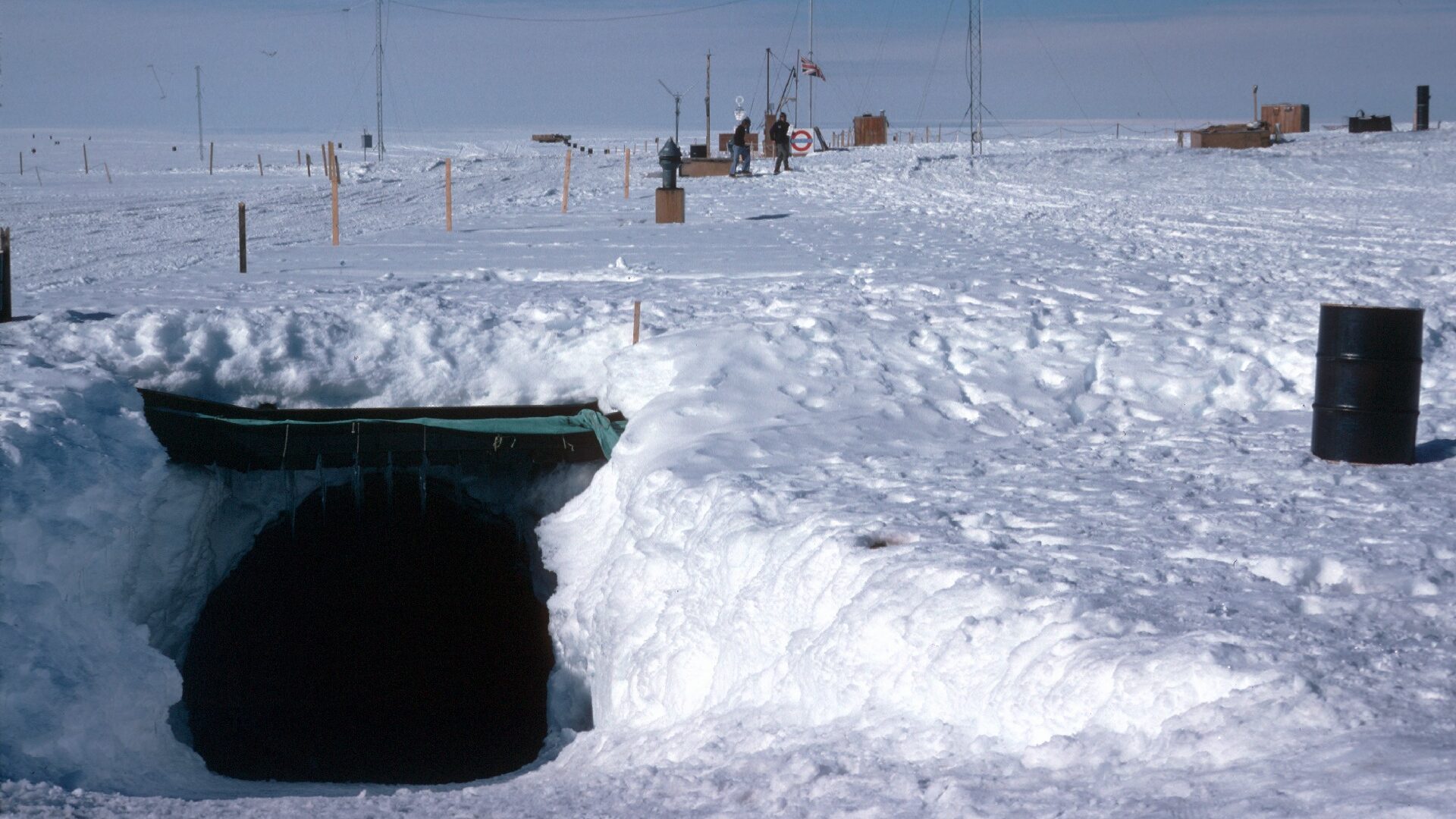
Halley III was designed for life underground, with huts inside corrugated steel tubes buried beneath the ice. Scientists reached their quarters by climbing down a shaft around 30 feet deep. Jonathan Shanklin was there in its final years:
“You had to go down through two or three different stages,” he says. “Inside, some of it was quite comfortable. Other bits were not. There were four of us in each bunk room and the air temperature could fall pretty low. Often, your glass of water would be frozen in the morning.”
The toilet was a little less romantic:
“A 45-gallon fuel drum with a plank over the top and a hole cut in the plank.”
Halley’s history is full of discovery, but it is also full of frozen breath, difficult sleep, improvised plumbing, deep discomfort and people making do. Halley III lasted 11 years before it too became too deep to use safely. Halley IV followed. It was also eventually overwhelmed. The ice kept changing the rules and each new version of Halley had to respond.
The discovery that changed the world
Through all the rebuilding and adapting, the measurements continued. By the early 1980s, scientists at Halley had been recording ozone above Antarctica since 1956. Ozone sits high in the stratosphere, shielding life on Earth from harmful ultraviolet radiation. Then the numbers began to fall off the graph.
At first, the obvious question was whether something had gone wrong with the instrument. Professor Shanklin had gone south partly to compare a new Dobson ozone spectrophotometer with the existing one. The answer was clear. Both instruments were telling the same story: the ozone above Antarctica was thinning dramatically.
The real power, though, lay in the record behind those readings – because Halley had ozone measurements stretching back nearly 30 years. That continuity meant the team could test explanations and rule some out. It showed this was not just noise, not a glitch and not simply part of a solar cycle. Something profound was happening in the atmosphere.
“That long-term record was crucial,” says Jonathan. “It is not something you can pause for a few years and then pick up again. Continuity matters.”
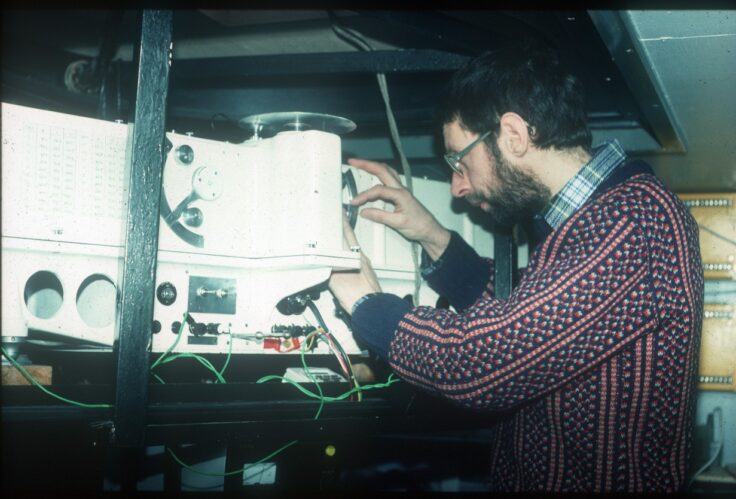
In 1985, Jonathan Shanklin, Joe Farman and Brian Gardiner published their findings in the journal Nature. They had discovered the ozone hole: a catastrophic annual thinning of the ozone layer, driven by chlorine from chlorofluorocarbons, or CFCs, then used in products such as aerosols and refrigerators.
The discovery changed the world. The 1987 Montreal Protocol phased out CFCs and became one of the most successful international environmental agreements ever signed. The discovery did not begin with one paper – it began with people taking measurements in a difficult place, year after year, long before they knew exactly how much those measurements would matter.
That thread connects generations in unexpected ways at Halley. Dr Mervyn Freeman, Head of the Space Weather and Atmosphere Team at BAS, is the son-in-law of John Smith, the meteorologist on the first main wintering party at Halley in 1957 who took some of the station’s earliest ozone measurements – the data that, three decades later, helped reveal a hole in the sky.
The station on skis
If Halley’s science depends on continuity, its survival depends on reinvention. Halley V rose above the snow on steel stilts and could be jacked up as the snow accumulated – a major advance, but it could not solve every problem. The Brunt Ice Shelf moves around 400 metres towards the sea each year. Eventually, even a raised station can drift towards danger.
So BAS asked a remarkable question: what if the station could move?
In 2004, BAS launched an international design competition for a new Halley. The brief was extraordinary: create a station that could survive Antarctic winters, house up to 70 people in summer, leave the lightest possible environmental footprint – and be fully relocatable. The winning design, by Hugh Broughton Architects and engineers AECOM, looked almost unreal.
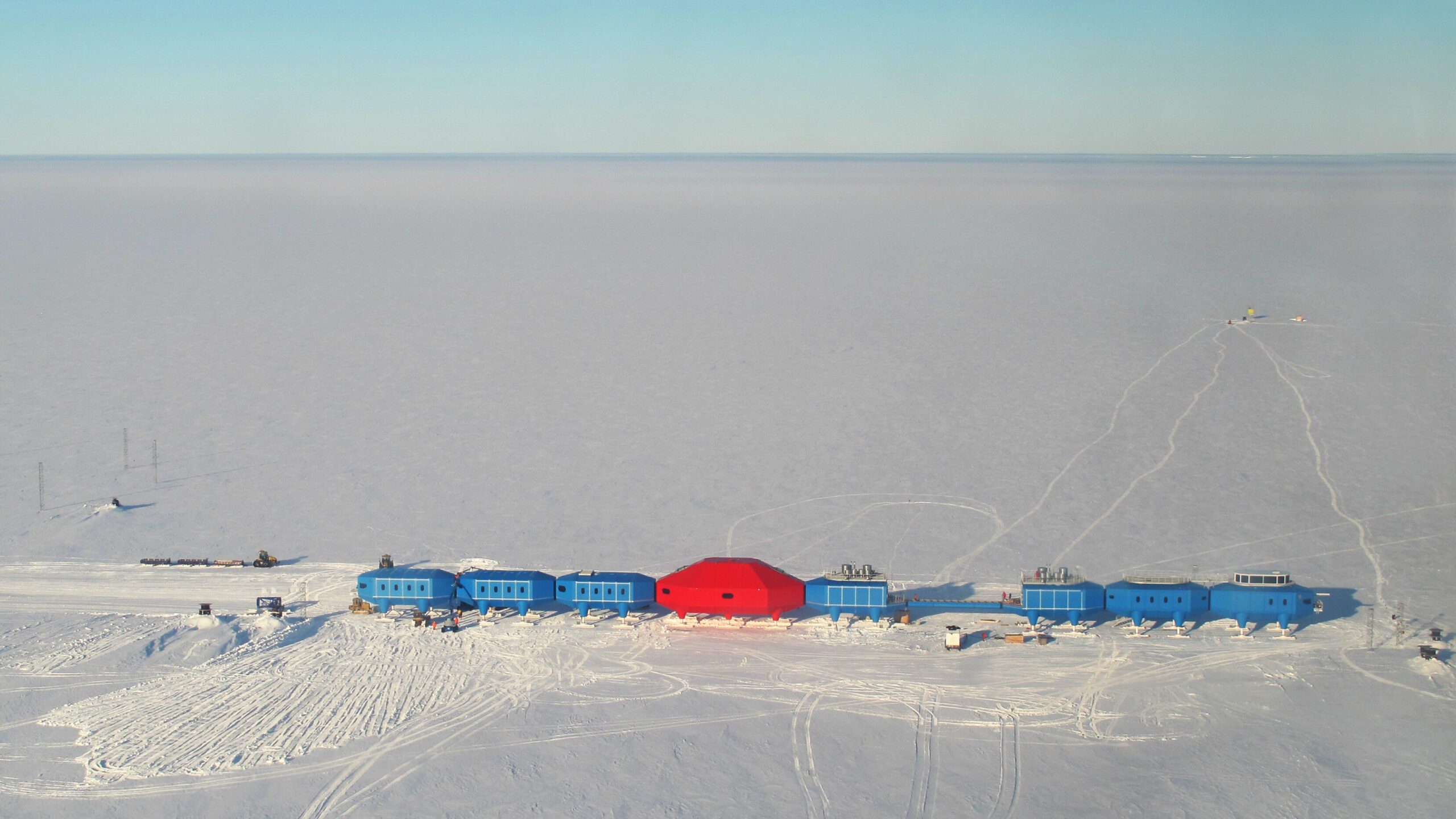
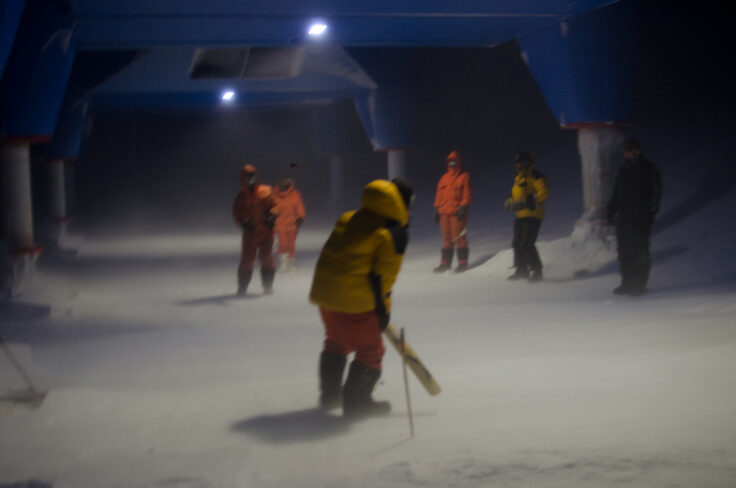
Halley VI is made up of eight brightly coloured modules raised on hydraulic legs and mounted on giant skis. Its legs allow it to climb out of the snow, and its skis allow it to be towed across the ice. It opened in 2013 – but soon after, that ability became essential. Chasm One, a long-dormant crack in the Brunt Ice Shelf, began to grow again. Thomas Barningham, now Halley Station Operations Manager, was at Halley at the time:
“BAS recognised the risk and put the project together,” he says. “The whole station was moved – around 23 kilometres – to a safer location.”
It is worth pausing on the scale of that operation: a research station in Antarctica, towed 23 kilometres across a floating ice shelf. In January 2023, an iceberg roughly the size of Greater London calved from the shelf. Halley, by then safely relocated, watched it go.
Since 2017, BAS has not overwintered staff at Halley because of the risks posed by ice shelf instability. For many research stations, losing the winter would mean losing the science. At Halley, it became the next engineering challenge.
The answer was automation, powered by microturbines: small jet engines about the size of a wardrobe, designed to generate electricity with far less maintenance than conventional generators, using air bearings rather than oil.
“In a nutshell, it’s a small jet engine that generates electricity,” says Thomas. “The engineering challenge was how to fuel it safely when nobody is there. We care deeply about the environment down there, so a lot of work went into making sure it could refuel without any risk of a spill.”
When the last aircraft leaves in February, the darkness comes in – but Halley does not fall silent. The microturbines keep turning, the instruments stay warm and the data keeps coming. In the middle of the Antarctic winter, with no human being on site, a station on skis continues to watch the planet.
A window into space
Some of Halley’s most important science looks far beyond Antarctica. The station sits on the edge of the auroral zone, where Earth’s magnetic field channels activity from space towards the poles. The aurora may look like shimmering curtains of green and purple light, but to scientists it is evidence of a much larger story playing out around the planet.
“Halley provides a natural window on what is happening in space around the Earth,” says Mervyn. “By looking at the upper atmosphere above the polar regions, you can infer what is happening much further out in space.”
That’s important because modern life depends on satellites – weather forecasting, GPS, communications, internet services and financial systems all rely on technology in orbit.
Solar storms can damage electronics and alter the orbits of satellites in low Earth orbit. In an increasingly crowded space environment, knowing where everything is matters enormously. Measurements from Halley feed into models used by the European Space Agency and the UK Met Office, helping protect technology that millions of people rely on every day.
Reading the ice
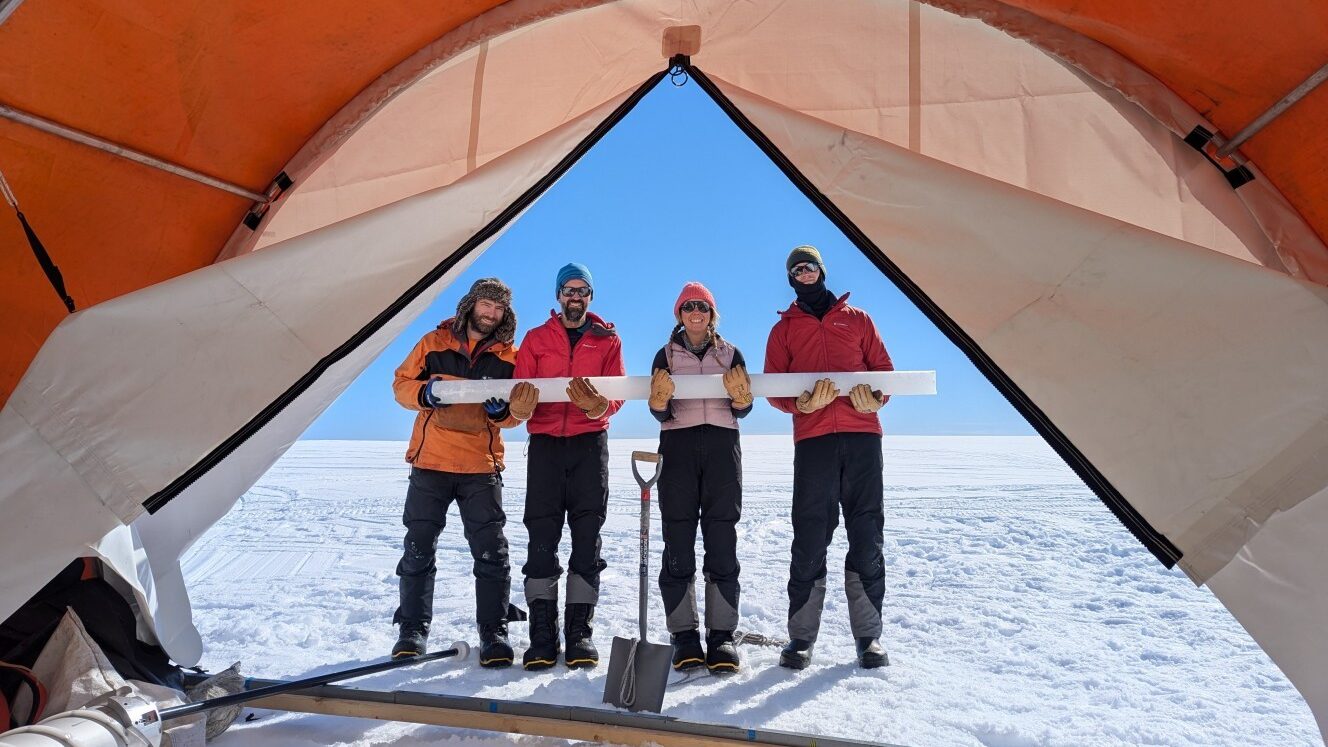
Halley also looks down, into the ice beneath it. Dr Emma Pearce, glaciologist at British Antarctic Survey, studies how ice shelves fracture: why cracks form, how quickly they grow and what happens when they don’t stop.
Ice shelves act like corks, holding back inland glaciers and regulating how quickly ice flows into the sea. When they weaken or break, glaciers can speed up, adding to sea level rise.
“One of the largest uncertainties in sea level rise projections is how icebergs form and how stable ice shelves and glaciers are,” says Emma. “Sea level rise is happening. The question is how fast – and that matters enormously for how societies plan and respond.”
Satellites can see cracks from above, but they cannot tell the whole story. To understand the physical properties of the ice – its structure, its strength and how it behaves under stress – scientists still need to go there. Emma has spent weeks in the deep field around 60 kilometres from Halley, living in a small shelter with a handful of colleagues, drilling ice cores and taking measurements.
“We need to be there,” she says. “Those are things you can’t do from orbit.”
That remains one of the great truths of Halley. Even in the age of satellites, robots and remote sensing, some knowledge still depends on people in the field, doing careful work in a place that demands patience, skill and trust.
The people who make it possible
Ask anyone who has been to Halley what the place is really like and something shifts in their expression. The science is vital and the engineering remarkable. But what people reach for first is the community.
Dan McKenzie, Halley Station Leader at British Antarctic Survey, describes the station as “a little village on ice” that draws an unusually high number of returning faces. Scientists, chefs, mechanics, carpenters, field guides – all dependent on each other in a place where there is no quick outside help.
“People leave loved ones at home,” he says, “and then they gain them again down there – surrogate sisters, brothers, uncles, parents.”
That sense of community is not a soft extra. It is essential infrastructure.
“The thing that really strikes you is the utmost trust that those people can deal with anything,” says Emma. “I broke my pocket knife and a mechanic made me a new blade. One season I ripped the arm off my ET toy on the plane. Someone sewed it back on. If there were an apocalypse and Halley were a spaceship, we’d probably be fine.”
Halley is built from modules, steel, hydraulics and scientific instruments, but it is also built from people who know how to mend, improvise, cook, calculate, drive, drill, listen, lead, laugh and keep going.
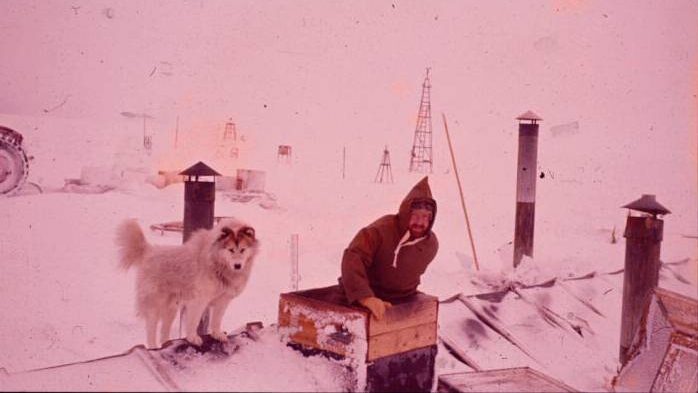
Even in its earliest years, there were touches of home on the ice. In 1957, the station had one more companion than you might expect: Stumpy, a dog given to the British team by the neighbouring Norwegian base because her legs were too short for sled work. She became the station pet – an unlikely companion in a place where company matters.
The rituals matter too. Saturday nights become an occasion, with tablecloths, people dressing up and a proper dinner. At the end of the season comes folk night, with music, comedy, cabaret and hidden talents emerging from people who may have spent weeks quietly fixing generators or drilling ice.
One season, Emma secretly taught herself the tin whistle in a remote field shelter, practising only when the drilling generator was loud enough to drown her out. Long-term science does not happen by magic; it happens because people build a life around it.
At the end of the season, the work is packed up, the station prepared for winter and the aircraft waits on the skiway. Dan describes standing on a sledge to catch a little more height as the plane prepares to go.
“You can see their little faces in the windows waving back. Everyone is safe. The season went well.”
Then the station is empty, the sun goes, the winter closes in. But the work continues.
Still there, still watching
Halley Research Station has changed almost beyond recognition since 1956. The wooden huts have gone. The buried tunnels have gone. The fuel-drum toilet is history. The station has been swallowed by snow, rebuilt, lifted on legs, placed on skis, towed across the ice and automated for winter. Its purpose has remained remarkably constant.
Halley exists because there are questions that can only be answered by watching carefully from the same place, year after year. Questions about the atmosphere above us, the space around our planet, the ice beneath our feet and the future we are all moving towards.
At 70, Halley is also something more human than that. It is a reminder that science is not only about breakthroughs, but about continuity, care, maintenance, teamwork and people doing difficult things in extraordinary places because the knowledge matters.
“Small teams are delivering great global science in a really challenging place,” says Thomas. “Because if we can do that in Antarctica, we can do it anywhere.”
Seventy years after that first team stopped on the ice because they could go no further, Halley is still there: moving, adapting and watching. Behind every measurement, every discovery and every winter survived, there is the same quiet truth: Halley endures because people keep coming back to make it work.
Halley Research Station was established on the Brunt Ice Shelf, Antarctica, on 6 January 1956. It is operated by the British Antarctic Survey, NERC part of UKRI.