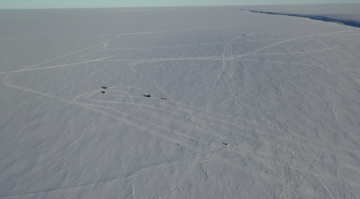
Cracking Antarctica’s iceberg code
RIFT-TIP is investigating iceberg calving on the Brunt Ice Shelf. It uses field monitoring, lab testing, and modelling to predict when icebergs will form.
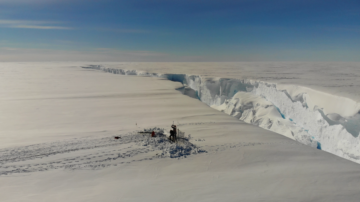

I am an Ice Fracture Geophysicist in the Ice Dynamics and Palaeoclimate team at British Antarctic Survey. My research uses geophysical observations to understand how the structure and mechanical properties of snow and ice control fracture, deformation and ice-shelf stability in Antarctica. As part of the RIFT-TIP project, I lead the geophysical component of research on the Brunt Ice Shelf, integrating seismic observations with ground-penetrating radar, GPS, Distributed Acoustic Sensing, ApRES and ice-core analysis to investigate fracture processes and rift propagation.
My background is in environmental geophysics, with a particular focus on applying seismology to glaciological questions. During my PhD at the University of Leeds, I developed seismic Full Waveform Inversion methods for glaciology and used them to investigate firn densification and melt layers. I later worked at the University of Strasbourg, where I developed and applied ambient-noise correlation and Distributed Acoustic Sensing approaches to improve imaging of snow and ice structure. Across my research, I combine field surveys, laboratory analysis and computational modelling to understand how ice properties evolve and how these influence glacier and ice-shelf behaviour.
I work closely with collaborators at University College London and the University of Otago. Through these collaborations, I link geophysical measurements with ice-core analysis, microstructure, fracture mechanics and modelling, with the aim of improving understanding of ice dynamics under a changing climate.
Pearce, Emma ORCID record for Pearce, Emma. Marsh, Oliver J. ORCID record for Marsh, Oliver J.. Mitchell, Thomas M. Tuhkuri, Jukka. Thomas, Elizabeth R. ORCID record for Thomas, Elizabeth R.. Johnson, Siobhan. (2026) Impact of surface melt and brine infiltration on fracture toughness of ice shelves.
Agnew, Ronan S. ORCID record for Agnew, Ronan S.. Pearce, Emma ORCID record for Pearce, Emma. Karplus, Marianne. Ranganathan, Meghana. Hoffman, Andrew O. Hunt, Madeline. Pretorius, Andrew. Shanly, Sooraj E. Beres, Mitchel. Pradhan, Kaushik Kumar. Seldon, Yeshey. Booth, Adam D. Clark, Roger A. Young, Tun Jan. (2025) Active and Passive Seismic Surveys over the Grounding Zone of Eastwind Glacier, Antarctica.
Pearce, E., Marsh, O., & Thomas, E. (2026). Ice core physical property data from Brunt Ice Shelf close to the site of Halley VI Research Station from 2023/2024 and 2024/2025 (Version 1.0) [Data set]. NERC EDS UK Polar Data Centre. https://doi.org/10.5285/c059bb26-276d-4be6-ae8c-778aee12a3b4
Pearce, E., Marsh, O., Thomas, E., & Baur, D. (2026). Continuous flow analysis chemistry, melt stratigraphy, age scale and line-scan images from firn Core S2, Brunt Ice Shelf, Antarctica, 2024 (Version 1.0) [Data set]. NERC EDS UK Polar Data Centre. https://doi.org/10.5285/db075c2a-0b32-4ea9-a6f6-41e3bc922c24
Booth, A., Agnew, R., Pretorius, A., Pearce, E., Cameron, E., Hehlen, M., Karplus, M., May, D., Nakata, N., Seldon, Y., Summers, P., Tulaczyk, S., & Young, T. (2025). Passive- and active-source seismic data recorded with Distributed Acoustic Sensing on Eastwind Glacier, Antarctica, February 2024 (Version 1.0) [Data set]. NERC EDS UK Polar Data Centre. https://doi.org/10.5285/23dbd529-3a57-4933-bb9d-16ee1c85fda0
RIFT-TIP is investigating iceberg calving on the Brunt Ice Shelf. It uses field monitoring, lab testing, and modelling to predict when icebergs will form.
The International Thwaites Glacier Collaboration unites global scientists to study Antarctica’s most vulnerable glacier, predict sea-level rise, and inform climate action worldwide.
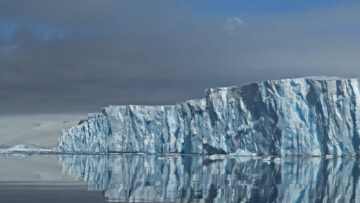
RIFT-TIP (Rates of Ice Fracture and Timing of Tabular Iceberge Production)
Role: Ice Fracture Geophysicist
Led the geophysical component of a multi-disciplinary project investigating fracture processes, rift propagation and ice-shelf stability on the Brunt Ice Shelf. Integrated seismic observations with ice-core analysis, ground-penetrating radar and satellite data to understand how ice structure and mechanical properties control fracture and calving.
EastGRIP (North East Greenland Ice Core Project)
Role: Seismologist
Led seismic deployments and analysis within the EastGRIP consortium, working with collaborators from the University of Strasbourg, AWI and the University of Copenhagen. Research focused on firn structure, densification and anisotropy using active and passive seismic methods, helping to improve understanding of the internal structure and mechanical behaviour of the ice stream.
International Thwaites Glacier Collaboration (ITGC) – TIME project
Role: Seismologist
Seismic deployment and work for the TIME project as part of the International Thwaites Glacier Collaboration, contributing geophysical observations to studies of the Thwaites glacier shear margin. This work formed part of a broader international effort to understand the future stability of Thwaites Glacier.
EGGS on TOAST (Eastwind Glacier Geophysical Surveys on Top Of Antarctic ice Shelf Transition)
Role: Co-PI
Co-led an NSF-supported project focused on high-resolution geophysical surveys across the grounding zone of Eastwind Glacier. Delivered active and passive seismic and GPS datasets to constrain deformation, structure and fracture processes.
Understanding what is going on inside an ice shelf is important for many reasons. But mostly, it allows us to better understand their contribution to sea level rise, and to […]
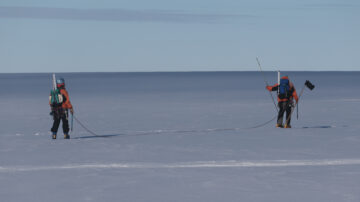
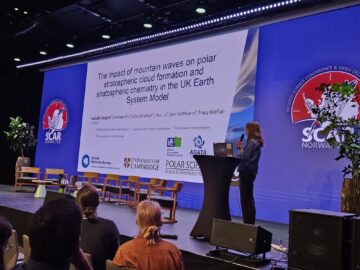
Our Antarctic experts attend the SCAR Open Science Conference in Oslo, sharing their latest findings and shaping plans for future collaboration.
A new study on Antarctica’s Brunt Ice Shelf has revealed that surface melting and seawater infiltration can have dramatically different effects on the structural strength of floating ice shelves.
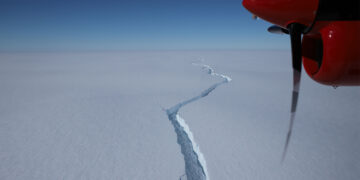
Scientists are a step closer to being able to predict when large icebergs will calve in Antarctica.