
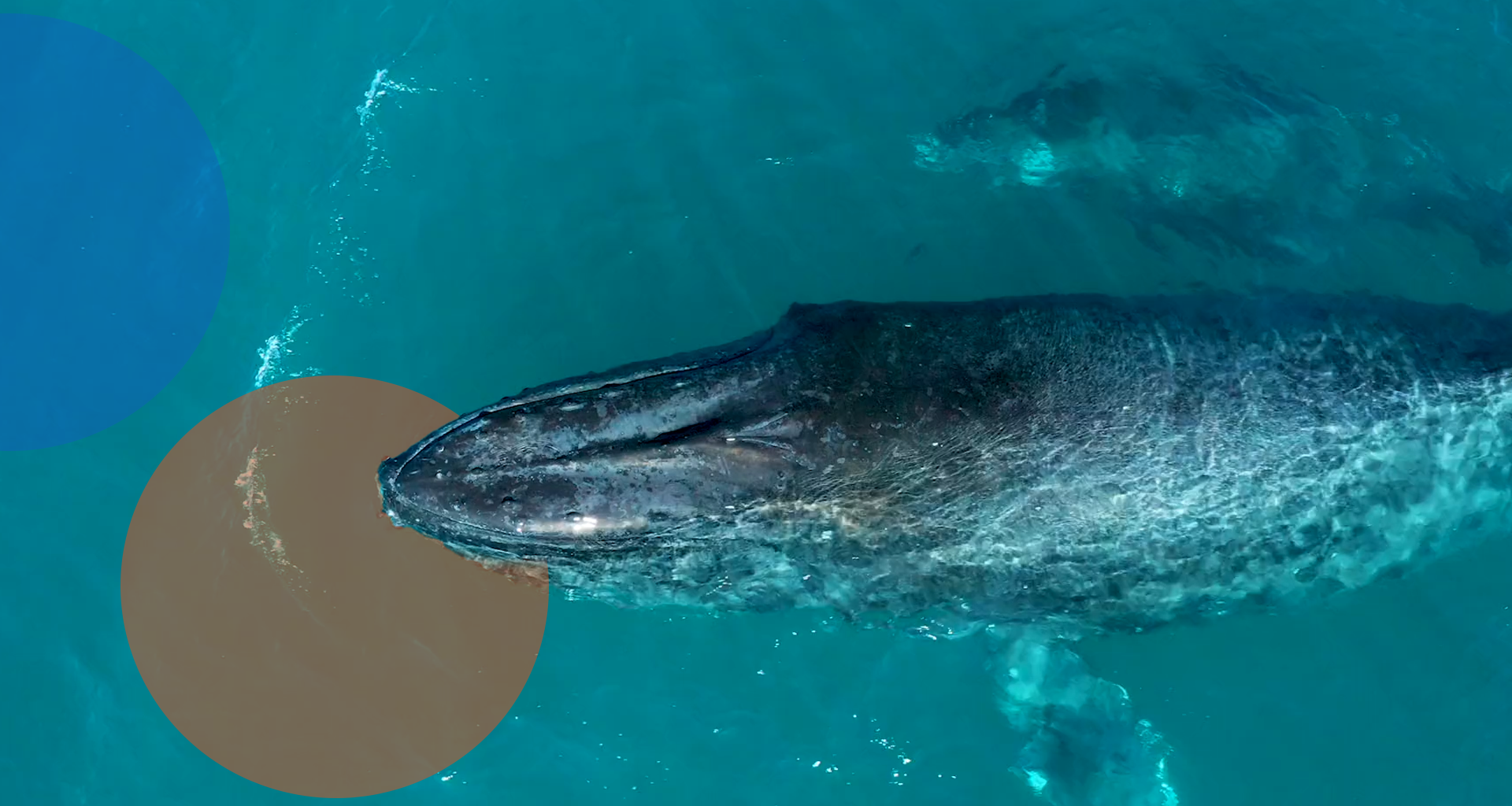
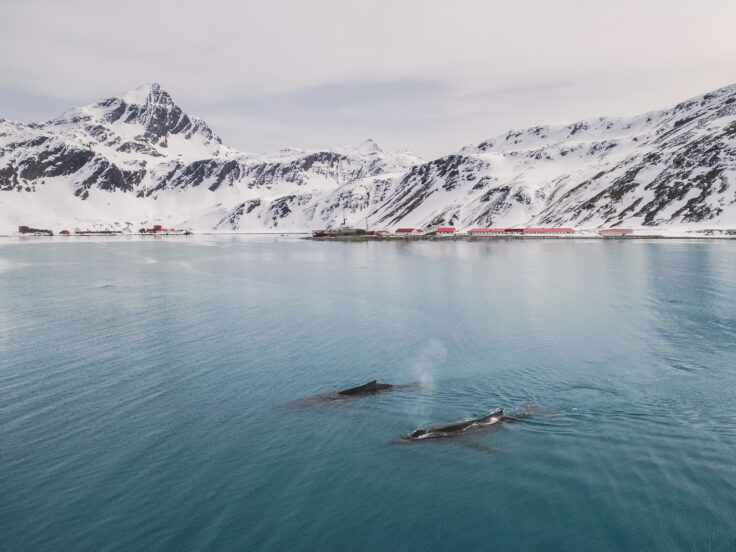
The beautiful sub-Antarctic island of South Georgia has long been a wildlife haven, home to colonies of elephant seals, wandering albatross, gentoo, macaroni and king penguins. The Marine Protected Area surrounding South Georgia and the South Sandwich Islands ranks among the world’s largest, established to safeguard this unique ecosystem.
For whales, South Georgia’s status as a oceanic hotspot is a huge draw. Many whale species undertake epic migrations spanning thousands of miles between their feeding and breeding grounds, seeking out areas teeming with life and potential food. During the austral summer more than 30,000 humpback, Antarctic blue, and southern right whales converge to feast on abundant krill and fish populations.
It’s this very abundance of wildlife in South Georgia that made it a major hub for whaling – the consequences of which are still being felt by the recovering whale populations today.
Greed for the biggest catch
Whales have been hunted for thousands of years by indigenous communities for food, building materials and tools – practices deeply woven into cultural heritage. However, commercial whale hunting for oil and food began as early as the 11th century, growing in scale and efficiency as technologies advanced through the centuries.
The modern era of whaling dawned in the 19th century, bringing exploding harpoon guns, faster and larger ships, and processing factories both at whaling stations and aboard vessels themselves. This transformation turned whaling into a lucrative but devastatingly lethal industry. In the Southern Ocean, the practice initially targeted humpback whales, but as new technologies emerged in the 20th century and humpback populations dwindled, whalers expanded their reach to other species.
“South Georgia was the epicentre of whaling,” says Dr Jennifer Jackson, a marine ecologist at British Antarctic Survey. “As they ran out of whales at South Georgia, the whalers started to just spread out everywhere.”
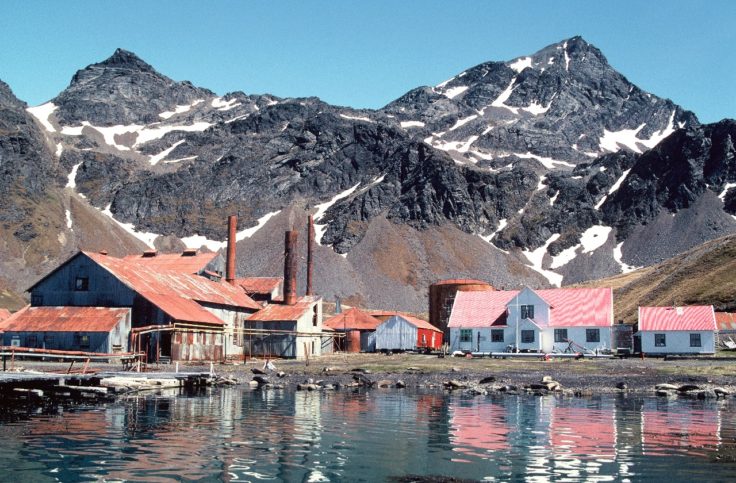
The abandoned site of Grytviken Whaling Station, South Georgia (Photo: Pete Bucktrout)
Jennifer’s research focuses partly on whale population recovery, and she explains how whaling developed in the Southern Ocean:
“There is this common myth that people throughout history have repeated: that whales have just gone somewhere else, because whales are big and the ocean is big, maybe whales just move away and hide from being hunted. But the truth was incontrovertible – that the lack of whales was due to declining populations. But whalers just kept moving to find new outlets.”
Whale populations were decimated. A comprehensive 2015 study estimated that of the 2.9 million large whales killed commercially in the 20th century, 2 million were caught in the Southern Hemisphere.
The International Whaling Commission (IWC) – originally founded to conserve whale stocks for sustaining commercial whaling – established a moratorium on commercial whaling in 1986. Today, the IWC serves as a collaborative platform, bringing together whale researchers from across the globe to work towards whale conservation.
Recovery – in leaps and bounds or slow going?
“Whales have taken a long time to recover because they were brought down to low levels,” confirms Jennifer. Monitoring whale populations is still a central focus for scientists today. “Whales also have long generation times, slow reproductive rates, and there are new stressors in the oceans that they are recovering into.”
Whales are inherently elusive animals, often migrating thousands of miles across oceans and only surfacing to breathe or engage in other behaviours. So, finding whales in order to study them is the first substantial hurdle. To overcome this challenge, scientists focus their efforts on known whale hotspots – breeding regions and feeding grounds where encounters are more likely.
South Georgia represents one such feeding ground: once a whaling epicentre, now a hub of scientific monitoring. Penny Clarke, a PhD student at BAS, worked at King Edward Point Research Station in South Georgia across the 2023-24 scientific season. She reflects on her first impressions:
“South Georgia was a sensory overload. It was like being in a David Attenborough documentary. When we arrived, the experience was simply speechless – incredible. There were these huge beach master elephant seals bounding along the beach, fur seals, king penguins. The mind reels at how crazy it is, but in the most amazing way.”
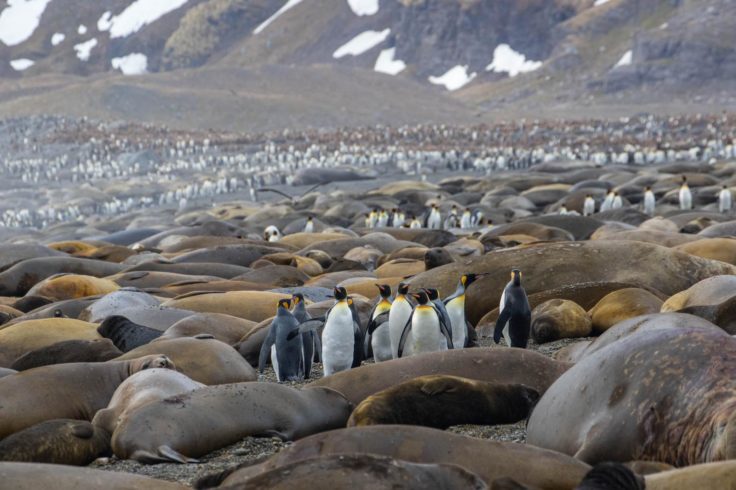
King penguins amongst elephant seals at St Andrews Bay in South Georgia
A recent collaborative project with the Government of South Georgia and South Sandwich Islands is the Hungry Humpbacksproject. Humpbacks bore the brunt of Southern Ocean whaling but are recovering at an encouraging rate, as Jennifer, the project’s principal investigator, explains:
“Humpback whale populations are recovering relatively fast, we estimate between 10-12% per year in the southwest Atlantic. We now think they’re over 90% recovered.”
The recovery of humpbacks brings great news, but an ongoing concern is ensuring krill stocks remain sufficient to sustain these enormous animals into the future. They are among the whale species that feed on small fish and the tiny shrimp-like organisms that swarm through the ocean. These ‘baleen’ whales have evolved an extraordinary feeding system: instead of teeth to catch larger prey, they possess fibrous baleen curtains that allow them to engulf massive mouthfuls of thousands of krill, filtering the water back to the sea.
“One major output is to help inform decisions around krill fishery quotas,” explains Penny, who is one of the team working on the Hungry Humpbacks project. “How much krill are whales consuming? It’s important to make sure we’re not overfishing and then impacting on the ability of whales to survive in the waters of South Georgia.”
How to study whales in the ocean
Scientists can predict where whales might appear, but how do they actually study these ocean giants? Stephanie Martin has visited South Georgia for over 20 years in various roles. With extensive experience monitoring whales, she explains the challenges of observing whales across varying weather and sea conditions:
“There’s no substitute for eyes on the water because they can operate in more variable conditions,” says Stephanie. “But poor weather conditions mean fewer sightings of whales. Is it because there are fewer whales, or is it just because of the conditions?”
“So, you have to apply standards when you’re doing survey work too, because you want to resolve this question: did you miss them or are they not there? That’s one of the biggest challenges of studying cetaceans worldwide.”
To try and resolve this question as accurately as possible, scientists combine many different techniques. Passive acoustic devices deployed from ships can identify which whale species are present – and even indicate the location from which an animal was calling. This proves especially valuable for locating rarer species like blue whales, allowing teams to navigate towards whales for closer monitoring.
During boat surveys, researchers can collect skin biopsy samples to determine the sex and pregnancy status of individuals. Scientists also use boat surveys for satellite tagging whales, which helps track their movements and identify significant locations and migration routes that can guide policymakers on protective measures.

Photography plays a crucial role too: the unique markings visible in high-quality whale photographs mean that individual animals can be identified across study areas and time periods. The inherent difficulty of whale observation has given rise to citizen science initiatives such as Happywhale, which allows anyone to share whale sighting photographs, helping scientists better understand whale distribution across vast oceans.
This proves particularly important for rare species like the Antarctic blue whale, as Jennifer highlights:
“Using photo identification of the flanks of blue whales is a workable way to measure the population, but we need a lot of eyes on the water. This is why cruise ships and expedition ship support is really important, because we’re more aware than we have ever been about the value of opportunistic photographs.”
However, scientists don’t photograph whales solely for identification purposes. These images can also be used to calculate an individual’s weight, and even estimate krill consumption. Penny’s work in South Georgia during the Hungry Humpbacks project used this technique how her team used camera drones to monitor whales in South Georgia during the Hungry Humpbacks project.
“Photogrammetry, in simple terms, is a way to measure with imagery,” she explains. “So, let’s say you’ve got a picture of a whale overhead and on its side. You’ve got height and width – so you can work out body mass. If you can do repeat measurements of the same whale, you can see how their body condition changes throughout the season. And from that, you can evaluate how much krill they’re consuming throughout the season.”
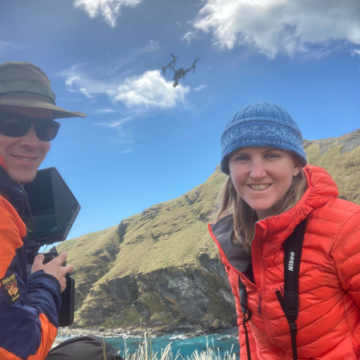
Nico Lewin and Penny Clarke flew a drone out over the ocean around the coast of South Georgia, capturing video and photo data of the whales that supported data on whale and ecosystem health (Credit: Penny Clarke)
Modern day threats for the modern day whale
While humpback whales offer a positive recovery story, other species are becoming the focus of future research. Jennifer is centring her next research project on the Antarctic blue whale through a project called Lost Giants.
The last global abundance estimate for Antarctic blue whales dates to the 1990s – and it suggested that there were fewer than 3,000 individual whales. Although blue whales have been returning to South Georgia in recent years, no specific study of these giants has been conducted in the region.
Lost Giants aims to establish baseline understanding of how many Antarctic blue whales visit the region, helping guide conservation and protective measures. This work will contribute to an international programme called Antarctica InSync, which seeks to understand and protect Antarctica’s vast and varied ecosystem through coordinated circumpolar studies.
While commercial whaling threats have greatly diminished, new challenges have emerged for modern whales. Jennifer identifies the main contemporary risks:
“There’s fishery entanglement, ship strike risk, pollution and noise. The main risks for South Georgia are potentially reductions in food and ship strike risk. With our shipping lanes becoming busier, the risk of whale ship strikes is increasing across the globe. Because of this, ideas about compulsory ship speed limits in regions of high whale activity are being discussed.”
The future of whale food security presents a complex challenge. With fisheries being exploited for human consumption, whales risk struggling to find adequate food sources. Climate change exacerbates this issue – extreme heat events could impact krill populations, causing cascading effects throughout the food chain.
“Antarctic blue whales are argued to be more vulnerable to climate change than some of the other species,” explains Jennifer. “This is because they are very much exclusive Antarctic krill feeders – whereas humpback whales prey switch, and right whales eat copepods too.”
“I called it Hope”
In a world where our changing climate and warming oceans are the source of so much bad news, the recovery of whale populations in the Southern Ocean since the whaling era is a remarkably optimistic story. Despite the challenges that might come in the future for these ocean giants, the overall picture of growing populations makes it a precious moment in history for scientists to witness.
“When I first went to South Georgia in 1999, that first season,” reflects Stephanie, “we were lucky if we saw two humpbacks. Over my career the change has been dramatic.”
During her deployment in South Georgia with Hungry Humpbacks in 2024, she recalls the special experience of seeing a blue whale mother and calf right next to their boat – only for it to happen again shortly after with a right whale mother and calf. Stephanie described what this moment meant to her and the team:
“The feeling was extraordinary because seeing mother-calf pairs of those two species off of South Georgia seemed impossible. The team was laughing – the reaction was like a kid at Christmas. After going to South Georgia for over 20 years, witnessing a blue whale mother-calf pair within five miles of the South Georgia coast was unprecedented for me. We nicknamed the whale mother Hope.”
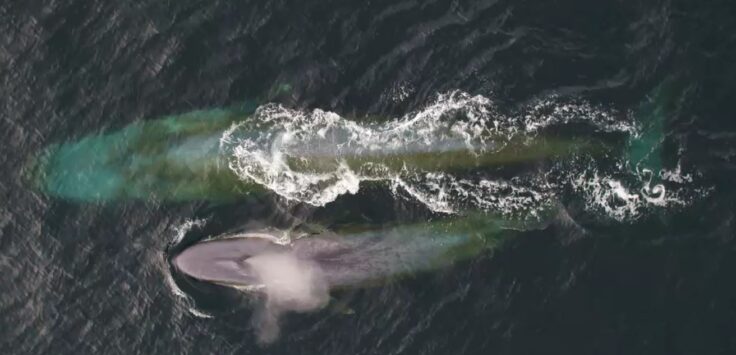
Blue whale mother and calf pair circling near South Georgia (Still: Stephanie Martin)
Hot off the press: at the start of October, Penny published a framework for assessing how very high-resolution optical satellites could be used to monitor whales, to supplement existing monitoring methods in remote and challenging locations. ‘Talking About the Weather: The Feasibility of Using Very High-Resolution Optical Satellite Imagery to Monitor Live and Stranded Cetaceans Around the UK and UK Overseas Territories‘ by Penny J. Clarke et al. is published in Marine Mammal Science.