
A birthday party on the Southern Ocean. A cake, baked in the galley of the RRS Sir David Attenborough, is shared among the 85 passengers and crew. But raising a steady glass is challenging. Captain Matt Neill tells me waves can reach heights of 50 feet in the notoriously treacherous Drake Passage.
He has navigated the icebreaker on a six-week science cruise around South Georgia and the South Orkneys, stopping to drop cargo and collect returning staff from Rothera Research Station on the return leg. They gather to celebrate the man whose name is emblazoned on the ship’s hull. Sir David Attenborough is turning 100 years old.
“I like to think he brings prestige and focus to this vessel,” Matt tells me via a Zoom call, during a break from his duties on the bridge. “What I would hope is that the ship lives up to his name, because he is the most famous scientific communicator in the world. The first priority for British Antarctic Survey is science, but the second is getting the message out – why we are doing it – and he embodies that.”
We chat about how Sir David’s nature documentaries explain that ‘why’ with wit and warmth; how his storytelling makes people care about places and creatures thousands of miles away. Largely, perhaps, because he seems to care so much himself.
“Programmes like ‘The Trials of Life’ really struck a chord with me,” Matt says. “I grew up watching him standing on the beach beside penguins or in the Arctic showing us how glaciers were melting faster than they should be. Then ‘Blue Planet’ went right down to the seabed, finding new species, finding new behaviours. There’s so much we don’t yet understand.”
Matt feels privileged to be supporting the scientists who are finding answers. Having worked for British Antarctic Survey for 15 years, he still finds it unbelievable that his job allows him to witness some of the sights he once saw on his family’s TV screen.
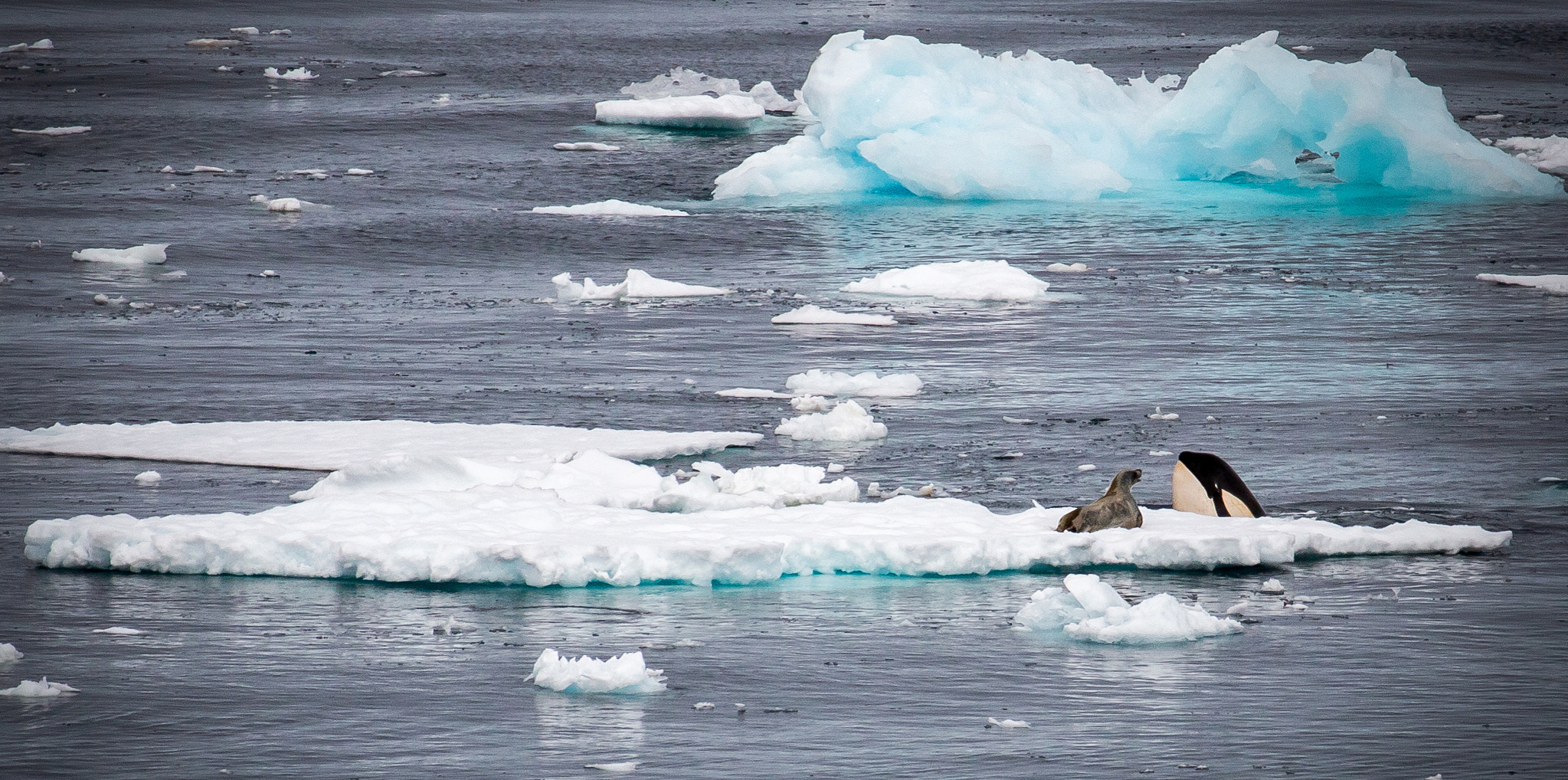
“Watching killer whales figure out their prey, you can almost see their thought patterns,” he says. “A couple of the pod waiting behind the ice and the others chasing the seals towards them. I’m seeing things like that every time I’m down here.”
PhD students Roseanne Smith and Kat Turner shared a similarly surreal full-circle moment. Both were part of the BIOPOLE project on the ship’s first science cruise in 2023. Preparing to set sail, they heard an unmistakable recorded voice making an announcement over the tannoy.
“Sir David Attenborough,” says Roseanne, a Paleoclimate specialist, “saying ‘the ship is about to leave – if you’re not supposed to be on the ship you need to go!’ It’s the ultimate storytelling voice. So arresting and so enthralling.”
She chose an Environmental Sciences degree in the first place, she tells me, because she felt passionately about the fragility of the natural world – particularly about the cold places on our planet – and that was massively informed by David Attenborough’s work.
Kat, who models physical oceanography, reminisces about stepping onto sea ice to take cores. These cylinders of ice are like time capsules; they provide a snapshot of historic climate and environmental conditions.
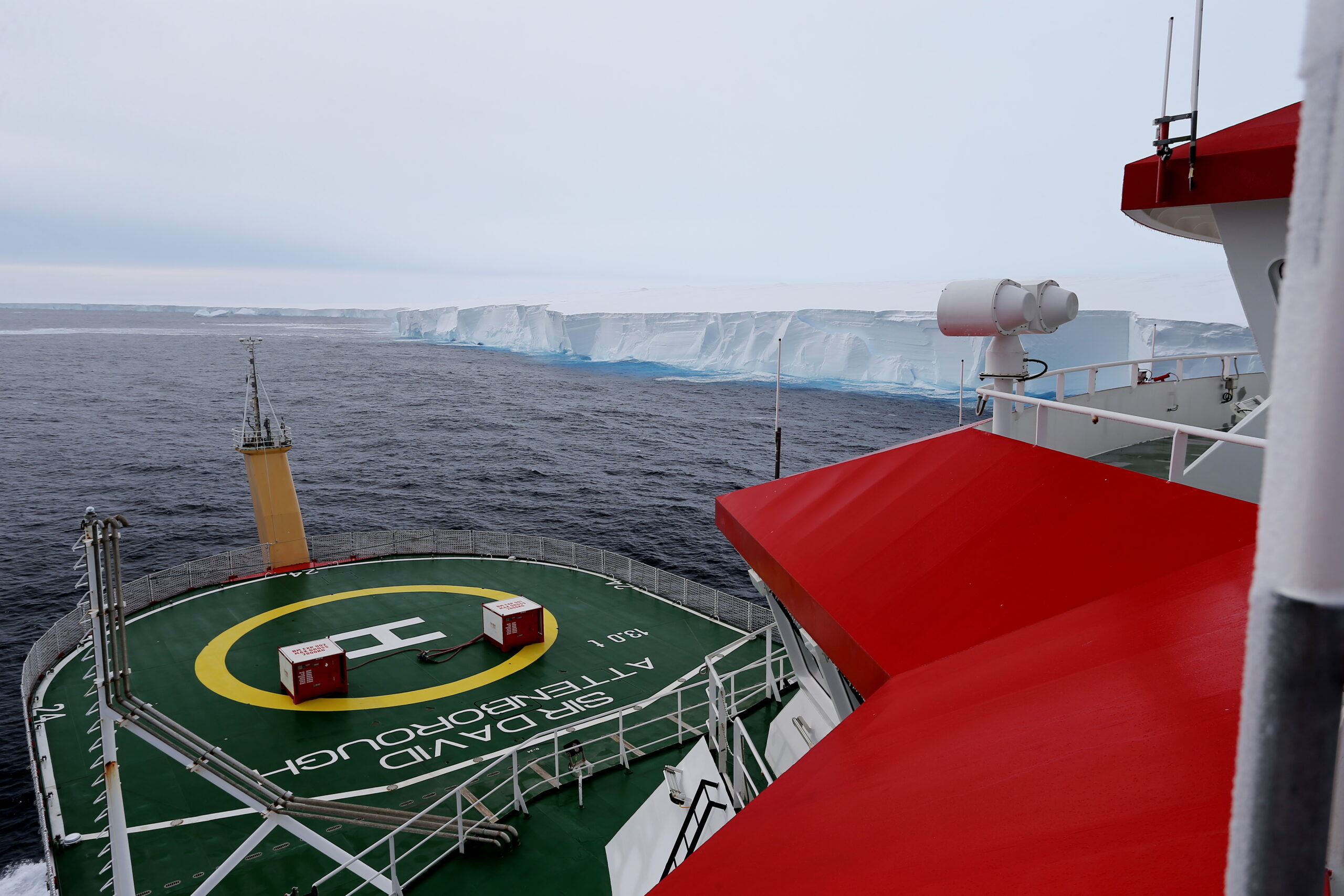
“We were really lucky that the ship happened to be going around the same area as the world’s largest and oldest iceberg A23a. We could see quite interesting things in the water around it so we were able to stop to take samples.”
But her first task was learning to navigate the network of corridors (known as alleyways) of the 129m-long ship. Coming across pictures and statues of Sir David that decorate communal areas, Kat said it felt as though he was omnipresent on board. Roseanne agrees.
“His work has changed generations. Being on the ship, with a sort of presence of the man himself, is a reminder that we carry that duty as well. Not many people have the experience of going to Antarctica. So, we have a story to tell too.”
Dr Sophie Fielding has more stories than most. Since the first science trials in 2022, she has spent two months of every year on board. It’s become such a home-from-home that, these days, she is more frequently landsick than seasick. As SDA Science Capability Coordinator, she can reel off the ship’s capabilities – knowledge she shared with Sir David when she gave him a tour. Highlights included Trace Metal Clean Sampling which monitors iron at depths of up to 6000m. This specially designed system is made from titanium, rather than steel, so water samples aren’t contaminated by iron in the scientific instruments.
These iron levels are critical in the carbon cycle that occurs in the Southern Ocean (where cold, deep waters rise to the surface to release natural carbon dioxide, while simultaneously absorbing human-produced carbon). This is because the iron is used by tiny ocean creatures called phytoplankton to grow. As they grow, they absorb carbon, which helps to regulate the cycle.
But it’s no small task to monitor micronutrients at minute nanomolar levels without contamination.
“That’s like trying to measure a teaspoon of iron in the Thames,” Sophie explains. “And we’re trying to do that from a metal ship, which seems like quite a challenge!”
The ship’s moon pool is a first for a British research vessel. It’s a hole through the middle of the hull allowing instruments to be deployed into the water in rough seas and icy conditions. The RRS Sir David Attenborough’s seakeeping abilities make it much more resilient to these extremes. Pushing the limits of what’s physically possible allows teams to push the limits of scientific research.
“With our old vessels, we used to have to stop,” Sophie explains, “because sometimes the ship wasn’t able to stay in the right position for what we wanted to do. But now it’s able to do that in much rougher weather. And we have a CTD boom (a specialised, extendable crane) that sticks its arm out and lowers the instruments in. So, the whole ship has been designed to make taking samples safer in such a challenging environment.”
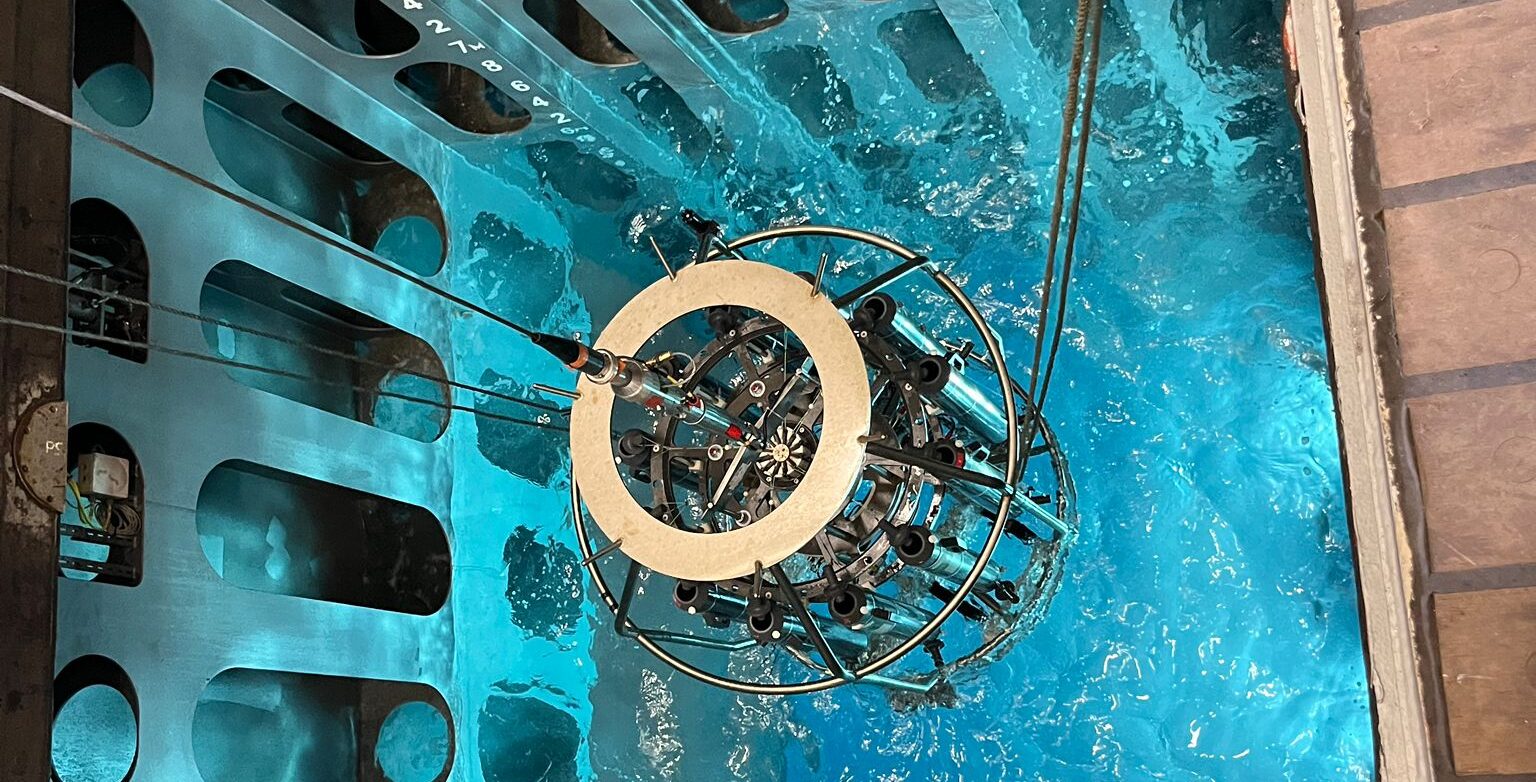
It’s a design that juggles the constantly competing needs of keeping staff warm and samples cold. Two constant temperature labs are kept at a chilly 2°C. Sophie tells me a large part of the science deck, which is the size of a football pitch, is taken up with fridges and freezers that store samples at temperatures as low as minus 80°C.
“A science cruise is all about bringing samples onto the ship. Be it water or animals or sediment – anything like that,” Sophie tells me. “Much of this material is transported back to the UK but preservation techniques can potentially affect results, so it’s important to have instruments like a scanning electron microscope to allow immediate analysis. And there’s plenty of scope to add to what’s possible. The ship was built for the future, not just the present – in a way that means we can bring in the technology that we’ll need to answer important questions.”
Future-proofing was a key aspect of the design. British Antarctic Survey Director, Prof Dame Jane Francis, saw the very first piece of metal being laid and gradually watched the ship grow from there. Sir David Attenborough attended the ceremonial keel laying – a maritime ritual meant to bring good luck to the ship and its crew – and placed the traditional coin beneath the hull at the Birkenhead shipyard where the ship was built.
“One of the things that people always find amazing is that some of the crew and engineers went to work in the shipyard for five years while it was being built,” she says. “They were part of the whole process of making sure the ship came to life. And I think that’s pretty unique. They understand every nut and bolt and piece of cable in the build.”
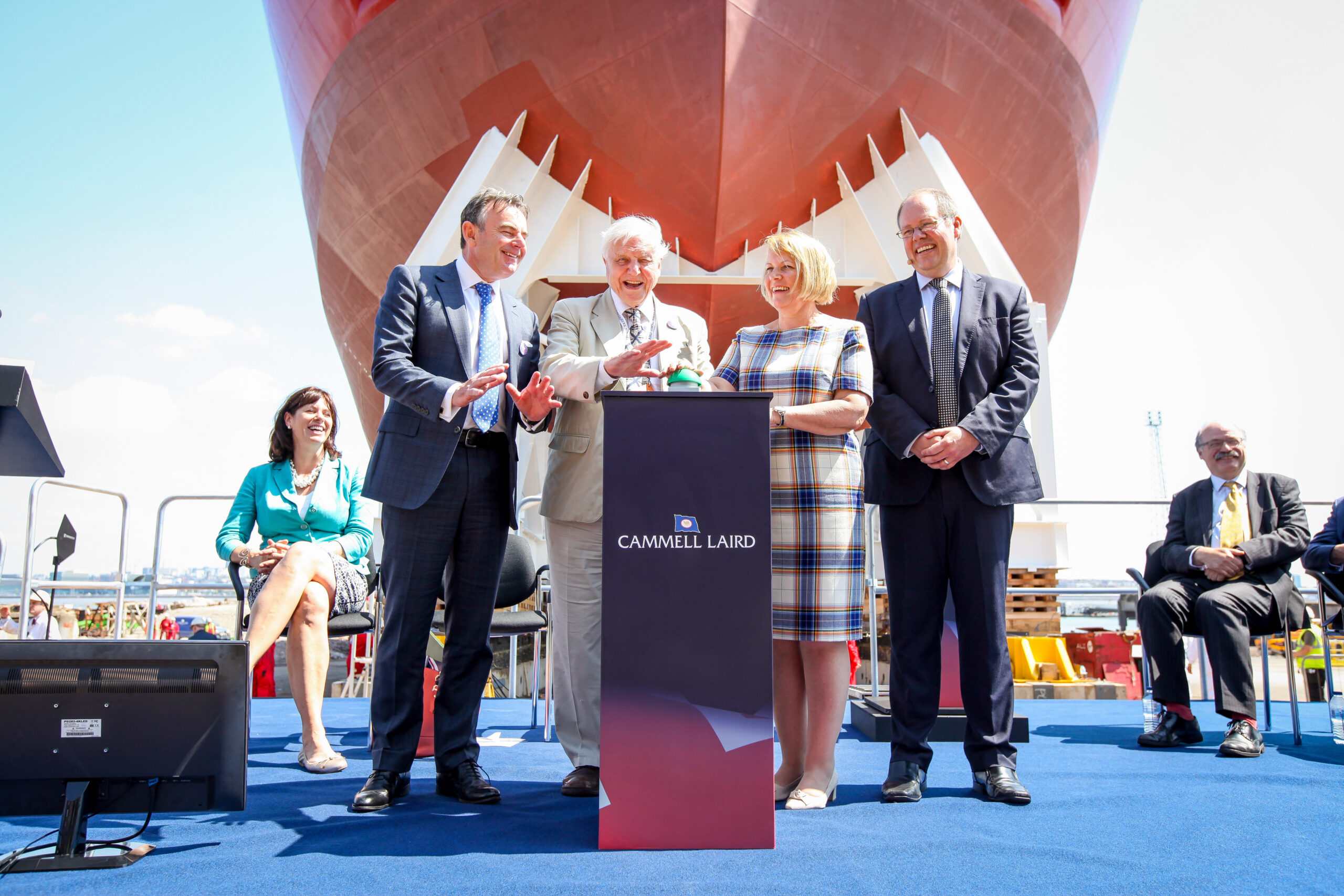
Since its first deployment, the SDA has travelled more than 160,000 nautical miles and taken more than 2,000 tonnes of cargo south. Jane remembers some unanticipated excitement on the occasion of its launch. Hot weather melted the tallow on the rails that guided the ship into the water.
“Sir David and I pressed the button and the ship went down the slipway far, far faster than expected. And the poor tugs that were in the River Mersey started reversing very quickly because this huge hull was coming towards them!”
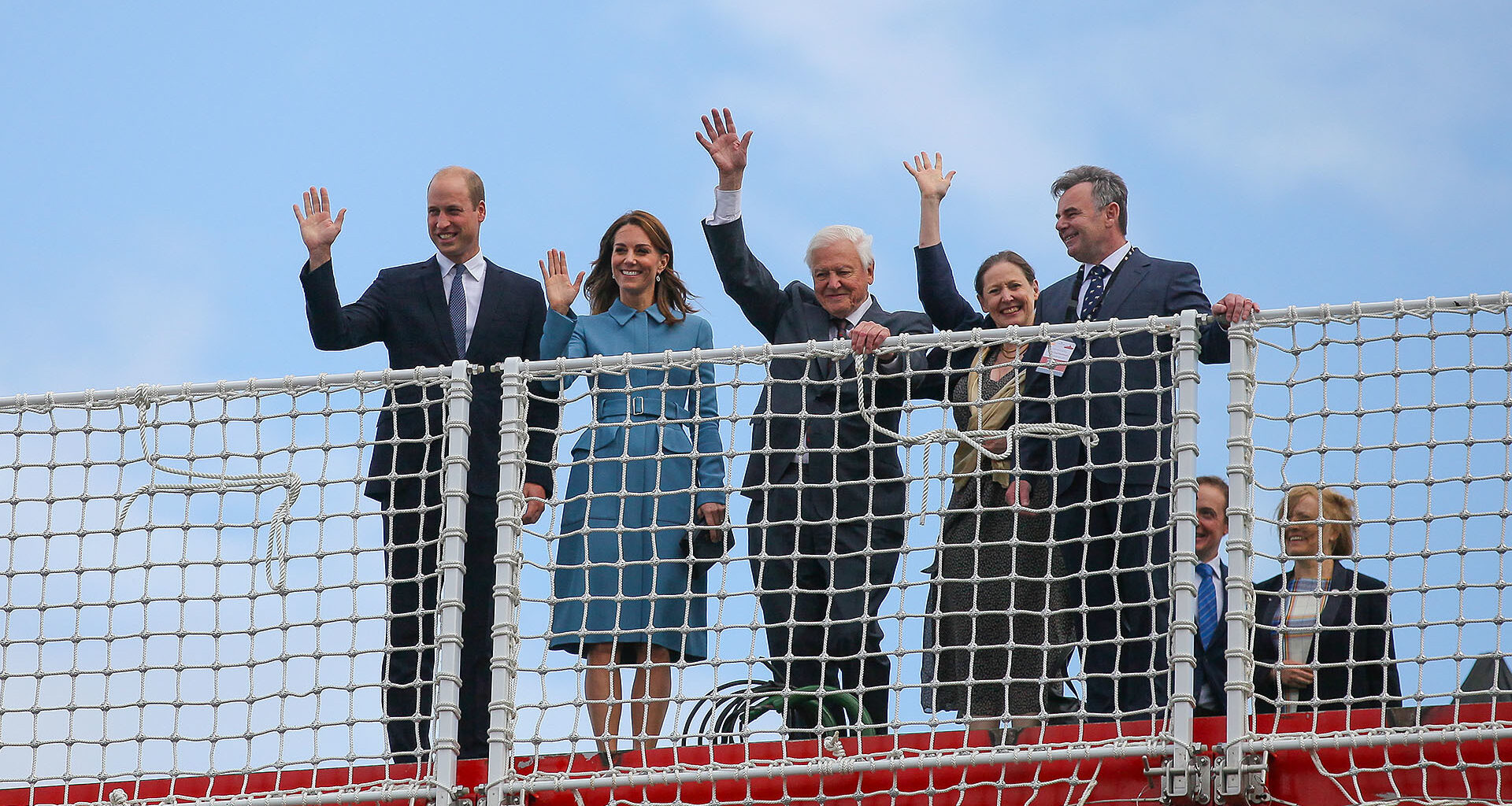
Afterwards, the gathered crowds were treated to a Royal walkabout by the Prince and Princess of Wales but, in the end, it was the twice-knighted Sir David who stole the show.
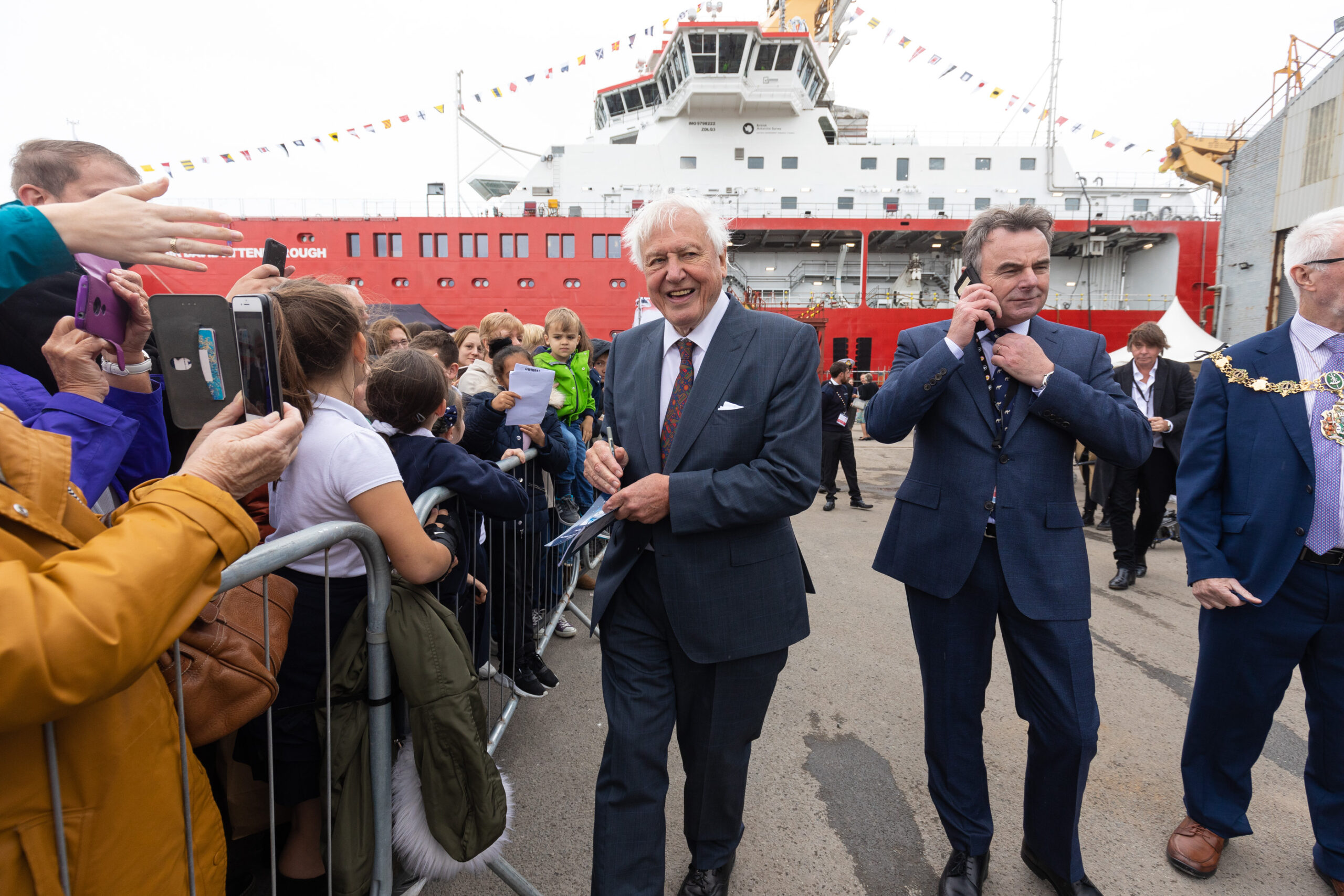
“I asked him if he’d like to go to meet people and the reaction from the crowd was quite astonishing,” Jane tells me. “When they saw Sir David Attenborough coming towards them it was almost like William and Catherine were pushed to the side. He was the most popular person that day, for sure.”
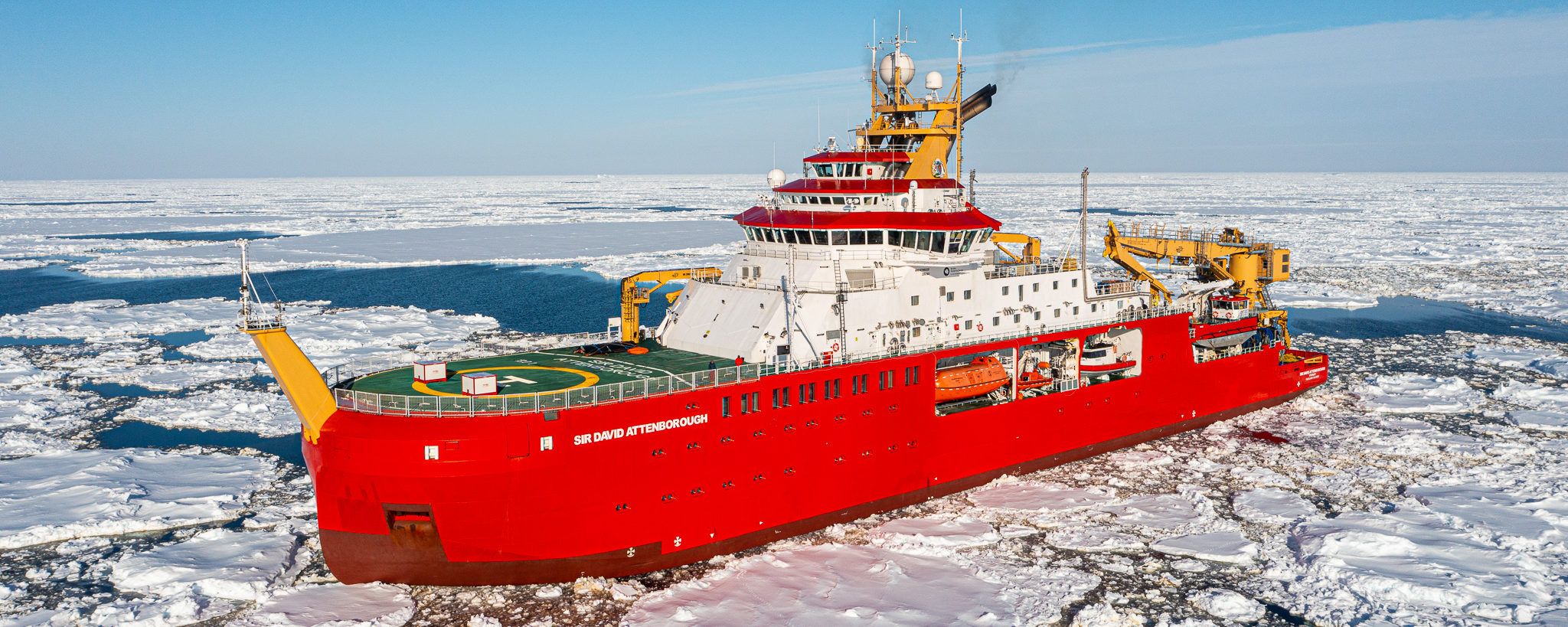
That popularity is a trait shared by his namesake. When the RRS SDA was being tested in British waters, fans would gather at the coast to catch a glimpse of it. And it’s still turning heads in Antarctica as passengers on commercial cruise liners whip out their cameras to take selfies.
“It’s a thing of beauty that stands out so clearly in this environment of white ice and blue skies,” Jane says. “And then you have this blaze of red hull shining out, beautifully crisp and clear. It gives you a feeling of warmth.”
It’s noticeable, I tell her, that BAS staff speak about the ship almost as if it’s a colleague.
“That’s true!” Jane says. “The ‘SDA’ just trips off the tongue now. And it’s more loved, more recognised, more part of BAS than our buildings here in Cambridge. It’s just iconic.”
She is well aware that is, in part, because of the 2016 high-profile public poll to name it; proof of the adage that ‘all publicity is good publicity’.
“It’s funny now,” she says, “because if I talk to someone about the ship and they look a bit puzzled I say ‘Boaty McBoatface’ and they know exactly what I am talking about.”
But I suggest to her that its iconic status, like that of its eponym, also comes from a sense of trust in the work that’s carried out on board. And in its safety, she adds:
“It’s a ship built for science but it’s also a ship that you feel very comfortable on. And once you get to Antarctica, it’s really in its element. Here we are, taking this ship to the ends of the Earth, going somewhere that’s quite hostile, that’s difficult to work in. And the ship is there to protect us. Even though it’s thousands of miles away from where the nearest person lives, Antarctica is being affected by the rest of the world. We can see the ocean is warming up. We can see the ice is melting.”
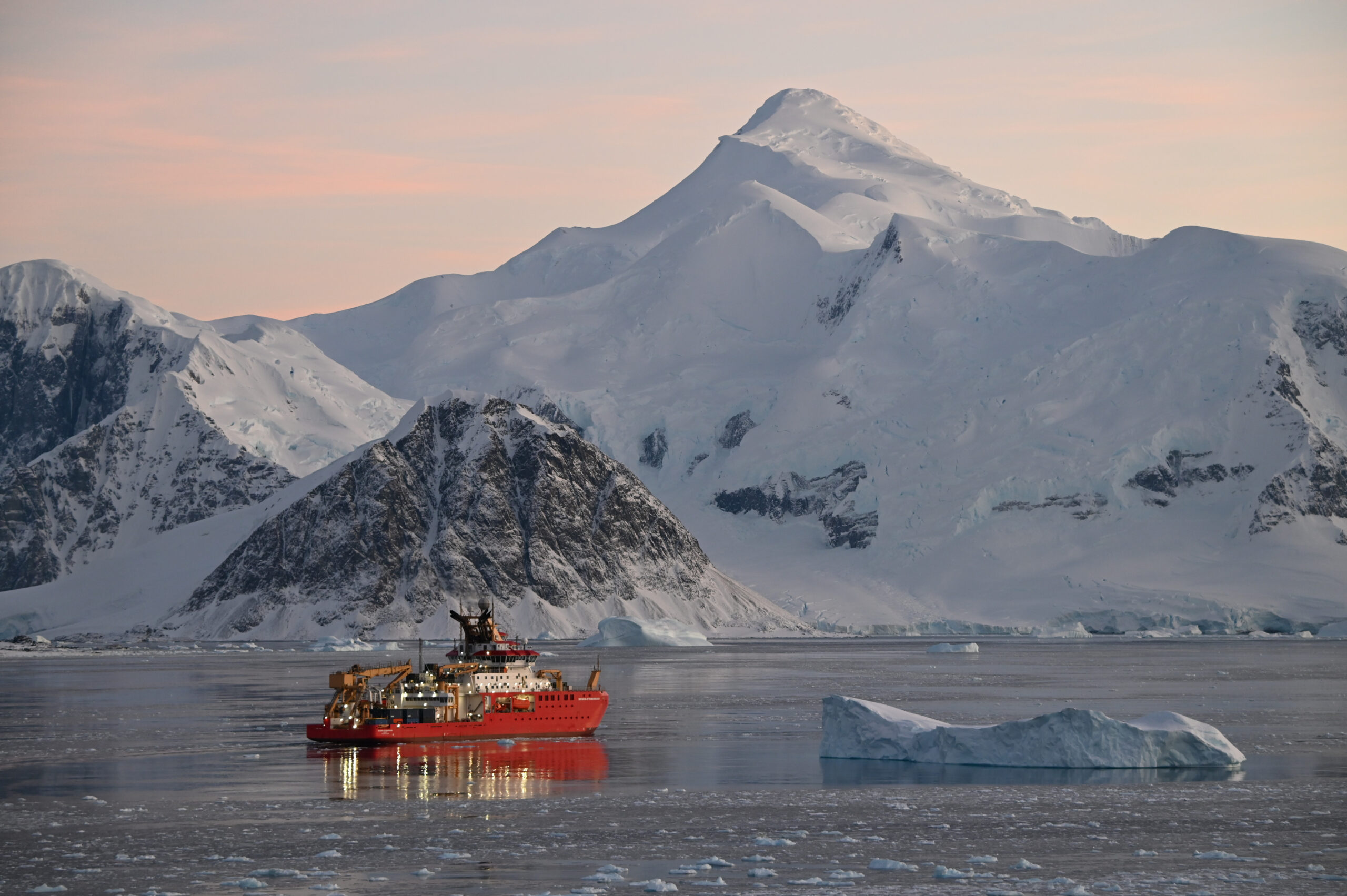
Ironically, it’s that rise in temperature that’s enabling BAS to broaden its research.
“Normally any ship would have gone south at the beginning of Antarctic Spring,” Jane explains, “to try to get to Rothera in time to take the presents for Christmas Day. And they’d leave again around March because the ice was forming. But these days there’s so little ice around that the ship can be in Antarctica all year round. Last year it was there in mid-June. That was the first time that a British ship has been that far south since Shackleton’s Endurance Expedition. An expedition that took place the decade before Sir David Attenborough was born.”
A century later, this change to the rhythm of Antarctic science means BAS scientists can monitor carbon levels in the ocean during the winter.
“This is the new area of discovery: what happens in the cold and dark in the polar regions,” Jane says.
The very fact the data can now be collected is proof that the research is more vital than ever. A rate of change that was unthinkable when Sir David’s first Antarctica documentary Life in the Freezer first aired in 1993.
“I think what’s really interesting with BAS and Sir David Attenborough is that’s he’s visited the Antarctic over several decades,” Dr Sophie Fielding says as we end our call. “So, he’s very aware of the changes that can be seen in his lifetime. Which is quite a long lifetime at this point!”