QUASAR
QUASAR uses AI to improve Antarctic sea ice measurements from satellites, making climate data more reliable for scientists tracking changes in polar regions.
Understanding the role of the Polar Regions in climate change is a huge scientific challenge and an urgent priority for society. Our multidisciplinary climate research programmes investigate a wide range of science questions providing accurate information to politicians and policy makers.
The Antarctic is a pivotal part of the Earth’s climate system and a sensitive barometer of environmental change. Although remote and inhospitable, Antarctica is Earth’s most powerful natural laboratory. Understanding how the Antarctic is responding to current climate change – and what the continent was like in the past – is essential if scientists are to be able to more accurately predict future climate change and provide accurate information to politicians and policy makers.
British Antarctic Survey (BAS) has for the past 60 years been responsible for most of the UK’s scientific research in Antarctica and its current five-year research strategy is focussed on deepening our understanding of climate change.
Antarctic ice cores reveal the clearest link between levels of greenhouse gases in the atmosphere and the Earth’s temperature. They show that the temperature of the climate and the levels of greenhouse gases are intimately linked. In 2004, ice core scientists at BAS working together with colleagues from other European nations successfully extracted a three-kilometre ice core from the Antarctic. This core contains a record of the Earth’s climate stretching back 800,000 years – giving us by far the oldest continuous climate record yet obtained from ice cores.
BAS geologists can look back even further in time. By studying Antarctic rocks and sediments from the sea and lake beds, they are able to get a picture of what the Antarctic was like millions of years ago when the continent was warm and supported plants and animals such as dinosaurs. Understanding how the ice sheets that currently cover the continent developed and how they have receded in the past is essential if we are to be able to predict how those ice sheets will behave in a warmer world.
Much of BAS science is done on the Antarctic Peninsula – one of the fastest warming parts of the planet. BAS glaciologists are also studying the West Antarctic Ice Sheet, parts of which are thinning rapidly. Their work is crucial to understanding whether this thinning could signal the start of the ice sheet’s collapse, an event that would cause sea levels to rise much more than currently predicted.
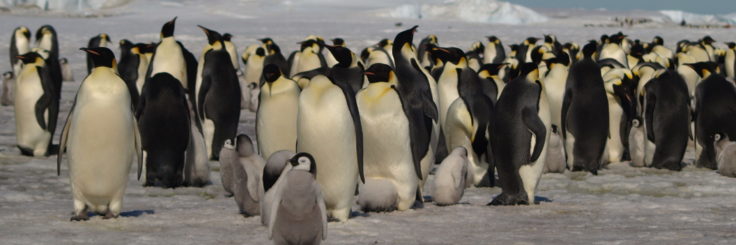
On sea as well as on land, BAS scientists are investigating climate change. As the waters warm around Antarctica, ecologists at BAS are looking at how penguins, seals and the other species that make up one of the world’s largest marine ecosystems are responding.
Because the causes and effects of climate change are extraordinarily complex, assembling all the pieces of the climate change jigsaw is a huge challenge. By conducting world-class science in the Antarctic, BAS is making a significant contribution to meeting this challenge.
QUASAR uses AI to improve Antarctic sea ice measurements from satellites, making climate data more reliable for scientists tracking changes in polar regions.
National Antarctic programmes, including British Antarctic Survey are coordinating their science to better understand changes in Antarctica.
GIANT is a pioneering science project that will test the potential for early warning of a critical climate tipping point.
The evolution and ecology of Antarctic sea floor communities is a UKRI Future Leaders Fellowship, led by Dr Rowan Whittle, looking at the past, present and future of life at …
Environmental research relies on digital infrastructure (hardware, software and methods) to provide services that help researchers answer questions about the environment around us, and innovators to work out ways that …
The Arctic Summer-time Cyclone Project is a joint project of scientists from the University of Reading, University of East Anglia and the British Antarctic Survey with expertise in atmospheric dynamics, …
The Big Thaw is an ambitious new UKRI/NERC-funded Highlight Topic project assessing past, present and future changes in global mountain water resources by studying snow/ice accumulation and melt in the …
Digital Twinning is next generation technology for data fusion and computer modelling enabling us to rapidly get answers to “what-if” questions. Digital Twins (DTs) are already in operation in industry …
The NERC funded SIWHA_CO2 project “Sea Ice and Westerly winds during the Holocene in coastal Antarctica, to better constrain oceanic CO2 uptake” will be a breakthrough in our understanding of how …
In order to accurately predict impacts of space weather and climate variability on the whole atmosphere we need an accurate representation of the whole atmosphere. The mesosphere (~50-95 km altitude) …
1 June, 2023
Concern is rising about tipping points in the Antarctic region (Armstrong et al., 2022). Recent heatwaves, changes in the Southern Ocean, and a reduction in the extent of Antarctic sea …
27 October, 2022
Introduction Understanding Antarctic warming and its consequences is vitally important for our planet. Parts of Antarctica, including the Antarctic Peninsula and West Antarctica, have experienced significant warming over the last …
2 October, 2025
Ancient ice from Antarctica, extracted as part of the Beyond EPICA – Oldest Ice project, captures a unique climate record spanning at least the past 1.2 million years. The team …
23 July, 2025
Scientists from British Antarctic Survey have contributed to research that significantly improves predictions of future precipitation – rainfall and snowfall – in High Mountain Asia, a region that provides water …
4 July, 2025
A new study in collaboration with BAS scientists reveals for the first time that zooplankton migration contributes significantly to carbon storage in the Southern Ocean – a process currently overlooked …
26 June, 2025
A new study challenges recent claims about dramatic “greening” in Antarctica and how this conflicts with decades of field-based ecological knowledge. The new opinion article ‘Is Antarctica Greening?’, published in …
10 June, 2025
Antarctica’s emperor penguin population may be decreasing faster than some of the most pessimistic predictions. A new analysis of up-to-date satellite imagery suggests the birds’ numbers declined 22% over a …
5 June, 2025
Antarctica could see a doubling of extreme weather events – such as atmospheric rivers – by 2100, with implications for future sea level rise. A new study published last week …
22 April, 2025
British Antarctic Survey’s Net Zero team collaborates with the Centre for Polar Observation and Modelling to highlight polar science at major climate conference. The British Antarctic Survey (BAS) net zero …
17 February, 2025
British Antarctic Survey (BAS) researchers have been selected for funding from The Advanced Research + Invention Agency (ARIA) to help improve our understanding of climate tipping points. These tipping points …
9 January, 2025
The fourth Antarctic campaign of the Beyond EPICA-Oldest Ice project has achieved a historic milestone this week, by successfully drilling a 2800-metre-long ice core, consisting of ice from the Antarctic …
12 December, 2024
Over 30 researchers from international institutes are working on ice core drilling campaigns in Antarctica to probe the ice sheet’s behaviour, carbon cycling in the Southern Ocean, and the Earth’s …