Atmospheric and Glaciochemist DSL
Antarctic surface mass and energy exchanges
SURface FluxEs In AnTarctica (SURFEIT)
- Start date:
- 1 July, 2022
- End date:
- 31 March, 2026
What SURFEIT does
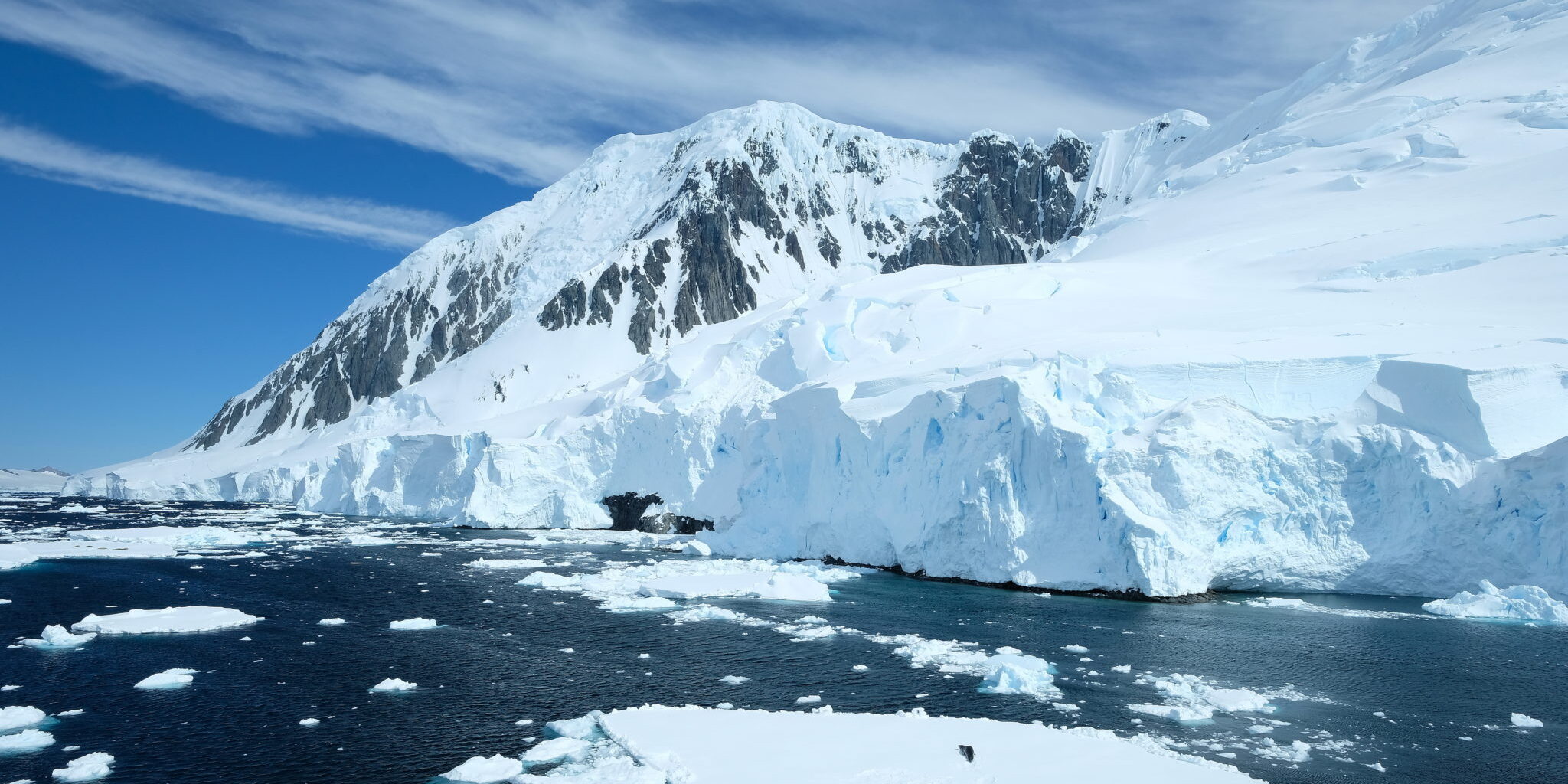
The programme studies how exchanges of mass and energy between the Antarctic ice sheet and the atmosphere affect global sea level.
It brings together leading scientists from the UK and international partners. Researchers combine field measurements, satellite observations, and advanced modelling to reduce uncertainties in climate projections and improve predictions of Antarctic ice loss.
Why this matters
SURFEIT helps us to:
- understand how snow and ice processes influence Antarctic ice-sheet mass and stability
- identify the atmospheric and ocean drivers of changes in surface fluxes
- reduce uncertainty in global climate and sea-level forecasts
- provide robust data for scientists, policymakers, and coastal planners worldwide
Accurate projections of Antarctic ice loss are critical for preparing and adapting to future sea-level rise. Current projections vary widely. SURFEIT addresses this by maximising the use of international data and fostering a new global research community.
Who is involved
SURFEIT is a British Antarctic Survey National Capability International research programme, funded by Natural Environment Research Council.
It links UK scientists with global partners from the US, Europe, and beyond.
Around 100 researchers from multiple disciplines are involved, including atmospheric science, polar meteorology, ice-sheet modelling, and climate prediction. The programme works closely with policymakers and the wider scientific community, to share findings and build collaboration.
How SURFEIT works
SURFEIT delivers its objectives through three complementary approaches:
- building an international research community that connects BAS scientists with global partners.
- combining new and existing measurements to develop numerical models and shared data infrastructure.
- applying these capabilities to address key challenges in calculating Antarctic surface fluxes and their impact on global sea level.
Science objectives
The programme aims to:
- develop and implement polar aerosol–cloud processes in the UK Earth System Model (UKESM) — including aerosol from sea ice and key sea ice flux processes for the first time.
- assess uncertainties in Antarctic climate datasets — improving surface mass balance estimates for sea-level projections.
- investigate how atmospheric circulation variability affects Antarctic surface fluxes — enhancing confidence in future predictions.
- improve projections of ice mass loss from ice-shelf hydrofracture and other flux-driven processes — essential for understanding long-term Antarctic ice loss.
- SURFEIT also focuses on growing a new international community through collaboration, exchange, and engagement with the wider research sector.
SURFEIT primarily aims to grow a new international community that works collaboratively on our key question:
How will changes in Antarctic surface fluxes impact global sea-level to 2100, and beyond?
We also seek to achieve several key scientific objectives:
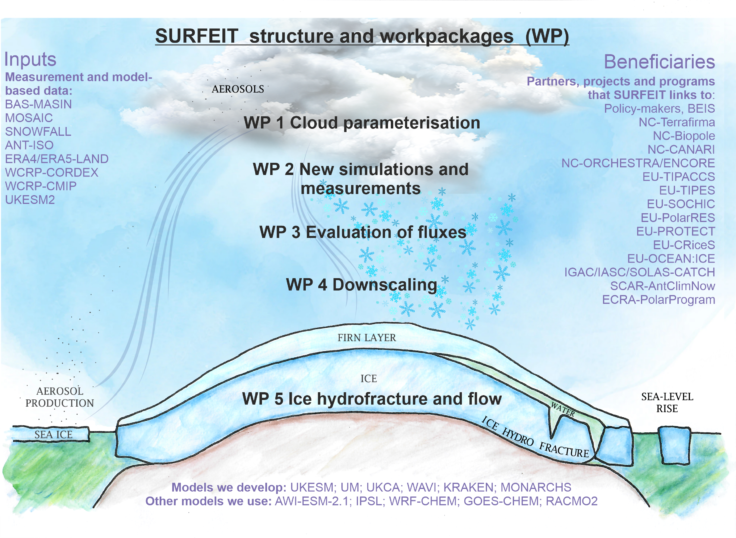
- To develop, implement, and evaluate missing polar aerosol-cloud processes in the UKESM earth system model: This will be the first-time aerosol from sea ice, alongside key sea ice flux processes, have been included in the UKESM model. This yields an opportunity to assess their surface flux impacts.
- To assess the key uncertainties in atmospheric climate models and reanalyse products for Antarctica: Surface mass balance changes derived from these products currently cause a large uncertainty on the projection of Antarctic-derived sea level rise.
- To investigate and characterise how changes in atmospheric circulation variability will impact Antarctic surface fluxes over the coming century: An improved physical understanding of flux changes and drivers is necessary to ensure confidence in our future Antarctic projections.
- To develop improved projections of ice mass changes due to iceshelf hydrofracture, and other surface flux driven processes: Ice fracture may drive the bulk of Antarctic ice loss after 2100, so improving these projections may be the most significant objective of our programme.

Schematic illustrating SURFEIT structure and work packages.
-
-
Atmospheric Scientist
-
Atmospheric Scientist
-
Climate Physicist
-
Science Leader/Polar Oeans
-
Ice Stream Modelling
-
Senior Climatologist
-
Glacial Processes Satellite
-
Atmos Sci Stratosphere Troposhere Coupling

-
IDP Science Leader IMP 3
BAS Science Strategy Executive Group, Ice Dynamics and Palaeoclimate team
-
Ice Sheet Modelling
-
Ice Sheet Modeller
-
Atmosphere Ice and Climate Dep Science Leader

-
Programme Support Manager
Project partners for SURFEIT include:
- Dr Gunnar Spreen, University of Bremen, Germany.
- Dr Priscilla Mooney, NORCE, Norway.
- Assistant Prof Rachel Chang, Dalhousie University, Canada.
- Dr Jennie Thomas, IGE, Grenoble, France.
- Prof Lyatt Jaeglé, University of Washington, USA.
- Dr Ronny Engelmann, TROPOS, Germany.
- Dr Camille Risi and Dr Jean-Baptiste Ladant, LSCE, France.
- Dr Hans Christian Steen-Larsen, University of Bergen Norway.
- Dr Mathieu Casado, CNRM, France.
- Dr Martin Werner, AWI, Germany.
- Dr Richard Wood & Dr Jeff Ridley, MetOffice, UK.
- Prof Michiel van den Broeke, Utrecht University, Netherlands.
- Dr Kari Luojus, Finnish Meteorological Institute, Finland.
- Dr Patrick Martineau, Japan Agency for Marine-Earth Science and Technology (JAMSTEC).
- Dr Irina Gorodetskaya, Centre for Environmental and Marine Studies (CESAM), Portugal.
- Prof Seong-Joong Kim, KOPRI, Republic of Korea.
- Prof Ryan Fogt, Ohio University, USA.
- Dr Kyle Clem, Victoria University of Wellington, New Zealand.
- Dr Pranay Seshadri, Equadratures (founder and lead), UK.
- Dr Ravindra Duddu, Vanderbilt University, USA..
- Dr Sammie Buzzard, Cardiff University.
- Dr Emilio Martínez-Pañeda. Imperial College London.
- Dr Alison Banwell, University of Colorado, USA.
- Prof Jonathan Kingslake, Columbia University, USA.
- Prof Paul Monks, Chief Scientific Adviser, Department for Business, Energy and Industrial Strategy, UK.
-
New funding to predict future sea-level rise in Antarctica
Read more of: New funding to predict future sea-level rise in AntarcticaResearchers at British Antarctic Survey (BAS) will develop new and ambitious ideas to tackle critical global environmental challenges, such as global sea-level rise from Antarctica, thanks to new funding. The […]