
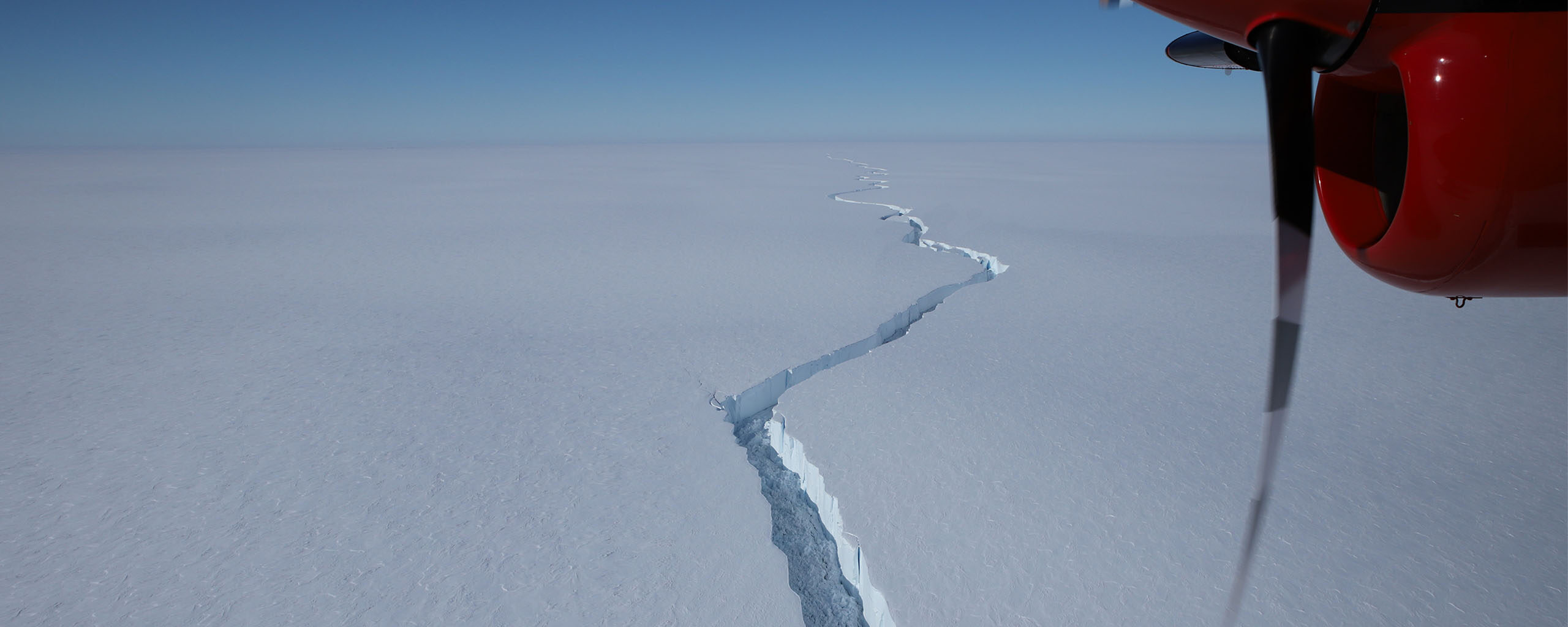
A new study on Antarctica’s Brunt Ice Shelf has revealed that surface melting and seawater infiltration can have dramatically different effects on the structural strength of floating ice shelves. This provides fresh insight into how cracks develop in ice and how future sea-level rise may unfold.
The research, led by British Antarctic Survey (BAS) and published in the journal The Cryosphere, examined how refrozen surface meltwater and brine from the ocean alter how resistant ice is to forming cracks and breaking – known as fracture toughness.
Ice shelves act as critical ‘cork’ that hold back and slow the flow of glaciers into the ocean. When they weaken or collapse, inland ice can accelerate toward the sea, increasing global sea-level rise. Understanding what controls ice-shelf fracture is therefore a major challenge for climate scientists.
Lead author Dr Emma Pearce, a glaciologist at British Antarctic Survey (BAS), said:
“Ice-shelf fracture remains one of the largest uncertainties in predicting Antarctica’s future contribution to sea-level rise. Our work shows that processes such as refrozen surface melt and seawater infiltration within an ice shelf can fundamentally alter the mechanical strength of the ice, creating contrasting zones of increased strength and weakness that influence how fractures spread, and rifts develop.
“This research helps build more realistic models of ice-shelf instability and will help to reduce uncertainty in future sea-level-rise projections.”
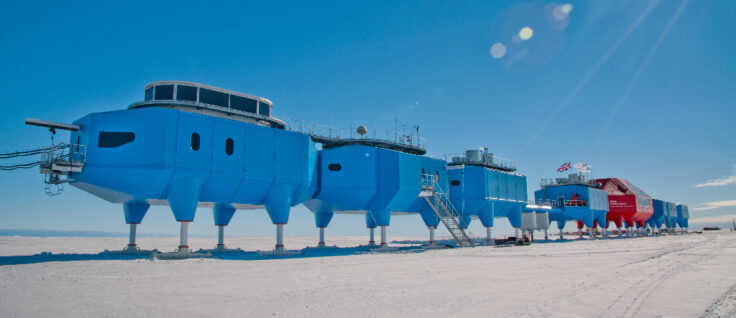
The team drilled a 37-metre ice core near BAS’ Halley VI Research Station on the Brunt Ice Shelf during the 2023–24 Antarctic summer. Analysis showed that the upper portion of the ice shelf contained approximately seven percent refrozen meltwater, while radar surveys identified continuous brine-rich layers at depths of around 37 metres.
The researchers then conducted laboratory tests on three types of ice to see how each fractured under pressure: naturally formed ice (ice formed from compacted snow, known as meteoric ice), melt-modified meteoric ice (ice that has melted and refrozen), and brine-infiltrated meteoric ice. The experiments measured how much stress each type of ice could withstand before a crack began to grow.
The results showed that ice affected by refrozen surface melt was up to 40 percent more resistant to cracking than ordinary ice. Although this melt-modified ice had larger grain sizes, which would normally be expected to weaken it, the researchers concluded that the compacting and thickening of layers caused by the meltwater refreezing outweighed any negative effect associated with grain growth.
By contrast, ice saturated with brine was substantially weaker. Resistance to cracking reduced by 14 – 34 percent compared with similar brine-free ice. The scientists attribute this weakening to the chemical effects of salt and the lower freezing temperatures at which salty ice freezes, which reduces how well the ice holds together.
The findings highlight the complexity of Antarctic ice shelves, which are not uniform blocks of ice but mixtures of frozen snowfall, refrozen melt layers and brine-saturated ice. According to the researchers, these varying materials create zones of differing strength that can either slow down or spread crack growth.
The study also challenges a common assumption in many computer models of ice sheets and calving, which often apply a single measure of fracture-toughness value, or fracture law, across an entire ice shelf. The new results show that this resistance to cracking can vary substantially with density, salinity and depth. This means that computer models using constant values may fail to capture the true behaviour of rifts and calving fronts.
As Antarctica continues to warm, surface melting, snowfall changes and ice-shelf thinning are expected to alter the internal structure of ice shelves, potentially increasing their diversity. The researchers argue that incorporating this range of diverse ice types will be essential for improving predictions of ice-shelf stability, iceberg calving and future sea-level rise.
This research was in collaboration with University College London and Aalto University.
Impact of Surface Melt and Brine Infiltration on Fracture Toughness of Ice Shelves, was published on 12 May 2026 in The Cryosphere by Emma Pearce, Oliver J. Marsh, Thomas M. Mitchell, Jukka Tuhkuri, Elizabeth R. Thomas and Siobhan Johnson.