
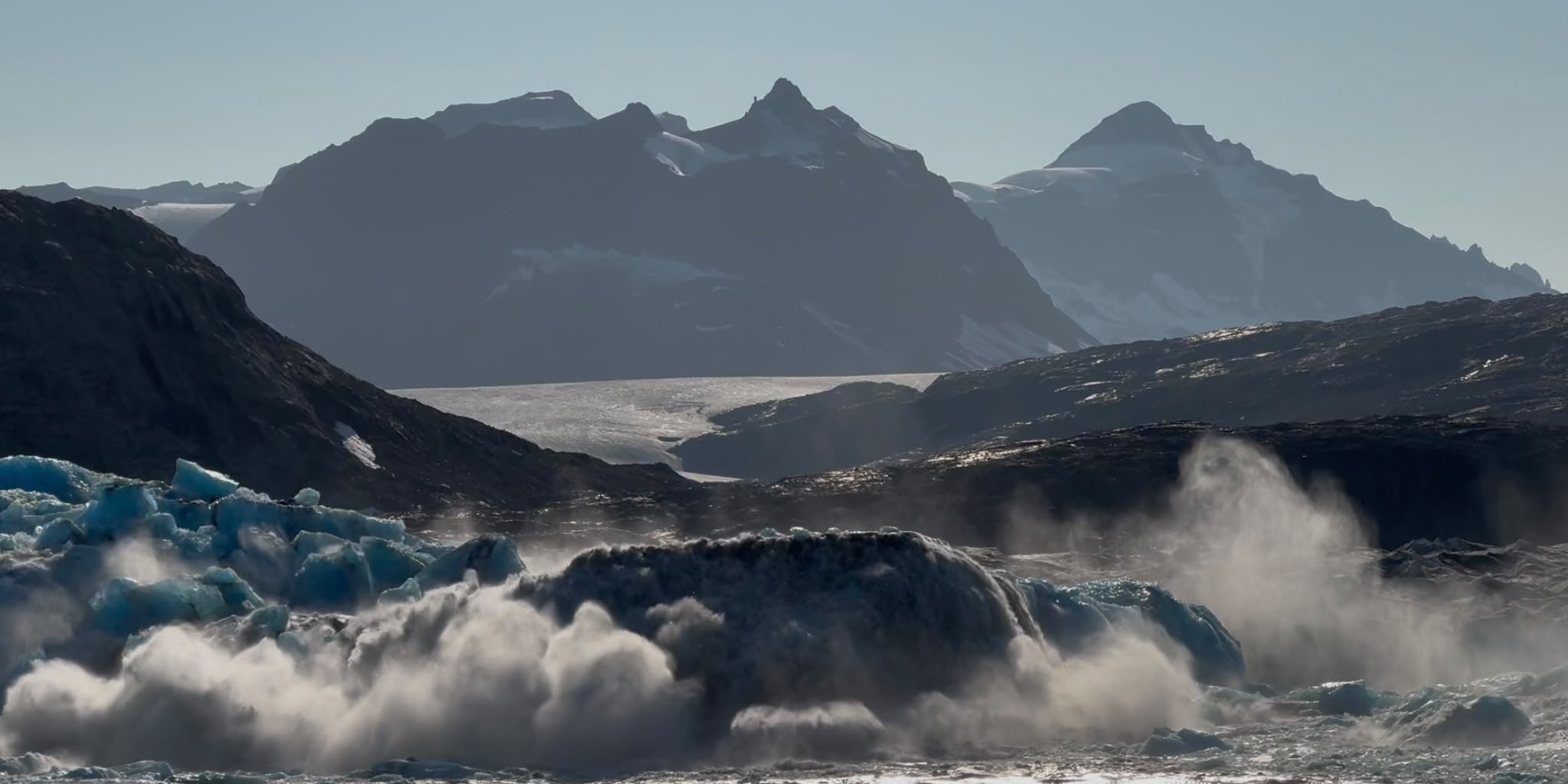
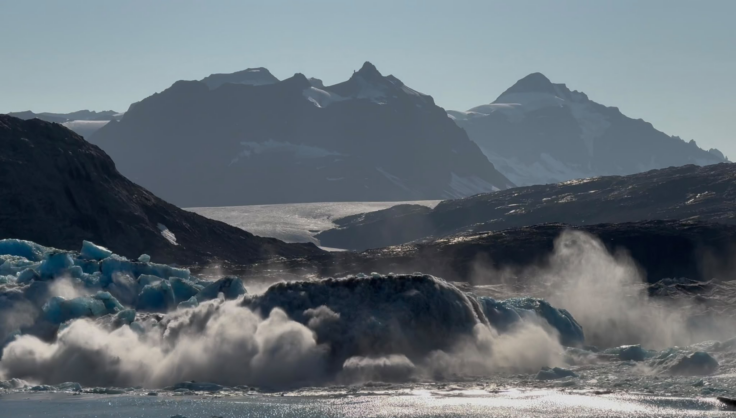
Scientists and crew on board RRS Sir David Attenborough captured footage of a huge glacier calving event in East Greenland. The ship is there as part of the GIANT science expedition. Scientists are trying to understand and model how Greenland’s glaciers interact with the warming ocean – including melting and calving – a set of processes that are not currently well represented in climate simulations.
The team were working near Sorgenfri Gletsjer, at the top of 3-miippugut Fjord, north of Kangerlussuaq Fjord. As evening set in, a big section of the glacier-front calved off all at once. The section that broke away covered 1km width across the ice face and was an average of 100m thick – totalling an estimated 18 million metric tonnes.
While Greenland’s ice sheet is losing mass at record rates, glacier calving events are a normal part of the fluctuation and balance of ocean-terminating glaciers, particularly in summer.
Captain Matt Neill, Master of the RRS Sir David Attenborough, said:
“At the time of calving, our ship was more than a kilometre away from the front of the glacier. Both the ship and our crew are well prepared to respond to events like this. As we saw the calving begin, were able to quickly turn the ship into the safest position.
It was incredible to see such a volume of ice shifting, and a reminder of the importance of the work we’re here to do.”
RRS Sir David Attenborough is a capable icebreaker-class vessel – usually seen near Antarctica, traversing sea ice and navigating around the vast tabular icebergs that are more typical to the frozen South. The ship is designed to cope with extreme and fast-changing conditions, and the crew are experienced at sailing and navigating in the polar regions.
This spectacular event is a reminder of why we are using a fleet of specialist autonomous vehicles to capture data near the ice face. Instruments on board include Gavia and EcoSubs – a family of robots that swim in coordination with each other, diving hundreds of metres below the surface to collect data from the glacial ice face, and the famous Autosub Long Range, known fondly as Boaty McBoatface. Completing the line-up are DriX and Meltstake. Between them, these autonomous vehicles with gather critical data, where the glacial ice meets the ocean – and where it’s too dangerous for humans to go.