
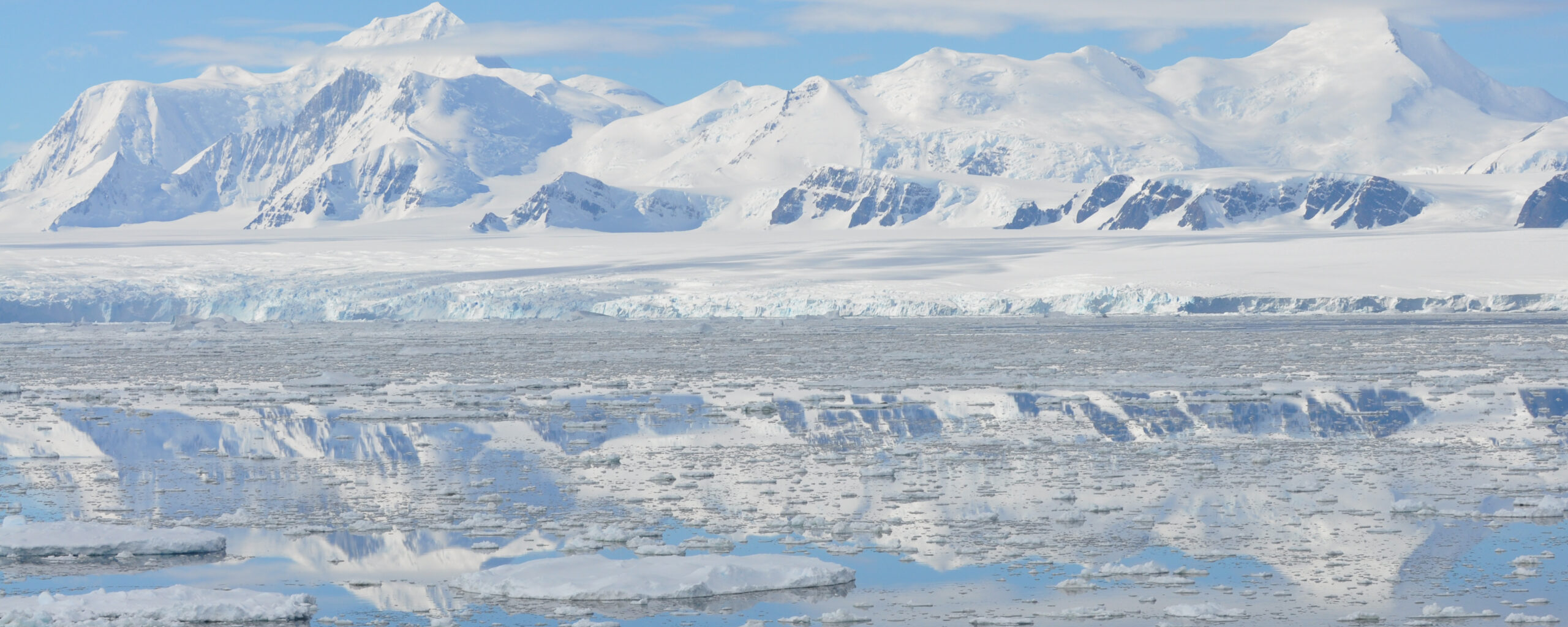
A new international scientific review, co-authored by researchers at British Antarctic Survey (BAS), warns that major gaps in our knowledge of Antarctica’s coastline are now among the biggest obstacles to producing reliable predictions of future global sea level rise.
The review, published in the American Geophysical Union journal Reviews of Geophysics, brings together 80 scientists from 17 countries, spanning glaciology, oceanography, geophysics and atmospheric science. It was coordinated through the Scientific Committee on Antarctic Research (SCAR) RINGS Action Group, which is also endorsed by the Council of Managers of National Antarctic Programs (COMNAP).
The paper brings together existing observations, models and theory to show how incomplete data on the interactions between ice, ocean, atmosphere and the solid Earth around Antarctica’s coast continue to limit our ability to estimate ice loss and forecast future sea level rise.
Dr Pierre Dutrieux, who leads this work at BAS, said:
“This work builds on decades of hard-fought surveys led by individual countries and institutes from around the world. The conclusion is clear: we need a coordinated international push to fill the many remaining gaps in our description of the seafloor and ice geometries along the Antarctic margin. Only then will we have healthy foundations to predict the future of the Antarctic ice sheet.”
A critical control point for sea level rise
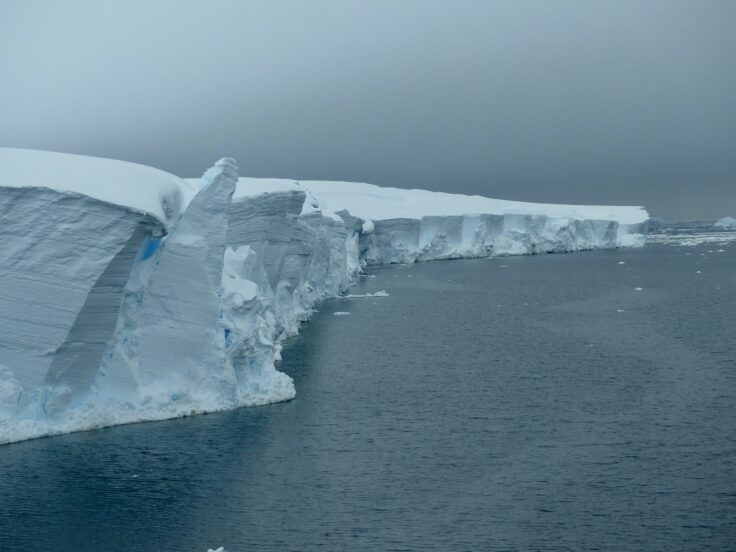
The Antarctic coastal zone is far more than the edge of the continent. It is a tightly connected system where grounded ice meets the ocean, and where small changes can have outsized consequences. Processes occurring near the grounding zone, the point where ice lifts off the seabed and begins to float, can regulate how much ice flows into the ocean or, under certain conditions, trigger feedbacks that accelerate ice loss.
Observations over recent decades show that Antarctica is losing mass. This is driven primarily by interactions between ice and the surrounding ocean, and by ice flow at the edges of the ice sheet, rather than surface melting alone. Yet key coastal conditions remain poorly mapped.
The biggest gaps, and why they matter
The review identifies persistent gaps in direct observations of coastal bed topography and the cavities beneath ice shelves. Because ice sheet models are highly sensitive to conditions at the coast, even the most advanced models can produce misleading results when this data is missing or poorly constrained.
Satellite observations provide powerful measurements of ice motion and surface change, but they cannot see through the ice to observe the bedrock beneath it.
First author and chair of the RINGS Action Group, Dr Kenichi Matsuoka of the Norwegian Polar Institute, said:
“Antarctica’s coastal zone is where ocean, ice, atmosphere and the underlying bed interact, making it central to predicting future sea level rise. Yet limited observations in this region leave critical gaps in understanding, meaning Antarctica remains a major source of uncertainty.”
He added: “Satellite data alone cannot reliably estimate ice loss into the ocean, and computer models alone cannot predict future change. Both depend on accurate knowledge of bed topography. Observations like those proposed in this paper provide a key missing piece.”
A roadmap for coordinated action
Because no single nation can achieve comprehensive coverage of Antarctica’s coastline alone, the authors argue that international coordination is essential to close these gaps efficiently.
Dr Matsuoka said: “Uncoordinated surveys risk leaving gaps or duplicating effort. This paper provides an evidence-based framework to support coordinating RINGS activities under SCAR and COMNAP, helping to build more comprehensive datasets for improved sea level projections.”
He continued: “Such internationally coordinated efforts can serve as a stepping stone towards the next International Polar Year 2032 to 2033.”
For BAS, the review underscores the importance of continued UK leadership in coordinated, international polar science, and reinforces the case for sustained investment in coastal and sub-ice shelf observations as a foundation for improving global sea level projections.