Science Leader IMP 1
BAS Science Strategy Executive Group, Space Weather and Atmosphere team, Leadership teams, BAS Executive team

Space Environment Impacts Expert Group (SEIEG) is an independent committee of experts drawn from academia, research institutes, companies, and agencies.
The primary purpose of SEIEG is:
SEIEG is independent of government and does not receive funding for the work it undertakes.
SEIEG was created in 2010 after a volcanic eruption in Iceland disrupted air travel across Europe.
This prompted experts and government to ask: what other natural hazards could cause similar chaos, and could space weather be one of them?
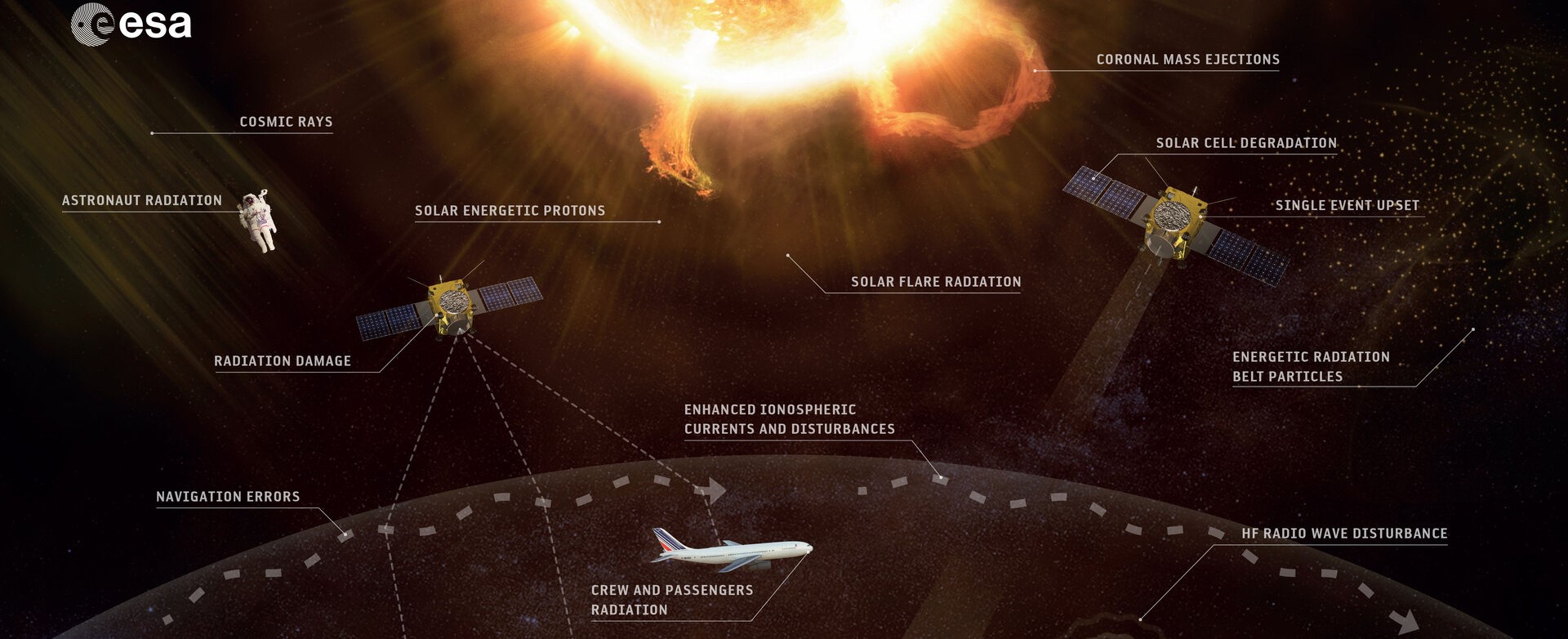
Space weather refers to changes in the near-space environment that disrupt modern technology and endanger human health.
Space weather is driven primarily by solar variations and causes disruption to power supplies, satellites, communications, aviation, navigation, pipelines and much more.
The UK Government strategy on space weather is set out in the UK Severe Space Weather Preparedness Strategy 2021. It sets out a plan to enhance the UK’s resilience to severe space weather events using three pillars.
They are:
SEIEG is working with the Met Office and government to help deliver this strategy.
Members of SEIEG have published influential reports and research papers which have been independently assessed by international peer review.
These include the Royal Academy of Engineering Report on extreme space weather (Cannon et al., 2013), assessments of the economic impact of a severe space weather event (Eastwood et al., 2018, Oughton et al., 2019) and the development of realistic worst-case scenarios (Hapgood et al., 2021).
These research findings have been used to support the UK National Risk Register (2020, 2023), the National Space Strategy (2021) and the BEIS severe space weather preparedness strategy (2021).
A SEIEG report on the May 2024 geomagnetic storm can be found here.
The purpose of the report is to set out what happened, record some of the key impacts, discuss what went well and what needs to be improved.
The report made 14 recommendations ranging from aviation to satellites and the National Grid so that the UK can be better prepared for a reasonable worst case space weather event.
Highlighted research papers on space weather related to:
| Member | Role | Organisation |
|---|---|---|
| Prof Richard Horne FRS | Chair | British Antarctic Survey |
| Dr Mike Hapgood | Former Chair | Rutherford Appleton Lab. |
| Dr Mario Bisi | Rutherford Appleton Lab. | |
| Prof Jonathan Eastwood | Imperial College London | |
| Mr Mark Gibbs | Met Office | |
| Prof Jim Wild | Lancaster University | |
| Dr Simon Machin | Met Office | |
| Dr Ciaran Beggan | British Geological Survey | |
| Prof Sean Elvidge | University of Birmingham | |
| Prof Cathryn Mitchell | University of Bath | |
| Prof Keith Ryden | University of Surrey | |
| Dr Gemma Attrill | Defence, Science and Tech. Lab. |
The wider membership includes:
| Prof Paul Cannon OBE | University of Birmingham |
| Ms Ellen Clarke | British Geological Survey |
| Dr Clive Dyer | University of Surrey |
| Professor Lucie Green | University College London |
| Prof Huw Morgan | Aberystwyth University |
| Prof John Preston | University of Essex |
| Dr John Rees | British Geological Survey |
| Dr Matt Owens | University of Reading |
| Dr Matthew Angling | In-Space Missions Ltd |
| Dr David Gibbs | Civil Aviation Authority |
| Mr Mathew Hofton | Electricity System Operator |
| Prof David Jackson | Met Office |
| Capt Bryn Jones | SolarMetrics Ltd |
| Dr Graham Routledge | Defence, Science and Tech. Lab. |
| Dr Rick Tanner | UK Health Security Agency |
| Dr Mike Willis | UK Space Agency |
| Dr Harneet Sangha | UK Space Agency |
SEIEG Report (2022). Summary of space weather worst-case environments. (3rd rev. ed.)
SEIEG Report (2020). Summary of space weather worst-case environments
SEIEG Report (2016). Summary of space weather worst-case environments. Revised edition
SEIEG Report (2012). Summary of space weather worst-case environments
BEIS Severe Space Weather Preparedness Strategy (2021)
National Space Strategy (2021)
Defence and Security Industrial Strategy (2021)
Solar Storm Risk to the North American Electric Grid, Lloyds Report (2013)
Cannon et al. (2013). Extreme space weather: impacts on engineered systems and infrastructure. Royal Academy on Engineering. Summary Report
Cannon et al. (2013). Extreme space weather: impacts on engineered systems and infrastructure. Royal Academy on Engineering. Full Report
Highlighted research papers on space weather related to: