PRESCIENT
PRESCIENT supports long-term, strategically important measurements and capabilities for the wider science community.
I am a paleoclimatologist, specializing in Polar climate variability.
I am head of Ice core research at the British Antarctic Survey, leading a team of analytical chemists, PhD students, engineers and technicians to produce high resolution chemical and stable isotope records to investigate climate variability in the Polar Regions. I have led several expeditions to Antarctica, the Arctic (Greenland and Svalbard) and most recently an expedition to drill the first ever ice cores from the sub-Antarctic islands.
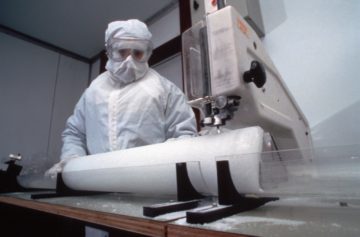
I am head of the National Capability “Ice core acquisition and analysis“, the UK’s only capability to recover and analyse ice cores (up to 1000 m).
Recent awards and Grants:
2025-2028: Principal Investigator – NERC: Exploring the Mid-Pleistocene Transition using Antarctica’s oldest ice core (MPT-ICE)
2025-2028: Co-Investigator (PIs: R Ivanovic, University of Leeds & David Thornalley, UCL) -VERIFY: Out Of Sample Testing For Early Warning Systems Using Past Climate
2025-2028: Co-Investigator (PI: C Giorio, University of Cambridge) – Leverhulme: Constraining the oxidising capacity of the Earth’s atmosphere of the past
2024-2027: Co-Investigator (PI: B Wouters, Delft University) – NWO/ Netherlands Polar Programme: Firn Capacity of Antarctic Ice Shelves via Satellites Observations (FIRN-CAISSO)
2023-2026: Co-Investigator (PI: A Burke, St Andrews) -UKRI-Norway: Figuring Out how to Reconstruct Common Era forcing of climate by VOLcanoes with novel data and modelling approaches (FORCE-VOL) [NE/Y001028/1/and NE/Y001044/1]
2023-2027: Co-Investigator (PI: O Marsh, BAS) – NERC: Rates of Ice Fracture and Timing of Tabular Iceberg Production (RIFT-TIP) [NE/X014991/1]
2021-2027: Principal Investigator – NERC: Sea Ice and Westerly winds during the Holocene in coastal Antarctica, to better constrain oceanic CO2 uptake (SIWHA_CO2) [NE/W001535/1]
2020-2024: Principal Investigator – Royal Society (FLIAR collaboration): Isotopes, ice cores, islands: Novel methods for tracking anthropogenic nitrogen deposition to coastal South African waters and remote marine ecosystems
2019: Principal Investigator- NERC: UK Relic Air Extraction and Gas Analysis System (UK RArE-GAS) [NE/T008911/1]
2019: National Geographic explorer
2018-2020: Principal Investigator- “Greenland Ice Core Expedition – Climate and sea Ice Past and present (GICE-CIPP)”. Reconstruct past climate and sea ice variability in the arctic using ice cores collected from coastal domes. Part of the international GreenLAnd Circumnavigation Expedition (GLACE).
2018: SCAR Weyprecht Lecture – POLAR2018 conference, Davos, Switzerland
2016-2018: Principal investigator, “Sub Antarctic Ice Coring Expedition (SUBICE)” Reconstructing past climate and the variability of the westerly winds using ice cores from the sub-Antarctic islands. Part of the international Antarctic Circumnavigation Expedition (ACE).
2014: Laws prize, awarded annually to an outstanding BAS scientist who has proven aptitude for research and is likely to make a significant contribution in the future
2013-2017: Principal investigator – NERC: Reconstructing wind strength and atmospheric circulation in West Antarctica over the past 300 years Developing a novel proxy for past wind conditions based on diatoms preserved in ice cores. (NE/J020710/1)
2009: Certificate of appreciation from World Meteorological Organisation and International Council for Science (ICSU)
My research focus is understanding past climate and environmental change over decadal to millennial timescales. I utilize novel and proven ice core proxies, observational records and model output to reconstruct past surface temperature, snow accumulation, sea ice variability and atmospheric circulation. My most significant scientific contribution was producing the first comprehensive record of Antarctic surface mass balance and quantifying the 20th century contribution to global sea levels.
Join the team:
Please get in touch if you are interested in joining my research team. I am currently supporting a number of international fellowships and visiting scientists and we are always happy to support new collaborations.
Take a tour of the labs:
Click here for a virtual tour of the labs and meet some of the team.
Learn more about our laboratory facilities here.
Leader of an international PAGES (Past Global Changes) project “Climate Variability in Antarctica and the Southern Hemisphere in the past 2000 years (CLIVASH2K)”
Scientific steering committee – Near-term Variability and Prediction of the Antarctic Climate System (AntClimNow) – Scientific Committee on Antarctic Research https://www.scar.org/science/antclimnow/home/
Scientific steering committee – INStabilities & Thresholds in ANTarctica (INSTANT) – Scientific Committee on Antarctic Research https://www.scar.org/science/instant/home/
Co-leader for the PAGES Antarctica2k project (2010-2017). Antarctica2K
Moser, D., Gallet, J., Thomas, E., Spolaor, A., & Scoto, F. (2025). Time-lapse video of tracer percolation experiment in Svalbard seasonal snowpack, Ny-Alesund March 2023 (Version 1.0) [Data set]. NERC EDS UK Polar Data Centre. https://doi.org/10.5285/62b9e5c5-190a-4137-ad95-3565e99395fe
Moser, D., Gallet, J., Thomas, E., Spolaor, A., & Scoto, F. (2025). Snow temperature, stratigraphy, density, and stable water isotope profiles from the seasonal snowpack near Ny-Alesund, Svalbard, in March 2023 (Version 1.0) [Data set]. NERC EDS UK Polar Data Centre. https://doi.org/10.5285/84bab093-750e-48f5-ae41-1e5824abdecf
Tetzner, D., Thomas, E., Allen, C., McCulloch, R., Perren, B., McGuire, A., Segato, D., Moser, D., Humby, J., & Miller, S. (2025). Major ions, Stable water isotopes, Microparticle (dust, diatoms, pollen and spores) and electrical conductivity records from the first Cordillera Darwin ice core 2017 – 2020 CE (Version 1.0) [Data set]. NERC EDS UK Polar Data Centre. https://doi.org/10.5285/2d9b5828-45d2-4361-b23b-cf027c15e97c
Moser, D., Gallet, J., Thomas, E., Spolaor, A., & Scoto, F. (2025). In-situ tracer percolation experiments: conditions, results, and alteration of stable water isotope signatures in the seasonal snow near Ny-Alesund, Svalbard, in March 2023 (Version 1.0) [Data set]. NERC EDS UK Polar Data Centre. https://doi.org/10.5285/9cd08043-4498-4688-91d8-bb8a867d9024
Tetzner, D., Temme, F., & Furst, J. (2025). ERA5 daily downscaled surface air temperature and snowfall at two Cordillera Darwin high elevation sites 2000 – 2022 CE (Version 1.0) [Data set]. NERC EDS UK Polar Data Centre. https://doi.org/10.5285/eddc907c-f8e9-48c4-9f23-de0f674dbee0
Tetzner, D., Allen, C., Thomas, E., Wolff, E., & Franzke, C. (2025). Annual diatom abundance and diversity from the Jurassic ice core, Antarctic Peninsula (1873-2012 CE) (Version 1.0) [Data set]. NERC EDS UK Polar Data Centre. https://doi.org/10.5285/371f680f-2c0b-4558-9a85-12aa8722be7e
Thomas, E. (2024). Major ion chemistry, stable water isotopes and snow accumulation from the Peter 1st firn core, 2002-2017 (Version 1.0) [Data set]. NERC EDS UK Polar Data Centre. https://doi.org/10.5285/6c28fe74-1a14-42ac-ae60-c2bc05c360b6
Emanuelsson, D., Thomas, E., Humby, J., & Vladimirova, D. (2022). Water-stable isotope (d18O, dD), sodium (23Na), and magnesium (24Mg) Continuous Flow Analysis data for the Palmer ice core, Palmer Land, Antarctic Peninsula, 1621-2011 C.E. (Version 1.0) [Data set]. NERC EDS UK Polar Data Centre. https://doi.org/10.5285/cb159b6c-a4b3-4245-80fd-4b4e8122a858
Thomas, E., Vladimirova, D., & Tetzner, D. (2022). CLIVASH2k Antarctic ice core chemistry database (Version 1.0) [Data set]. NERC EDS UK Polar Data Centre. https://doi.org/10.5285/9e0ed16e-f2ab-4372-8df3-fde7e388c9a7
Tetzner, D., Thomas, E., & Allen, C. (2022). Annual microparticle and ion fluxes in the Jurassic, Sherman Island and Sky-Blu ice cores (1992-2019 CE) (Version 1.0) [Data set]. NERC EDS UK Polar Data Centre. https://doi.org/10.5285/9ce1fd9f-cfaf-44fa-aa5d-45c24c0a76cc
Tetzner, D., Allen, C., & Thomas, E. (2022). Annual and sub-annual diatom abundance and distribution in the Jurassic, Rothschild Island, Sherman Island and Sky-Blu ice cores (1992-2019 CE) (Version 1.0) [Data set]. NERC EDS UK Polar Data Centre. https://doi.org/10.5285/e7166724-e7fa-4267-a2a7-6207ede57f70
Emanuelsson, D., Thomas, E., Tetzner, D., Humby, J., & Vladimirova, D. (2022). Age scales for the Palmer, Jurassic, and Rendezvous Antarctic Peninsula Ice Cores (Version 1.0) [Data set]. NERC EDS UK Polar Data Centre. https://doi.org/10.5285/b3eca350-79aa-49b2-bd6b-ffee86ad6559
Moser, D., & Thomas, E. (2021). Four approaches leading to the age scale of the Young Island ice core (Version 1.0) [Data set]. NERC EDS UK Polar Data Centre. https://doi.org/10.5285/8b60d15f-c8a5-4178-b7c2-0fef4a2717d2
King, A., Thomas, E., & Jackson, S. (2019). Records of isotopes, anions, cations and organic compounds measured in the Bouvet Island ice core for the time period 2001-2016 (Version 1.0) [Data set]. UK Polar Data Centre, Natural Environment Research Council, UK Research & Innovation. https://doi.org/10.5285/96dc0dd7-b5db-4444-97af-8ddfab1e7f78
PRESCIENT supports long-term, strategically important measurements and capabilities for the wider science community.
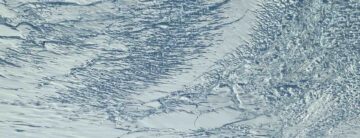
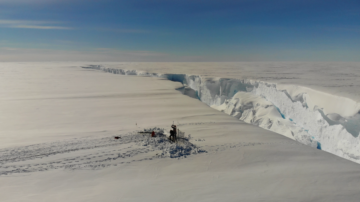
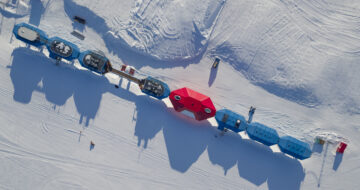
RIFT-TIP is investigating iceberg calving on the Brunt Ice Shelf. It uses field monitoring, lab testing, and modelling to predict when icebergs will form.
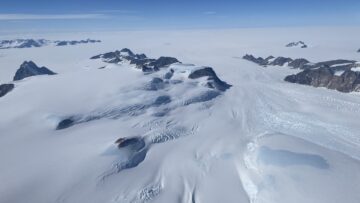
SIWHA investigates how westerly winds and sea ice have influenced CO2 uptake and release in the Southern Ocean.
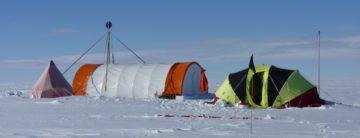
SUBICE, the Sub-Antarctic – ice coring expedition, part of the international Antarctic Circumnavigation Expedition (ACE), successfully drilled several shallow ice cores, from five of the remote and globally significant sub-Antarctic islands.
Studying ice response during past climate changes improves understanding of Antarctic ice sheet dynamics. This knowledge helps predict how ice sheets may behave under future warming scenarios.
This project used ice cores drilled across the Antarctic Peninsula and West Antarctica to reconstruct past climate and understand whether the recent warming in these rapidly changing regions is unusual over longer timescales..
This project used ice core chemical and biological tracers, including marine diatoms swept onto the ice sheet by wind, to reconstruct 300 years of wind strength and atmospheric circulation patterns in West Antarctica.
Defining the onset of the Anthropocene – an Antarctic ice core as a candidate GSSP site.
The Anthropocene Working Group (AWG) are searching for the optimal site to define the Global boundary Stratigraphic Section and Point (GSSP), also known as the “golden spike”, for the proposed Anthropocene Epoch. This would define a new geological era.
The Palmer ice core, from the Antarctic Peninsula, is one of 12 candidate sites being evaluated from across the globe. A suite of proxies, including plutonium (thermonuclear bomb testing) and fly ash (high temperature coal and fuel oil combustion) have been analysed in the ice layers.
The AWG is co-ordinating the assessment of candidate GSSP sites in collaboration with the Haus der Kulturen der Welt (HKW, Berlin) and the Max Planck Institute for the History of Science (MPIWG, Berlin).
You can read more about this project here.
You can watch a video presenting the Palmer ice core at the HKW here.
As some recent articles about our work in Orion magazine, Nature, and National Geographic.
Antarctic Circumpolar Expedition (ACE) – Sub Antarctic Ice Core Expedition (SUB-ICE)
The sub-Antarctic islands (SAI) are uniquely located to capture changes in the globally significant circumpolar westerly winds and the Antarctic circumpolar current, key to the mixing and ventilation of the world’s deep oceans. The Sub-Antarctic – ice coring expedition (SubICE) is an international collaboration to provide the first glaciological and palaeoclimate records from the remote and globally significant SAI’s, before glacial retreat and warming surface temperatures destroy this valuable palaeoclimate archive forever.
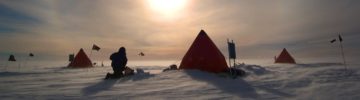
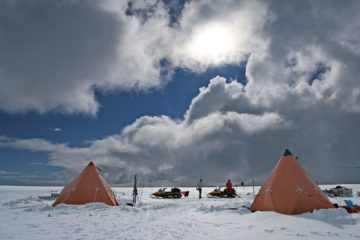
The experienced team drilled seven shallow ice cores (~20m), at both high and low elevations sites, at a number of glaciated SAI’s to improve our understanding of southern hemisphere climate dynamics. The sites include: Cape Hurley and Mertz Glacier (Adelie Coast, Antarctica), Young Island (the Balleny Islands), Peter 1st island, South Georgia (Nordenskjold Glacier and Heany Glacier) and Bouvet island (Bouvetøya).
More information about ACE here
BBC feature about Bouvet drilling here
Scientists are a step closer to being able to predict when large icebergs will calve in Antarctica.
A team of scientists from the British Antarctic Survey (BAS) is gearing up for an expedition to the Brunt Ice Shelf in Antarctica to unravel the mysteries behind the calving processes that result in the formation of colossal icebergs.
A new immersive exhibition, Polar Zero, opens at Glasgow Science Centre this weekend (2 October), injecting an artistic and cultural dimension to the climate negotiations at the Conference of the […]
The International Day of Women and Girls in Science is organised by UNESCO and UN-Women to promote full and equal access and participation in science for women and girls. The United […]
A new study reveals the importance of a small number of intense storms around Antarctica in controlling the amount of snow falling across the continent.
International Day of Women and Girls in Science today (11 February) is a celebration of women and girls in science and is organised by UNESCO and UN-Women. To mark this […]
A new study of snowfall across Antarctica provides vital information in the study of future sea-level rise. A team of scientists from NASA and British Antarctic Survey (BAS), describes how […]
The first comprehensive study of snowfall across Antarctica provides vital information in the study of future sea-level rise. Presenting this week (Monday 9 April 2018) at the European Geosciences Union […]
This paper reveals that the amount of snowfall in coastal West Antarctica has increased during the 20th century, with annual snow accumulation since the 1990s the highest we have observed […]
West Antarctic coastal snow accumulation rose 30 percent during 20th century Annual snow accumulation on West Antarctica’s coastal ice sheet increased dramatically during the 20th century, according to a new […]
UK national facility and capability
New ice core record shows climate variability in West Antarctica A 308-year ice core record provides new data on climate variability in coastal West Antarctica and shows that a clear […]
More evidence of changing weather patterns around the Antarctic Peninsula – a region where climate has changed rapidly over the last 50 years – is published this month in Geophysical […]
Scientific highlights:
I produced the most comprehensive record of past Antarctic snow accumulation (surface mass balance). You can download the full data here. The Antarctica 2k database revealed that snowfall in Antarctica has significantly increased since 1800 AD (Thomas et al., 2017), mitigating 20th century sea levels by ~10 mm (Medley and Thomas, 2019).
Contribution to IPCC report https://www.ipcc.ch/report/ar6/wg1/downloads/report/IPCC_AR6_WGI_Chapter_09.pdf
See the BBC press coverage here
Link to my NASA GISS sea level seminar here
Producing and compiling sea ice proxy records from ice cores. Evidence that sea-ice area increase in the Ross Sea (Thomas and Abram, 2016) and the decrease of sea-ice area in the Bellingshausen Sea are part of longer centennial trends and exceed internal variability on multi-decadal time-scales (Thomas et al., 2019).
Contribution to IPCC report https://www.ipcc.ch/report/ar6/wg1/downloads/report/IPCC_AR6_WGI_Chapter_09.pdf
Fieldwork:
I have led several ice core drilling projects in the Antarctic Peninsula, West Antarctica and Svalbard and participated in international drilling projects in both the Antarctic and Greenland. I led the sub-Antarctic ice core drilling expedition, drilling the first ever ice cores on the Balleny Islands, Peter 1st Island and Bouvet Island (the most remote island in the world).
You can view the BBC feature about our work on Bouvet here
Media and outreach:
Watch my recent TED talk here
Channel 5 documentary “Ice age – the apocalypse” with Michaela Strachan and Steve Backshall
Documentary – “Anthropocene, the undeniable truth” Directed by Cédric Defert. Follows the Anthropocene Working Group project to define the onset of the Anthropocene.
A grown-up guide to Planet Earth (Episode 6 – The Human Earth)
ITV Anglia climate special
BBC breakfast (09/08/21)
National Geographic explorer classrooms link and youtube.
Channel 4 News pre-COP26 special
UK Live lesson aimed at KS2 children