
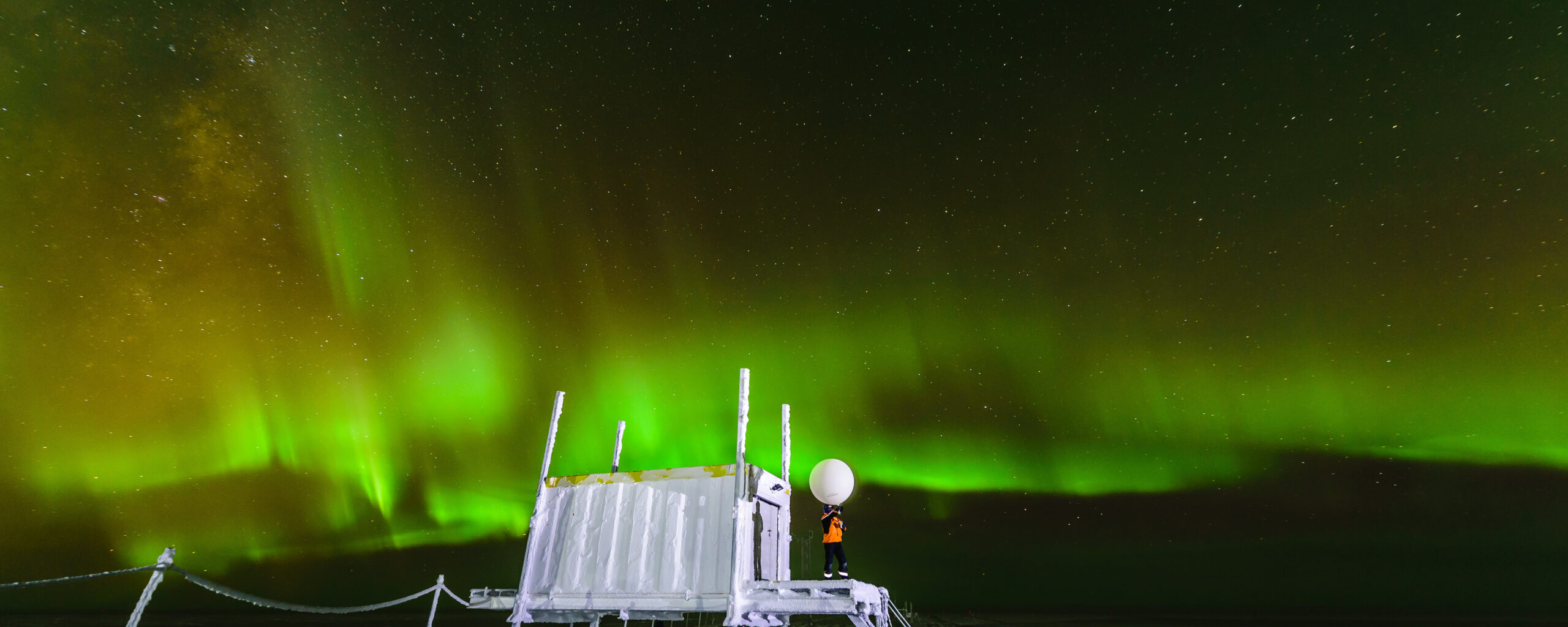
With the current heatwave, the impacts of weather are at the forefront of many people’s minds. But in today’s episode, we’re exploring a very different kind of weather – one that originates 150 million km away on the surface of the sun.
The space surrounding our planet can be just as turbulent as Earth’s atmosphere, with powerful solar winds and violent storms that send bursts of energy racing through our solar system. This ‘space weather’ can have very real consequences, creating spectacular auroras, interfering with satellite communications, disrupting power grids, and affecting the technology that modern society depends upon.
In this edition of Beyond the Ice, we meet Professor Richard Horne, a distinguished research scientist in the Space Weather and Atmosphere team at the British Antarctic Survey. He talks about why understanding space weather is becoming a priority in both science and industry, and why our poles, especially Antarctica, are some of the best places on Earth to study it.
This article is a quick summary of the full discussion on the Beyond the Ice podcast. Listen to the whole episode here.
The discussion, in brief:
Storms in space
Rather than the vast expanse of nothingness that many people picture, the space surrounding our planet can be just as dynamic as our visible skies.
“Space is not really a vacuum. There’s always magnetic fields and charged particles in space between the sun and the earth, throughout the whole galaxy.”
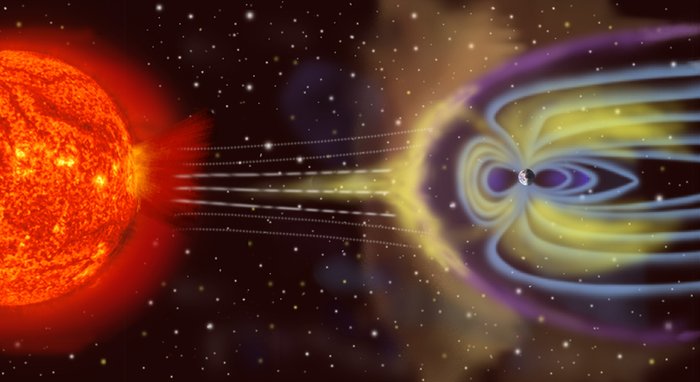
The magnetic fields on the sun’s surface can become twisted, leading to tension being released explosively in the form of solar flares and coronal mass ejections. The vast amounts of electromagnetic energy and solar particles ejected from the sun’s surface lead to powerful solar winds and violent storms in space.
“Think of it as like a huge, great big explosion on the sun and it throws off into space billions of tonnes of charged particles, mostly electrons and protons. And they go out into space and they take with it some of the solar magnetic field.”
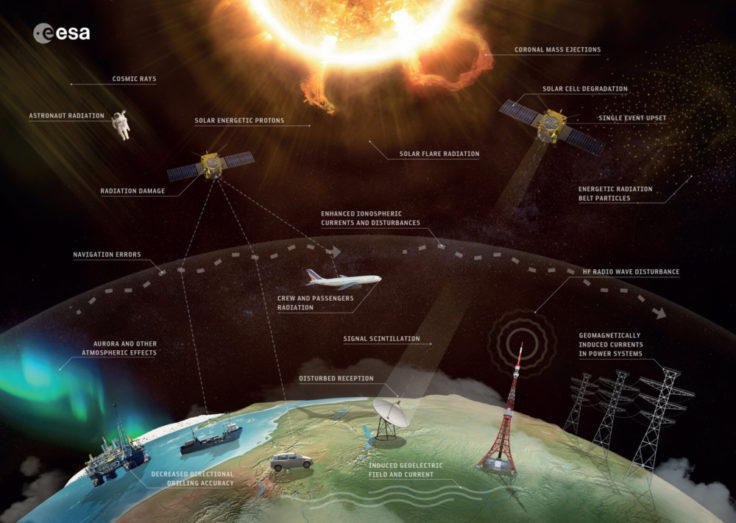
Space weather can have very real consequences, with the UK government describing severe space weather as ‘a rare event that could have significant impact to infrastructure and vital services, leading to both economic and social impacts’ in a recent report. But what does this have to do with polar science?
(Magnetic) poles apart
“When we have a coronal mass ejection and it comes in the direction of the Earth, it sees the Earth’s magnetic field as an obstacle. It tends to try and flow around it. But in some cases, the magnetic field in planetary space, originating on the sun, can connect to the Earth’s magnetic field and then tear it open, rip it open, particularly over the polar regions, and distort the Earth’s magnetic field.”
The poles are uniquely exposed to space weather because Earth’s magnetic field lines converge there, pointing almost directly downward. “Earth’s magnetic field acts like a giant funnel,” says Richard, guiding charged particles from space into the upper atmosphere above the polar regions. As a result, the Arctic and Antarctic are among the best places in the world to observe and study the impacts of space weather.
Antarctica especially presents a unique set of conditions for both observing and experiencing the impact of space weather.
“There’s a weakness (above Antarctica) in the Earth’s magnetic field. And as a result of that, charged particles can penetrate deeper into the atmosphere in the Antarctic than they can in the north, and that affects satellites which orbit through those regions. It causes additional radiation damage – and that can be significant.”
Technology under threat
Solar storms have always impacted Earth – and we find records of them present in unexpected archives, including tree rings.
“Carbon gets absorbed by wood trees from many years ago. And by looking at that, you can do things like radiocarbon dating and look for the signatures of those isotopes and the amount of them in different years. You can work back and work out that there was a huge great big solar storm, a radiation storm back in 660 BC. Ten times bigger, estimated by some of our Japanese colleagues, than anything we’ve seen in modern history.”
However, what has changed is the risks they pose, and Richard’s research has real-world consequences.
“Our modern way of life is so dependent. I mean, everyone’s got a mobile phone, right?”
Solar storms can damage satellites, disrupt GPS and other communications, interfere with aviation, and even threaten national power supplies. The latter is one of the greatest concerns at a national level.
“The power grid is perhaps the most important thing for the government. Everybody relies on power supplies.”
As our world becomes increasingly dependent on technology, understanding and forecasting space weather has never been more important. Richard and his colleagues’ research is key to this.
“When’s it going to be okay to carry on as normal? To do that, we think we need space measurements.”
As it stands, our advanced warning time of the arrival of a solar storm has an error of 13 hours – meaning there may only be a narrow window of time before a storm hits and a warning being issued to stakeholders.
“Our ability to predict the time of arrival is very poor. So we’ve got to improve upon that. That’s a kind of science problem, but it’s also an operational problem. But it gives us a steer. We learned from that and now we can give the scientific community a steer of where to focus effort.”
“All mitigation depends upon accurate warning.”
In the UK, the Met Office provides warnings of incoming solar storms, and Richard and his colleagues work closely with them to increase national preparedness.
“It’s the state of readiness. There are things people can do. For example, on a spacecraft, you’re going to delay an orbit manoeuvre. And we have had examples in the past where when the satellite operators had a forecast of a storm going to hit, they’ve brought forward a manoeuvre. They’ve taken the spacecraft out of its slot because they’ve got another one coming in. So if they want to fire thrusters and do anything like that, they want to do it in a period of low risk. They don’t want to do anything when anything is disrupted”.
“You can warn your customers that the signals that they are relying on may be at risk for certain periods of time.”
Previously, Richard has been involved with government-level scenario planning, where he runs through action plans for future severe solar storms.
“At this time, what would you be doing? And myself and some of my colleagues as scientists would be actually saying, okay, have you thought of this? Have you thought this could happen, that could happen? Have you taken that into account? Are you aware of this?”
“Hopefully, we don’t have one of these great big things, but if we do, then we at least become more prepared than we ever have been.”
The future of space weather
As we grow to rely more and more on technology as a society, we become increasingly susceptible to the risks posed by solar storms. In order to predict these events, we must first understand them, and to understand, we need measurements of what is actually happening in the space around our planet – but right now, these are lacking.
“We need measurements of the right stuff in the right place. And we haven’t got those at the moment.”
Richard stresses the importance of collaboration in order to achieve this.
“The scientists, we also need to work with the guys in the companies as well as the agencies to try and assess what that impact would be. That’s about working together, and that can also be a little difficult because not everybody really wants to share their data and so it’s confidential and so on. But what’s really important is to build trust with those guys, not just in government, but also with the companies.”
Alongside space weather itself, Richard notes that there are other compounding challenges on the horizon, products of advances in the growing field of space technology.
“I would say the number of satellites being launched into low Earth orbit and the risk of those colliding and then creating more debris and going into a Kessler syndrome – we might render some orbit altitudes unusable. I think that’s a real and growing risk and I think we’ve really got to address that more. And I think that’s really about regulation to some extent, space traffic management.”
The idea of traffic jams in space is a strange one, but it’s a reality currently approaching us – June alone saw an additional 304 objects added to the US Satellite Catalogue. Richard leaves us with a final note on the importance of further research into space weather and technology.
“How do the regulators know what’s safe? They need support. They need models. They need analysis. And that’s something the scientific community can provide to them.”
________________________________________________________________________
The Department for Science, Innovation and Technology released a report on the UK’s resilience to severe space weather in March 2026, which you can read here.
This was our final episode of Beyond the Ice, but a new podcast from British Antarctic Survey is coming in the autumn. What topics would you like to see covered by polar science experts on future podcasts? Let us know your thoughts on future editions in the comments.
________________________________________________________________________
Professor Richard Horne FRS is a distinguished research scientist at the British Antarctic Survey and Honorary Professor at the University of Sheffield. He is Chair of the Space Environment Impacts Expert Group which provides advice on space weather to the UK Cabinet Office.