
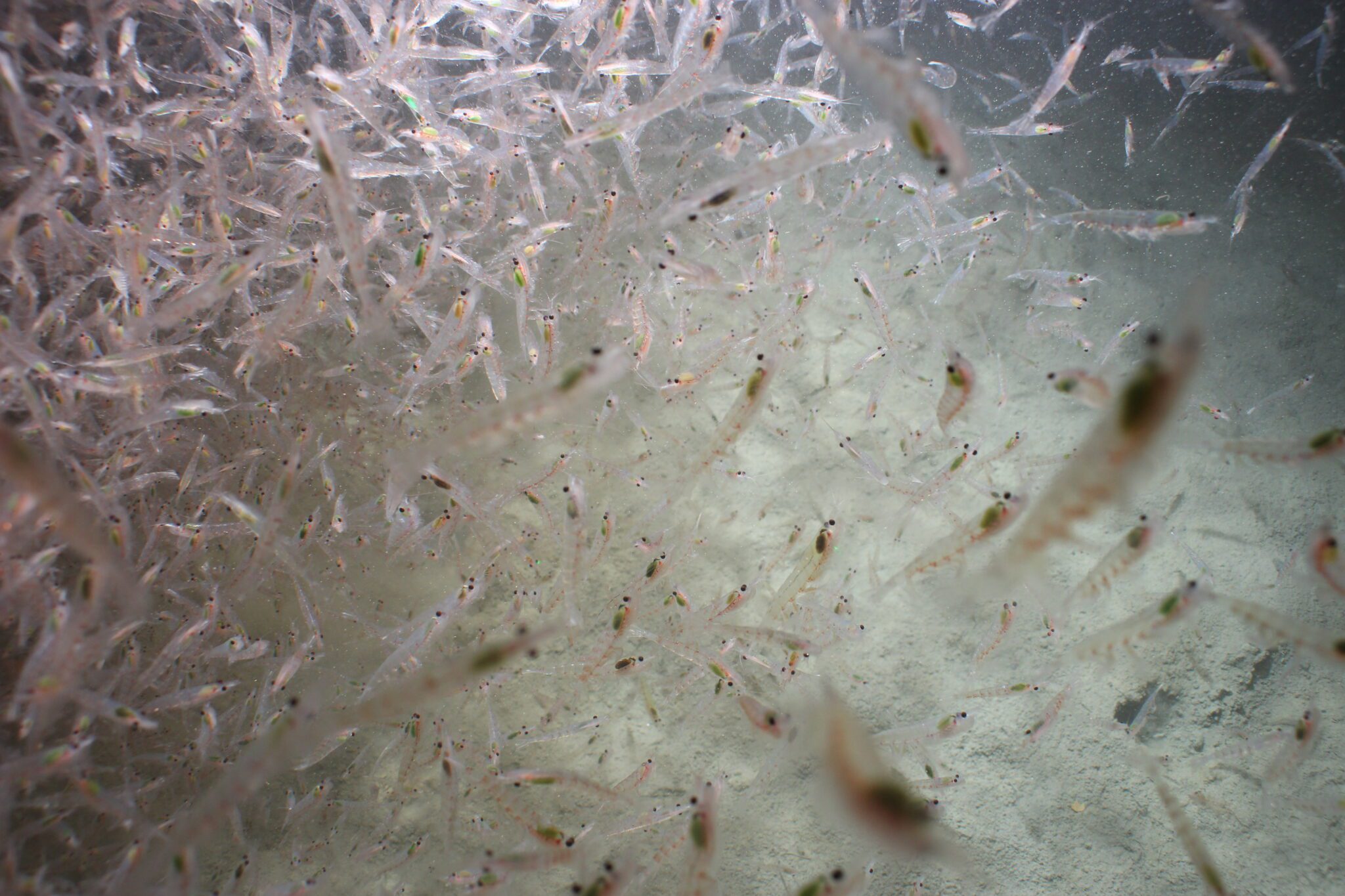
Antarctic krill are no bigger than your thumb, yet whales, seals and penguins depend on them, they help move carbon into the deep ocean and are increasingly targeted by the fishing industry. As international negotiators gather in Hobart this month to decide how the Southern Ocean is managed, three British Antarctic Survey (BAS) scientists explain why krill are important and how UK science helps inform the decisions that shape their future.
Late at night on a research ship in the Southern Ocean, Dr Martin Collins likes to turn out the lights. The net has just come up full of krill. Before they go into sample jars, he keeps a few alive in a bucket of seawater and carries it into a room with no windows. Once it is completely dark, he gives the bucket a nudge. The water fills with tiny points of blue light.
“They bio-luminesce,” says Martin, a marine ecologist at at BAS, and the UK Scientific Representative to Convention on the Conservation of Antarctic Marine Living Resources (CCAMLR). “So they produce their own light. I’ve seen it many times, but it’s always quite cool to show new people.”
Scientists think the glow helps krill signal to their neighbours and keep a swarm together. It is one of many things about these animals that surprise people. The biggest surprise is how many of them there are.
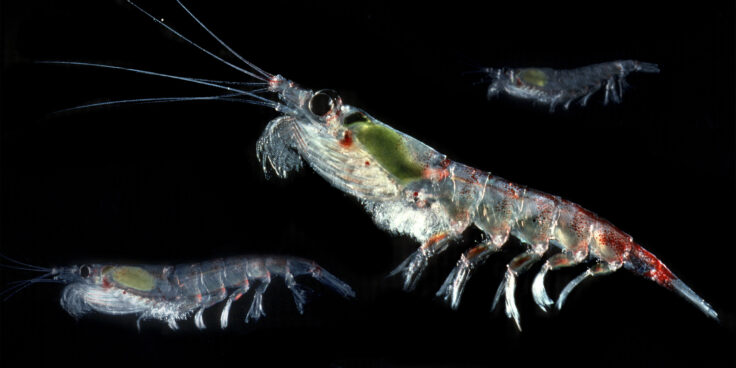
Antarctic krill are shrimp-like crustaceans. They grow to about 6cm long, live for up to six years in the wild and are found only in the Southern Ocean around Antarctica. There are thought to be around 800 trillion of them, roughly 100,000 for every person on Earth.
“One of the most astonishing things about them is their massive biomass,” says Dr Simeon Hill, a marine and fishery ecologist who has studied krill at BAS for 23 years.
Biomass is the combined weight of every animal in a species. Put every Antarctic krill on one giant scale and they would probably weigh about the same as the entire human population.
That abundance is why so much Antarctic life depends on them. Krill graze on phytoplankton, the microscopic algae that bloom in the sunlit surface of the sea. In turn, krill are dinner for almost 200 species, including whales, seals, penguins, seabirds, fish and squid. Antarctic blue whales eat almost nothing else, while the vast numbers of fish in the Southern Ocean may consume more krill than all the other predators combined.
Krill are often called a “keystone species”. Simeon would rather they weren’t. A keystone is the small stone at the top of an arch: only a tiny part of the structure, but the part that holds it up. Krill are the opposite of rare. “They are in fact a foundational species” he says. Take them away and the Southern Ocean would support far less wildlife.
An ocean that turns pink
Dr Sophie Fielding has worked at BAS for 21 years and has gone to sea looking for krill in almost every one of them. She calls herself ‘a glorified fisherman’. In practice, she manages a BAS long-term survey at the western end of South Georgia that has repeatedly measured the same marine ecosystem since 1996.
“I often feel quite sorry for krill. They’re eaten by everything,” Sophie reflects.
Most of the time, she finds her quarry with sound. Echo sounders mounted beneath a research ship send pulses down into the water. Different organisms return those sounds differently. “It’s very much like shouting on a hillside and hearing the echo come back from a hard cliff face,” she explains.
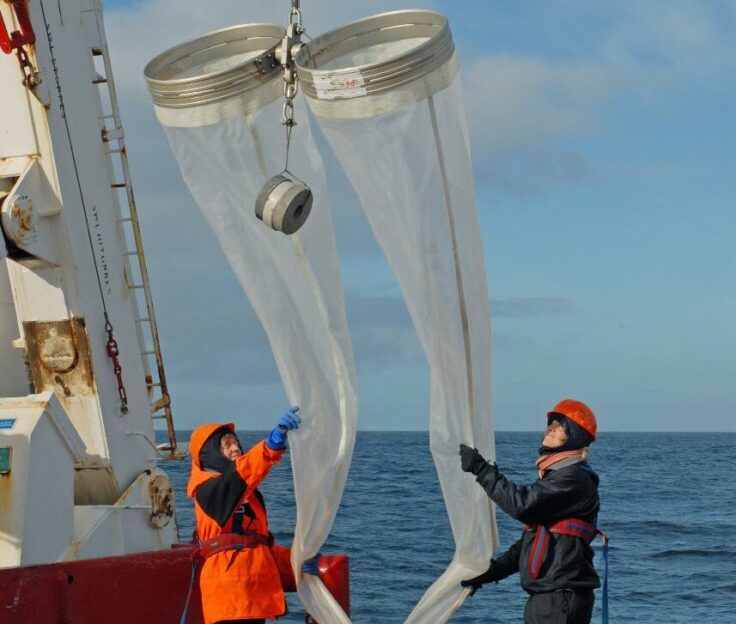
The time the echo takes to return tells her how deep the animals are. How loud it is tells her how many there are. Comparing echoes at different frequencies helps her tell a krill swarm from a shoal of fish. Alongside this, nets provide the vital reality check – bringing samples aboard so scientists can measure the animals and confirm what the instruments have detected.
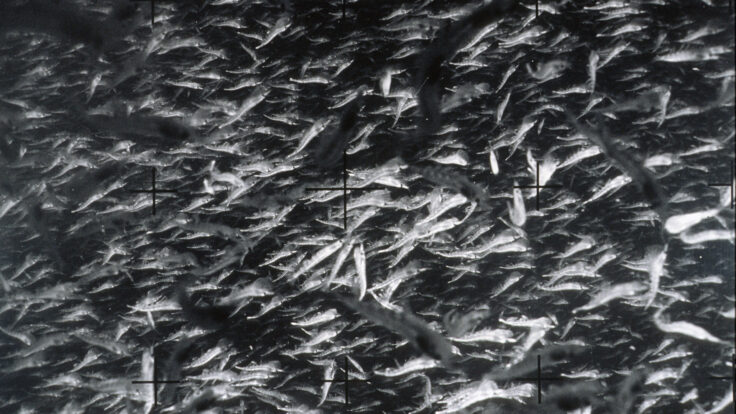
Occasionally, no instrument is needed. When a dense swarm rises close to the surface, the sheer number of animals can give the sea a reddish-pink hue.
It is an observation with roots stretching back a century. In the early 20th century, scientists on the Discovery Investigations, the first big study of the Southern Ocean’s whales and the krill they ate, climbed into ships’ crow’s nests and sketched surface swarms on graph paper. Those drawings still sit in the archives of the National Oceanography Centre in Southampton.
Today, scientists are investigating whether the same pink patches can be detected from satellites. The swarms can be immense. The largest Sophie has seen in her data stretched for around seven kilometres.
“We’re going from somebody sitting in a crow’s nest looking at the ocean to potentially looking at krill from space,” says Sophie.
Technology on the RRS Sir David Attenborough ship now lets scientists watch a swarm enter a sampling net in real time. Once Sophie spots a target on the echo sounder, the bridge turns the ship back towards the precise place where it was detected. The manoeuvre has to be so exact that the team eventually adopted the nautical term for returning a vessel to where a person has fallen overboard: a Williamson turn.
Being 50 metres out can mean missing the swarm altogether. With a camera mounted on the net, Sophie can open it for as little as 30 seconds to a minute and collect perhaps 1,000 or 2,000 krill – enough for measurements without crushing the delicate animals together at the bottom of the net.
This is part of a survey BAS has carried out in the same stretch of ocean off western South Georgia since 1996. It is the longest-running timeseries of Antarctic krill biomass in the Southern Ocean and it lets scientists see how krill numbers rise and fall over decades rather than in single snapshots.
Krill and the climate
Krill also help keep carbon out of the atmosphere. Phytoplankton take in carbon dioxide as they grow. Krill eat them and their faecal pellets sink much faster than dead phytoplankton would on their own. Carbon that sinks deep enough can stay out of the atmosphere for a century or more.
A 2024 study co-authored by Simeon estimated that krill pellets send about 20 million tonnes of carbon into deep water this way every year. That is similar to the amount stored each year by all the world’s mangrove forests. He explains:
They’re shunting this carbon-rich material out of the surface and into the deep ocean. People are increasingly recognising that krill play an important role in climate regulation through that mechanism.”
Krill are also feeling the effects of a warming ocean. They are a cold-water species and data from the southwest Atlantic suggest their population has shifted south. How well they cope will depend on how adaptable they are and scientists are discovering they’re an unpredictable bunch.
“In some ways they’re an infuriating organism,” confirms Simeon. “We can start to make generalisations about how they live their lives and then you get new observations and find them in a slightly different place doing something completely different.”
Whale blow in the dark
For Martin, the clearest reminder of how tightly the system is connected came at South Georgia in winter. South Georgia is a UK Overseas Territory. It allows krill fishing only in winter, to protect penguins and fur seals while they breed in summer. But BAS knew little about the ecosystem in winter, because its ships had mostly worked there in summer. So Martin set up a project to find out, working from the South Georgia Government vessel Pharos SG with a net just one metre square.
On two or three nights, with the net over the back deck, the team heard whales surfacing all around them. Martin remembers the close encounters:
“You’d hear the whale blow, and you’d probably get covered in a bit of whale blow if you weren’t careful. The whales were that close, feeding on the same krill that our small net was catching.”
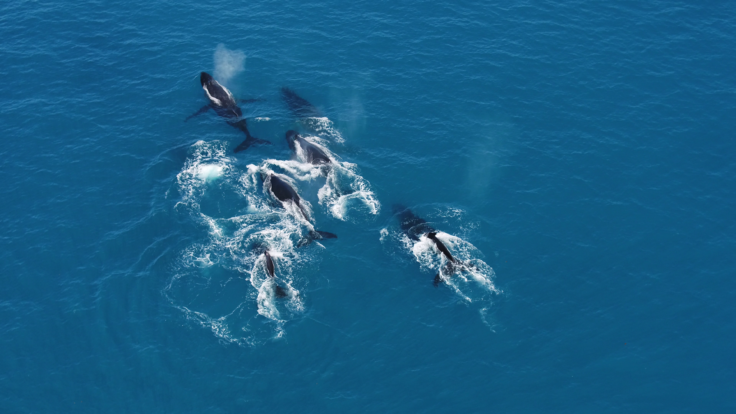
The winter work turned up a surprise. Scientists had long assumed that young krill need sea ice to survive the winter. The team found large numbers of larval krill that, when traced back, had not come from sea ice at all.
The fishing question
Whales, seals and penguins are not the only ones after krill. People have fished for them since the 1960s. Today most of the catch is ground into feed for farmed fish such as salmon or turned into omega-3 oil for supplements and pet food. Few people eat krill directly, though Sophie has tried them:
“Raw, they mainly taste salty. Cooked, they’re a lot nicer, more towards the shrimp that we normally eat.“
Fishing in the Southern Ocean is legal. It is managed under the Convention on the Conservation of Antarctic Marine Living Resources (CCAMLR), which defines conservation as including “rational use”. The scientists’ job is to help fishing and conservation work together.
On one measure, the krill fishery is very well run. It takes far less than 1% of the krill available, where many fisheries elsewhere take 20 or 30% of a stock. The harder question is where and when those catches are taken. Krill gather in predictable places. Penguins build their colonies near those places, whales swim thousands of miles to reach them, and fishing vessels head there too.
Take a large share of the catch close to a penguin colony while the adults are feeding chicks and the local harm could be serious, however small the total catch.
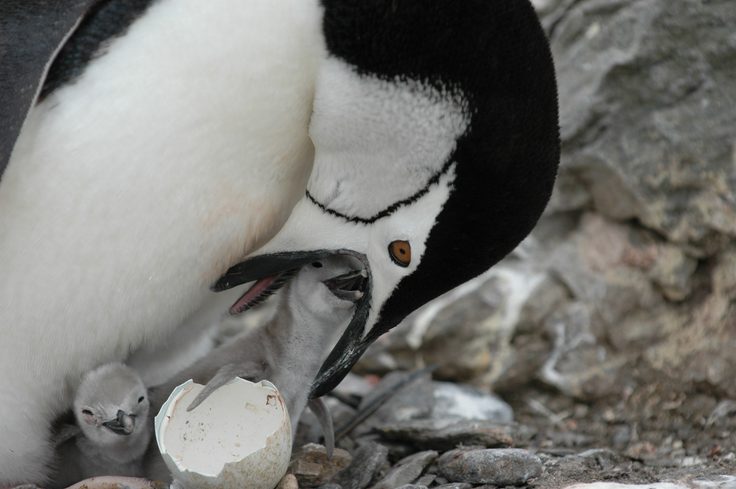
In the southwest Atlantic, where almost all krill fishing now happens, the annual catch is capped at 620,000 tonnes. In 2025, the fishery reached that limit for the first time and closed on 1 August. This year it closed on 12 August, months before the season was due to end.
Modern vessels trawl continuously, pumping krill on board from a net that can stay in the water for up to two weeks. They can catch about 800 tonnes a day, compared with around 200 tonnes using traditional methods. And in 2024, CCAMLR members could not agree to renew a rule that shared the catch between four areas. Since then, fishing has become concentrated in three places: the Gerlache and Bransfield Straits, both off the Antarctic Peninsula, in winter and the waters around the South Orkney Islands in summer.
“I think most scientists would agree that the 620,000 tonne catch limit, per se, is not a problem,” says Martin. “The concern we have is when that catch becomes concentrated. That’s when we can potentially see ecosystem impacts.”
If there’s a problem with having catch concentrated in particular locations, then one solution might be to spread it out. The hard part is finding a scientifically based way of doing it that every member of CCAMLR can agree to.
From the Southern Ocean to the negotiating table
That agreement has to be reached in Hobart, Tasmania, where CCAMLR has its headquarters.
CCAMLR came into force in 1982 as part of the Antarctic Treaty System, set up in response to rising krill catches. Martin is the UK scientific representative. He and his team take BAS evidence from field stations, research ships, long-term monitoring programmes and ecosystem models into an international process where 26 member states and the European Union must reach decisions by consensus. At the subsequent Commission meeting, they sit alongside Foreign, Commonwealth & Development Office colleagues providing scientific advice.
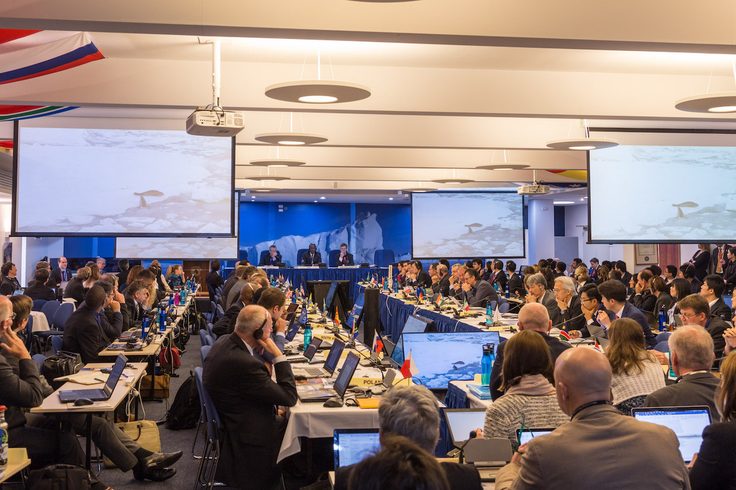
The discussions can be painstaking. Scientific papers may be debated, refined and returned to the table a year later. Delegates have different priorities and agreement can depend as much on careful negotiation as on presenting the evidence.
BAS has been supplying evidence to this process for decades.
Before CCAMLR even existed, BAS scientists including John Croxall and Inigo Everson helped develop the scientific case for managing fisheries in the context of the wider Antarctic ecosystem. BAS researchers subsequently helped establish the CCAMLR Ecosystem Monitoring Programme, bringing together long-term observations of penguins, seals and other species. BAS science also contributed to international work that dramatically reduced deaths of albatrosses and other seabirds caught accidentally by longline fisheries.
Today, those long records are being analysed to distinguish the effects of fishing from the natural swings between good and bad krill years and the growing influence of climate change. BAS monitoring at South Georgia and the South Orkney Islands, combined with modelling, is also feeding directly into attempts to develop the next approach to managing the krill fishery.
Satellites, gliders and autonomous vehicles promise a richer view of the Southern Ocean, but they still need to be tested against observations built up over decades and interpreted by people who understand the system.
Passionate about krill
There is still plenty scientists do not know about krill, including which spawning areas matter most, how consistently they are used from year to year and how populations will respond as the Southern Ocean changes. That uncertainty cannot be a reason to wait, says Martin:
“We need to make some sensible precautionary management decisions right now, while we carry on collecting the necessary science as well.”
That is why long-term BAS science is so important. Decades of publicly funded research have built the evidence and expertise needed to understand change in the Southern Ocean, inform international decisions and help protect an ecosystem with global importance.
And despite more than a century of research, krill still have the capacity to surprise – part of their appeal to scientists. “You could say I am now passionate about krill,” admits Simeon, who never set out to become a krill specialist.