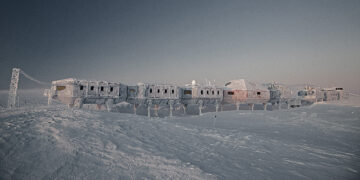
Head of Future Financial Strategy
BAS Science Strategy Executive Group, Leadership teams, BAS Executive team

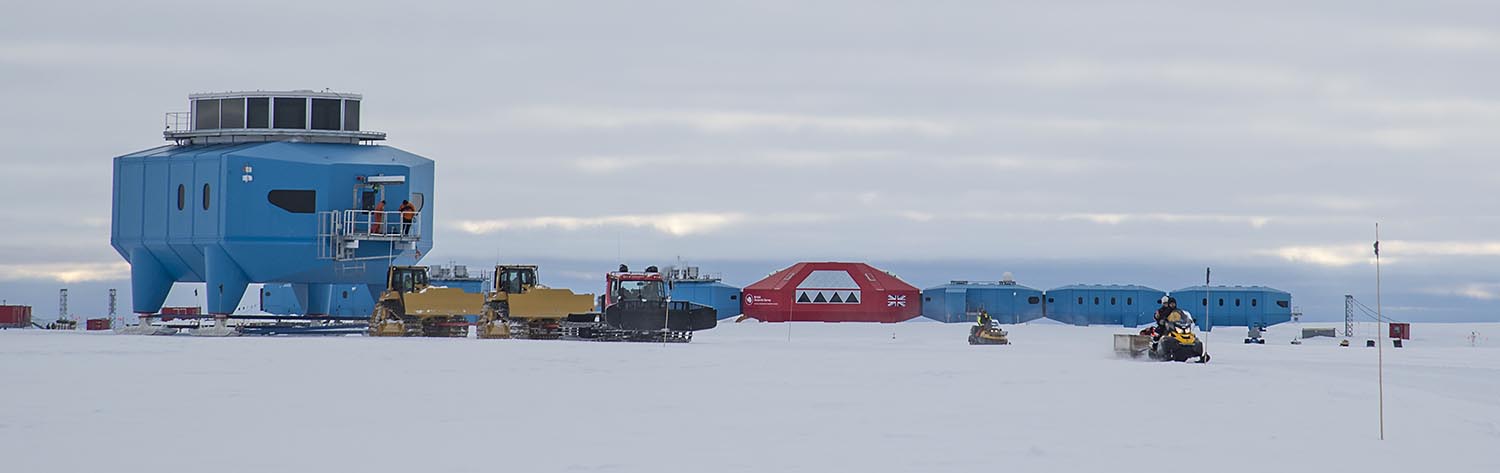
British Antarctic Survey relocated its Halley VI Research Station to a new site in the 2016/17 season.
The three-year operational project relocated Halley VI upstream of a previously dormant ice chasm that began to show signs of movement in 2012. The chasm could eventually cut the station off from the rest of the ice shelf. In 2015-16 austral summer a new location was identified and initial preparations for relocating began. During the 2016-17 summer season station modules were uncoupled and transported 23km across the ice. Completion is expected to be achieved in the 2017- 2018 season. The relocation of the station further upstream moves it away from the chasm and ensure Halley’s continued safe operation into the future.
As part of the relocation project, the Clean Air Sector Laboratory (CASLab) was moved to a new position during the 2018-18 field season. In 2018-19 the laboratory will be set up on its supporting legs and power and functionality restored to enable the tropospheric chemistry programme to resume. This research includes monitoring of a range of atmospheric pollutants and greenhouse gases, and process studies to understand naturally-produced reactive trace gases, including:
the first module leaves site 6 for site 6A
Halley VI is the first Antarctic research station to be designed specifically to cope primarily with the movement of the ice shelf towards the sea, as well as with the annual 1.5 m of snowfall and significant snowdrift. This was the first time that the station has been moved since it became operational in 2012.
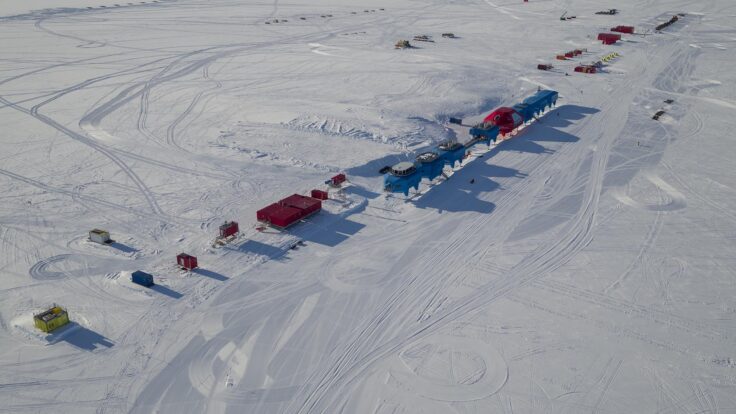
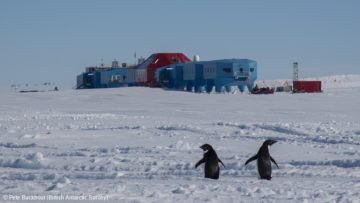
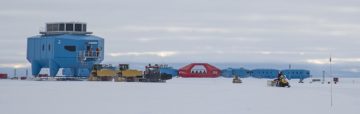
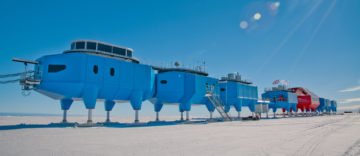
Halley VI, with the temporary camp towards the top right and winter science camp lower left.
The Halley VI Research Station is an internationally important platform for global earth, atmospheric and space weather observation in a climate sensitive zone (Antarctica).
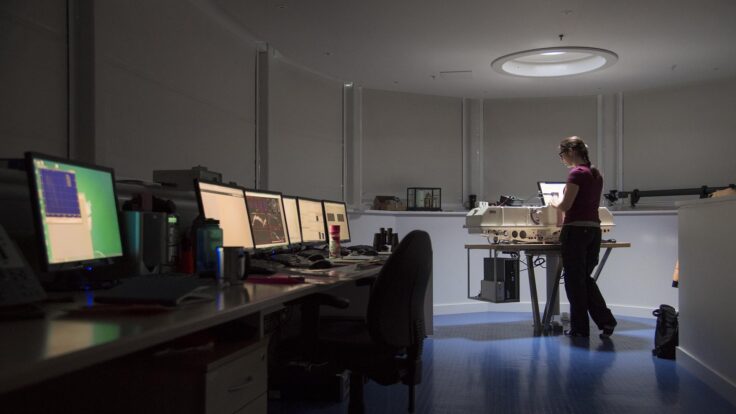
The Dobson, being used to measure atmospheric ozone at Halley VI
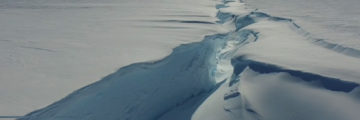
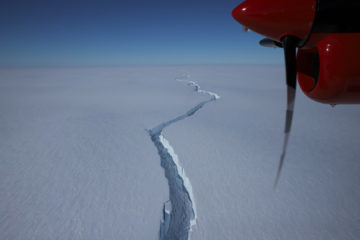
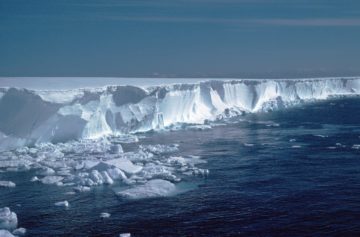
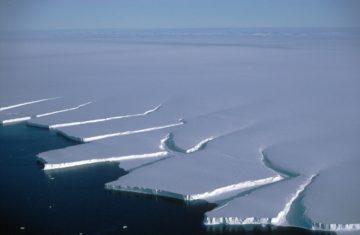
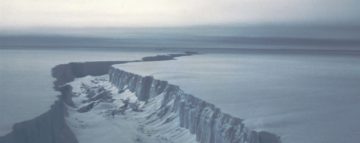
The Brunt Ice Shelf is the floating extension of the grounded ice sheet. It is composed of freshwater ice that originally fell as snow, either in situ or inland and brought to the ice shelf by glaciers. Cracks appear continuously on ice shelves as the ice deforms. Frequently, cracks that form during the summer months heal again over winter. At Halley a long-term ice-monitoring project, that uses satellite and radar data, detected new growth in a chasm that has been dormant for around 30 years.
Observations reveal that this particular chasm has been growing continuously for over two years. The crack tip is moving gradually upstream of the station. Scientists estimate that if it continues to grow at its current rate it will take several years to cut Halley VI off from the portion of the ice shelf that is further inland.
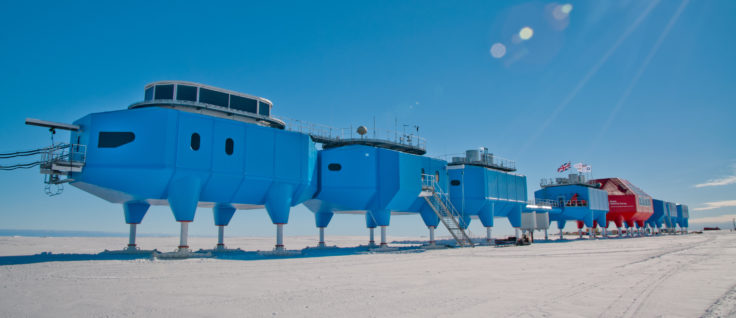
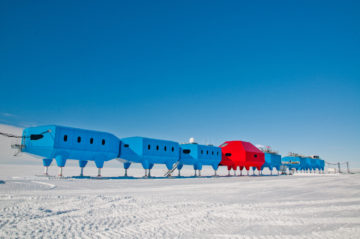
Halley Research Station upon completion at site 6
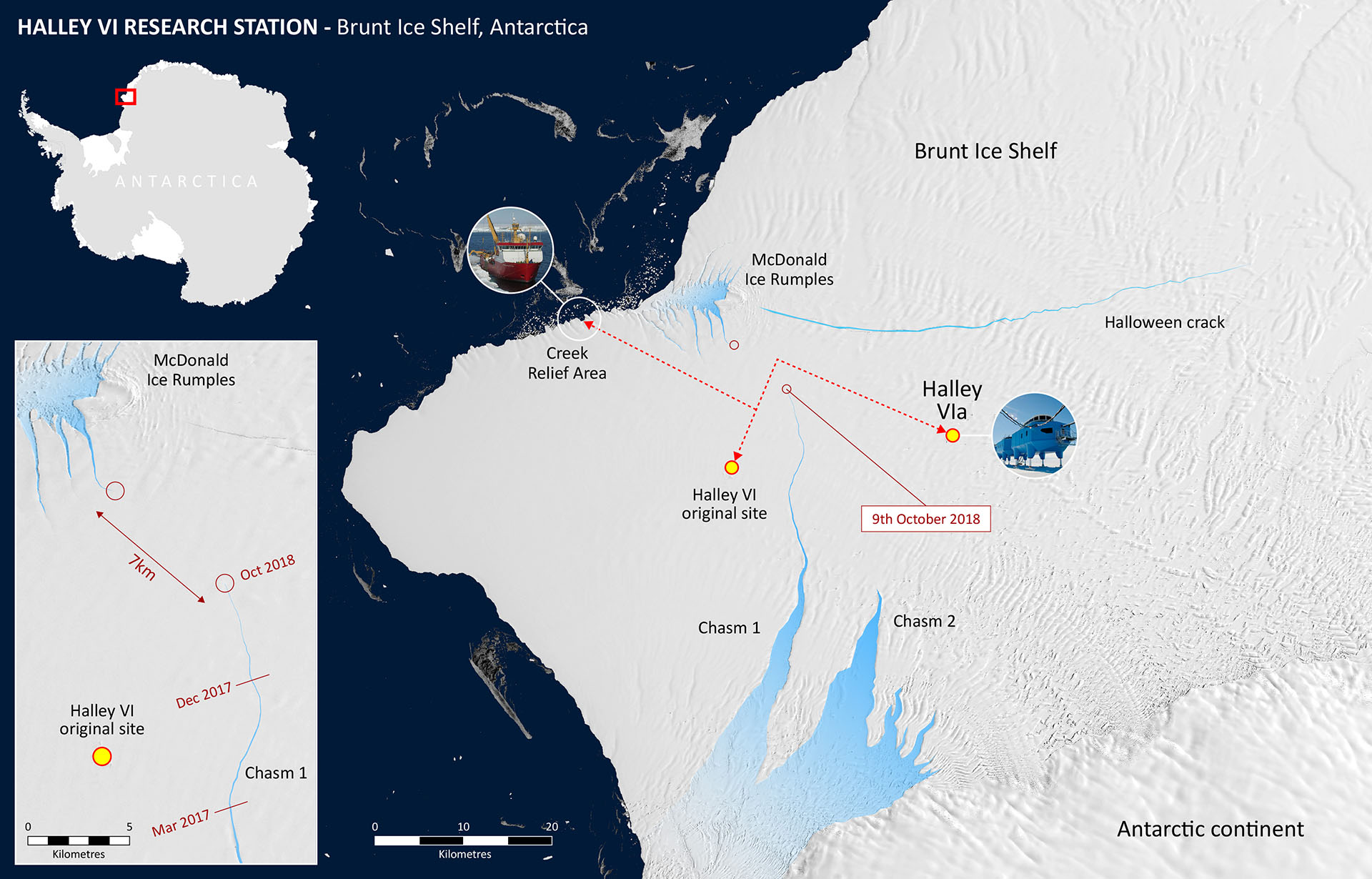
Brunt Ice Shelf, Antarctica
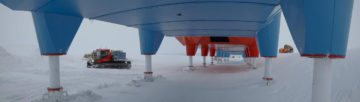
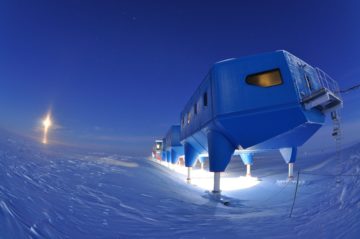
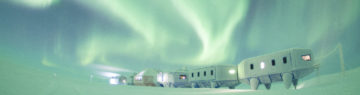
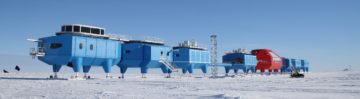
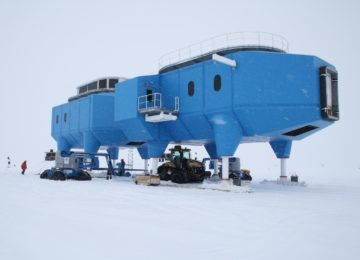
Halley VI is made up of a series of eight pods (like the carriages of a train) that can be disconnected. The individual pods – which sit on skis – can be uncoupled and towed across the ice using specialist heavy vehicles.
The station was designed and built to provide excellent laboratory and living accommodation that is capable of withstanding extreme winter weather, of being raised sufficiently to stay above metres of annual snowfall, and of being relocated upstream periodically to avoid calving events as the floating ice shelf moves towards the sea.

The first module (H2 Science) to move to the new 6A site, being relocated by two bulldozers and one piston bully.
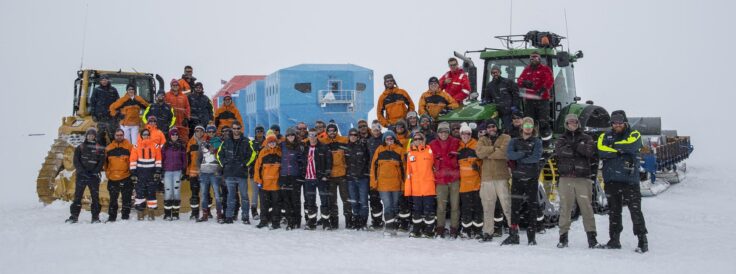
Halley VI Relocation Team Christmas 2016
2015/16 Operations and logistics preparations including scientific survey for the selection of the most appropriate new location
2016/17 Station modules will be moved to new location.
2017/18 Science equipment and instruments will be moved to new location.
Head of Future Financial Strategy
BAS Science Strategy Executive Group, Leadership teams, BAS Executive team
Neil Brims is the Electrician at Halley VI Research Station. In our latest blog, find out what life is like at Halley and how it feels to live at the […]
This is Part 2 of a guest blog written by Ramboll engineer Ben Rowe, who was embedded with the British Antarctic Survey for 11 weeks to advise and assist with […]
This is Part 1 of a guest blog written by Ramboll engineer Ben Rowe, who was embedded with the British Antarctic Survey for 11 weeks to advise and assist with […]
Following the calving of the A-81 iceberg at the end of January 2023, the Brunt Ice Shelf is moving faster than before. It is currently moving approximately 4 metres a day towards the sea, whereas before the calving it moved at an average of between 1-2.5 metres a day.
A huge iceberg (1270 km²) the size of the county of Bedfordshire has broken off the 150-m thick Brunt Ice Shelf, almost a decade after scientists at British Antarctic Survey […]
Station opens for 2017 summer season
British Antarctic Survey (BAS) has decided, for safety reasons, that it will close its Halley VI Research Station during the 2018 Antarctic winter. This will be the second time that […]
British Antarctic Survey (BAS) has successfully relocated Halley VI Research Station to its new home on the Brunt Ice Shelf. Operational teams have spent the past 13 weeks moving each […]
British Antarctic Survey (BAS) has decided not to winter at Halley VI Research Station for safety reasons. The station, which is located on the floating Brunt Ice Shelf in Antarctica, […]
British Antarctic Survey is getting ready to move its Halley VI Research Station 23 km across the ice. This is the first time that the station, which has a re-locatable […]
New season tackles ambitious science and logistical challenges The British Antarctic Survey (BAS) 2015/16 field season is underway with dozens of scientists and support staff – together with planes and tonnes […]
Halley VI honoured for outstanding design and construction It’s been quite a week for Halley VI, picking up numerous Architizer A+ awards in New York and winning two more at […]
British Antarctic Survey’s Halley Research Station scoops two 2014 Civic Trust Awards British Antarctic Survey’s Halley Research Station received a 2014 Civic Trust Award and a Civic Trust Special Award […]
British Antarctic Survey’s Halley Research Station wins British Construction Industry Award 2013 British Antarctic Survey’s Halley Research Station won a prestigious British Construction Industry (BCI) International Award at a ceremony […]
New state-of-the-art Antarctic research station becomes fully operational this month Britain’s latest Antarctic Research Station becomes fully operational this month, signalling a new dawn for 21st Century polar research. Opening […]
A futuristic design by Faber Maunsell and Hugh Broughton Architects has won the competition for the new British Antarctic Survey (BAS) Halley Research Station. In a very close-run contest, three […]
Tension is mounting for three teams of architects and engineers who are competing for the design of the new British Antarctic Survey (BAS) Halley Research Station. The winning team will […]
Six concept designs, from teams short-listed in an international design competition to build a new research station in Antarctica, are unveiled today (Monday 15 November) at an exhibition at the […]
Six multi-disciplinary design teams are short-listed for an international competition to design a new scientific research station in Antarctica. The Halley VI competition attracted 86 entries in this unique project […]
Operational Note – Media Briefing 10.30 am 29 June 2004, Royal Institute of British Architects 66 Portland Place, London. A major international competition to design a new scientific research station […]
Halley Research Station is globally significant for observing the Earth, its atmosphere, and space weather.