Science Leader IMP 3


The Conservation and leadership in Southern Ocean ecosystems (CONSEC) project explores how the Southern Ocean is responding to climate change and human activity.
British Antarctic Survey (BAS) leads the project. CONSEC studies the links between biodiversity, ecosystem health, and the changing environment.
The team investigates how the marine food web is changing.
Warming seas, melting ice, ocean acidification, and fishing all affect ocean life. From plankton to penguins, seals, and whales, CONSEC reveals how these ecosystems work and how they are changing. The results guide conservation and policy across the region.
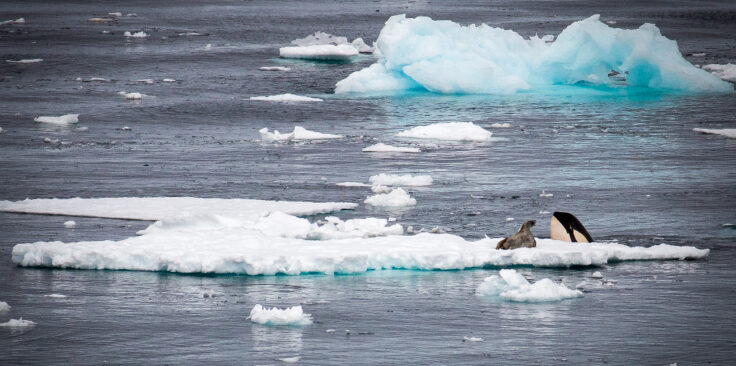
The Southern Ocean is one of the planet’s most important environments. It stores heat and carbon. It supports abundant wildlife. It helps stabilise the global climate. But it is changing fast.
Melting ice, shifting winds, and growing human pressure threaten species and habitats. These changes could trigger ecological tipping points. This means sudden, large-scale collapses in food webs. Once they happen, they are difficult or impossible to reverse.
Scientists need to understand these risks. This helps them protect ecosystems and support evidence-based conservation decisions.
CONSEC is a decade-long programme. It combines long-term monitoring, field research, and advanced modelling.
The team studies wildlife, ocean conditions, and ecosystem trends.
They focus on the south-west Atlantic sector of the Southern Ocean. This is one of its most productive regions. It includes waters around South Georgia, the South Orkneys, and the Antarctic Peninsula.
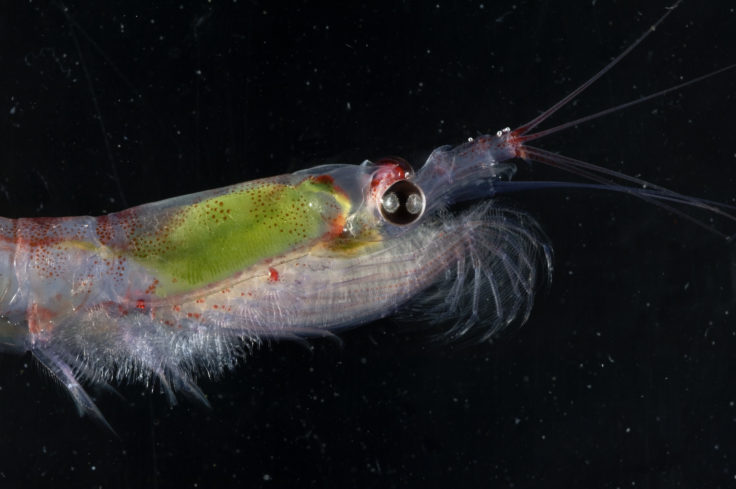
This region contains much of the world’s Antarctic krill population.
These tiny crustaceans form the foundation of the food web. They support large populations of krill-eating predators. They also play a crucial role in the ocean’s carbon pump. This natural process draws carbon from the atmosphere. It stores the carbon in the deep ocean for decades to centuries.
Researchers use ships, drones, and underwater instruments. These tools measure how species respond to change. The team also uses satellite data. They work with international partners to strengthen global conservation efforts.
The project contributes directly to managing Marine Protected Areas. These include areas in UK Overseas Territories such as South Georgia and the South Sandwich Islands.
The project aims to:
CONSEC is led by BAS scientists with partners in the UK and worldwide.
The project contributes to international organisations including:
CONSEC aims to identify suitable conservation and management measures based on long-term sustained observations and analysis across multiple trophic levels and adequate spatial scales.
The CONSEC programme focusses on regional ecosystems in the south-west Atlantic sector of the Southern Ocean, including the islands of South Georgia and the South Orkneys, where it undertakes long-term monitoring and targeted studies to provide information on how ecosystems are structured considering biodiversity, the life cycles of key species, food-webs and population dynamics.
It also considers crucial processes such as predator-prey interactions and the operation of the carbon pump.
Environmental stressors, including ocean warming, ocean acidification and plastic and chemical pollution, impact all these aspects of the ecosystem and are considered both in isolation and combined.
CONSEC is also developing models at regional and circumpolar scales to generate projections and provide clear information and recommendations for conservation and management decision-making.
CONSEC will deliver its aims through mutually interdependent worpackages and tools:-
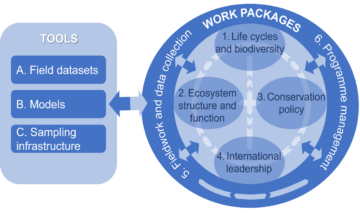
The four principal science workpackages are:-
The above are supported and overseen by two further work packages, dealing with collection of field samples and data and programme management, collectively managed by the Ecosystems Executive Group (EEG):
These work packages incorporate a number of Tools in order to meet their objectives, which can be summarised as follows:
Tool A Field datasets of sustained observations
Tool B Biophysical and ecosystem models
Tool C Sample collection infrastructure
The individual aims of the workpackages are as follows:
WP1 Quantifying life cycles, food-webs and biodiversity: to quantify the ecological and biological processes that affect the life histories and life cycles of key species in Southern Ocean ecosystems, and how these are affected by changes in the environment, including climate, pollutants, fisheries and other human stressors. This is fundamental to modelling population dynamics and food webs both now and into the future, as well as informing their conservation and management. Our focus is on Antarctic krill, other zooplankton (copepods, salps, pteropods, euphausiids), fish (myctophids, nototheniids) and higher predators (penguins, albatrosses, petrels, seal, whales), particularly species that are abundant and therefore are major prey or consumers, and others that are declining, or listed as threatened by IUCN (International Union for Conservation of Nature) and/or for which there is particular concern under international agreements (e.g. CCAMLR, ACAP, IWC; see below)
WP2 Determining ecosystem structure and their biogeochemical function: to understand the distribution of key species on seasonal and annual timescales, which is essential for considering how Southern Ocean ecosystems operate. Observations and biophysical models enable us to determine the influences of physical oceanographic and sea ice processes on the distributions of pelagic species such as Antarctic krill, while monitoring and habitat modelling of land-based predators allows us to generate quantified analyses of seasonal and interannual changes in their habitat. Together with knowledge of species-specific physiological optima and tolerance limits that affect the resilience of species to future environmental change , we can use these outputs to project potential changes in the distribution of key species, and hence to the Southern Ocean ecosystem, under varying environmental stressors. This is critical information for the development of conservation and sustainable management policies
WP3 Driving policy in conservation and sustainability in the Southern Ocean: to facilitate the provision of scientific advice to conservation and management bodies such as CCAMLR, ACAP and IWC. CONSEC scientists engage at a high level with these bodies, including preparing for meetings, writing papers and reviewing documents submitted by other members, contributing data and advice, and leading and engaging in extensive intersessional work programmes.
WP4 Providing international leadership in polar marine ecosystem research: to ensure the effectiveness of our research in terms of both increasing understanding of polar ecosystem process and influencing the agenda on ecosystem conservation and management. CONSEC scientists maintain both lead and contributory roles in numerous international programmes and initiatives. Collectively these efforts place us at the forefront of Southern Ocean and global ocean research, connecting this research with decision-makers and policy at both the Southern Ocean and global scale, and promoting Ecosystems and BAS science on the world stage.
WP5: Fieldwork, collection and analysis of samples and data: to carry out a wide range of sustained field and data collection activities that combine fieldwork on ships, research bases, autonomous data collection (i.e., oceanic moorings, gliders and sailbuoys, aerial drones and wildlife telemetry) and the collation of remote-sensing data.
WP6: Programme management: to coordinate and manage the programme to ensure it delivers its extensive remit and responsibilities to represent UK interests in Southern Ocean ecosystems, conservation and management in the international arena.
The full programme document can be downloaded here
Science Leader IMP 3
Zooplankton Ecologist
Ecological Modeller

Marine Ecologist
Marine Ecologist
Pelagic Ecologist
Seabird Ecologist Deputy Science Leader IMP 3
E Fellow
Marine Mammal Scientist
Ecosystem Scientist
Ecologist
Molecular Ecologist/Whale biologist
Signy Island Science Manager
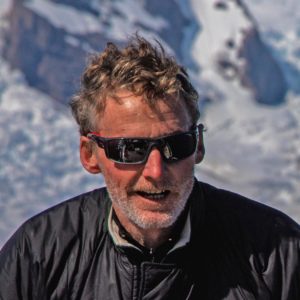
Marine Ecologist and UKs CCAMLR Scientific Rep

Marine Biogeographer
Ecologist
Data Analyst
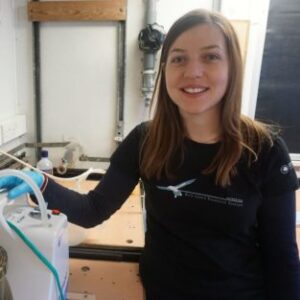
Marine Ecosystems Modeller
Ocean and Biophysical Modeller
Biological researchers have access to a suite of labs
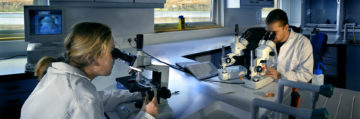
Analysing the diversity and responses of micro-organisms
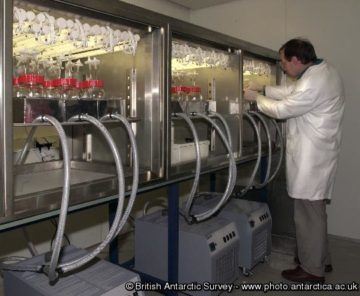
The weighbridge collects demographic, body mass and foraging frequency/duration data for Macaroni penguins on a daily basis throughout the breeding season.

Our state-of-the-art polar science ship provides scientists access to remote and challenging marine environments across the Antarctic and Arctic.
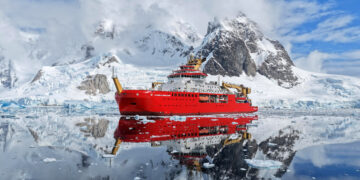
Scientific facilities and capability on the RRS Sir David Attenborough.
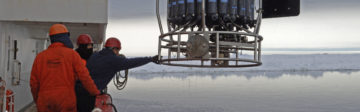
Technology and equipment for biological and geophysical studies
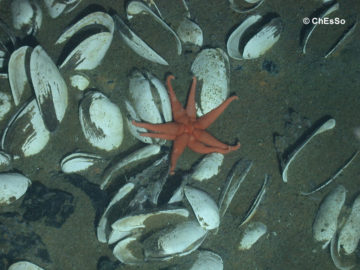
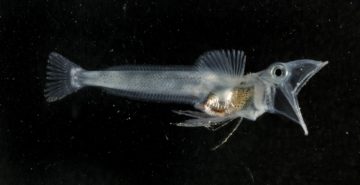
Interactions of ocean and atmosphere
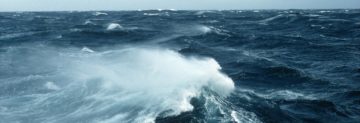
RRS Sir David Attenborough is the first British polar research vessel to feature a scientific moon pool.
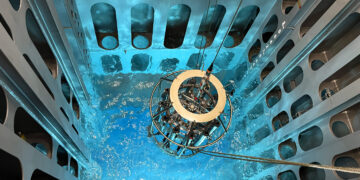
Innovative solutions to meet the changing needs of science
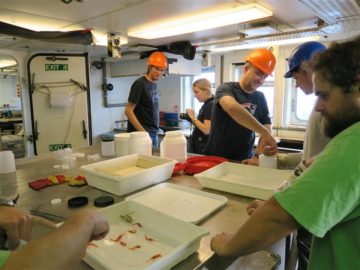
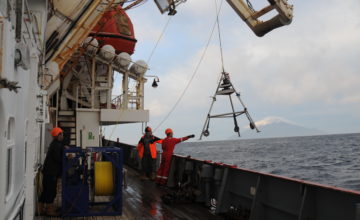
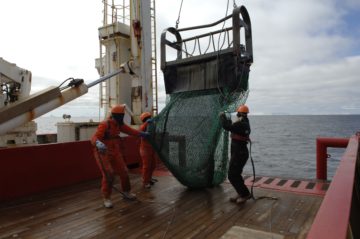
BAS owns a number of bespoke nets, trawls and sledges that can be deployed from the RRS Sir David Attenborough to sample ecosystems in the water column and on the seafloor.