Science Leader
BAS Science Strategy Executive Group, Space Weather and Atmosphere team

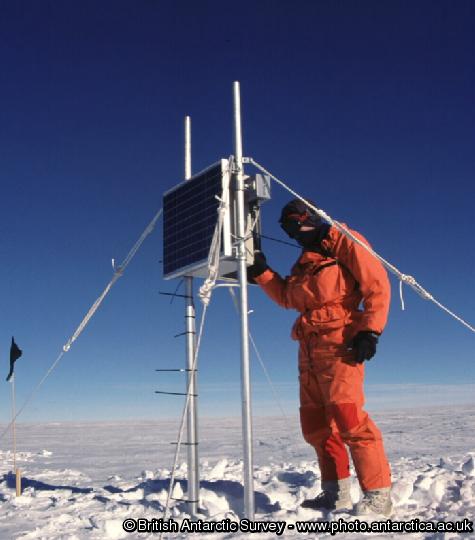
Search Coil Magnetometers (SCMs) are instruments designed to measure short-period fluctuations in the Earth’s magnetic field, alternating current (AC) variations, that typically occur over seconds to minutes (ultra-low frequency waves/geomagnetic micro pulsations). This isolates the wave-driven variations caused by electrical currents in the ionosphere and magnetosphere.
These waves are crucial to understanding the generation and movement of high-energy particles that can damage spacecraft and the precipitation of particles from space into the atmosphere, which can influence atmospheric chemistry and weather patterns.
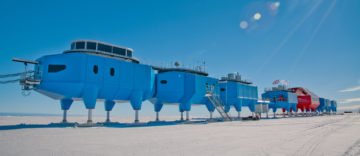
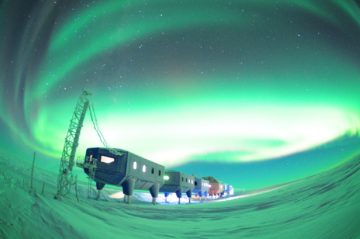
British Antarctic Survey operates SCMs at Rothera and Halley research stations, which are part of a global network coordinated by the Magnetosphere-Ionosphere Research Lab (MIRL) at the University of New Hampshire. This network spans both hemispheres, enabling global-scale analysis of space weather phenomena and magnetospheric dynamics.
The SCMs consists of, three (x, y, z) at Halley and two (x, y) at Rothera, orthogonal permeable core search coils and associated electronics.
At Rothera the SCM is housed in a wooden box aligned with the magnetic field that is exposed in the summer and buried with snow in the winter. This means it can experience some wind interference when it is exposed.
At Halley the SCM is buried in the ice.
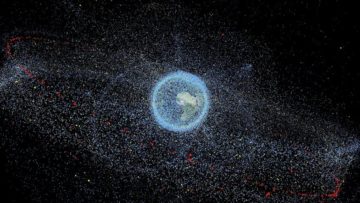
Joule Heating investigated how space weather affects the upper atmosphere’s ability to slow down orbiting satellite debris.
SPACESTORM is a collaborative project to model space weather events and find ways to mitigate their effects on satellites.

A ‘great’ space weather super-storm large enough to cause significant disruption to our electronic and networked systems occurred on average once in every 25 years. The results are published today […]
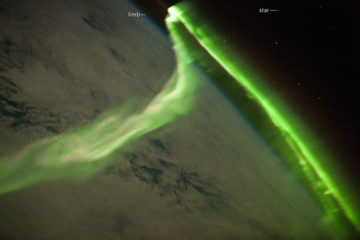
BBC Horizon documentary ‘Ice Station Antarctica’ to be broadcast on Wednesday 4 May at 8pm, BBC2.