
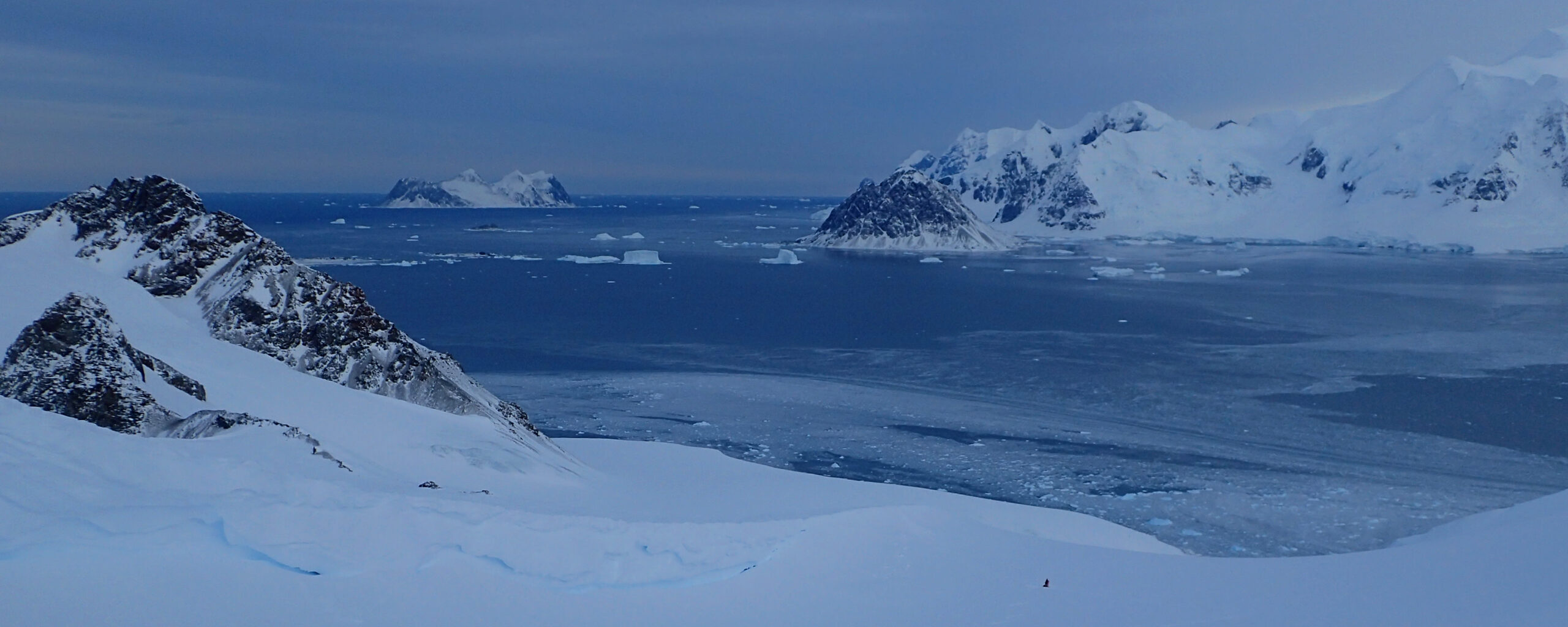
As extreme summer heat causes disruption across the UK and Europe this week, Midwinter at Antarctica’s Rothera Research Station is becoming increasingly unrecognisable.
Winter conditions at the UK’s largest research station on the Antarctic Peninsula are also no longer as cold as they once were. Long term records show that while temperatures usually average between -15 and -20°C, they are -2°C degrees this week. Earlier this month, Rothera experienced temperatures more typical of summer than winter, with rainfall and surface ice replacing the heavy snowfall normally expected alongside exceptionally low sea-ice levels.
Nearly 50 years of observations collected at Rothera reveal a clear shift in winter conditions. Preliminary analysis suggests June 2025 was the warmest June recorded since monitoring began in the late 1970s, and early indications suggest June 2026 could rank among the warmest on record as well.
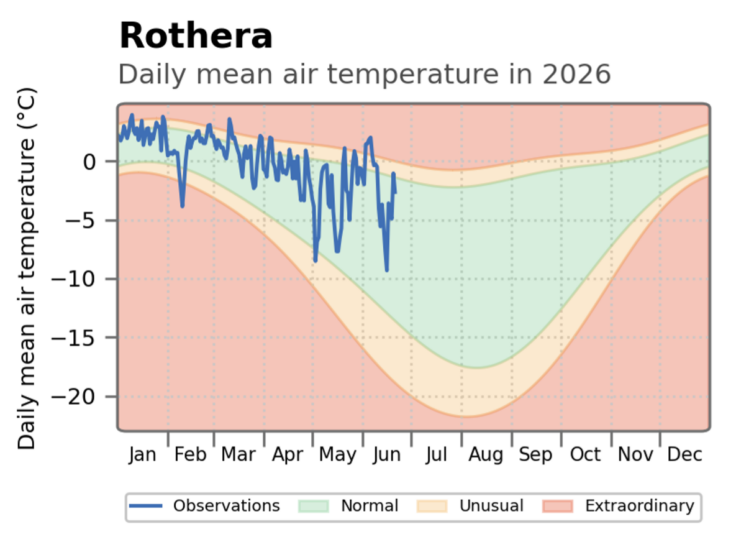
Rothera Research Station daily air temperature in 2026, relative to the 1981-2010 station climatology. Shading shows normal conditions between the 10th and 90th percentiles, unusual conditions between the 1st-10th and 90th-99th percentiles and extraordinary conditions below the 1st or above the 99th percentile. The observed 2026 daily temperatures are plotted as the overlaid line.
These observations are part of a bigger picture painted by a new rapid-analysis study published this week (23 June), contributed to by BAS scientists, which shows that this recent Antarctic Peninsula heatwave was amplified by human‑driven climate change. It underlines how extreme events, which are more likely and intense due to climate change, exacerbate impacts on an already warming system. The study was part of the ExtAnt project, led by British Antarctic Survey, on the impacts of extreme weather on Antarctica.
The changes extend beyond temperatures. Sea ice in the Bellingshausen Sea, west of the Antarctic Peninsula, has been declining for decades. This year marks the third time in the last four years that Rothera has had no sea ice present at midwinter. Across Antarctica, sea-ice extent has remained well below average in recent years.
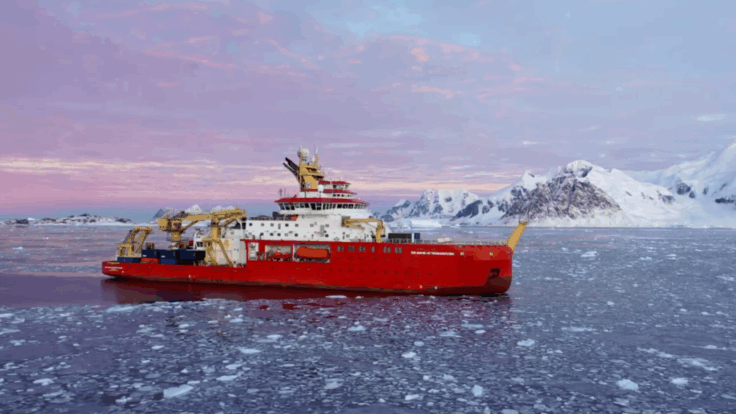
Scientists say the loss of sea ice has significant consequences. Sea ice acts as a buffer between the ocean and atmosphere, helping shield the Antarctic coastline from storms. When that protective barrier is reduced, warm, moisture-laden air from lower latitudes can more easily reach the continent, bringing rainfall, winter heatwaves, and accelerating the loss of snow and ice.
Dr Tracy Moffat-Griffin, head of the Atmosphere, Ice and Climate team at BAS says:
“While Antarctica remains one of the harshest environments on Earth, long-term records show that cold winter extremes around Rothera are becoming less common. Climate projections suggest this trend is likely to continue, with future winters characterised by fewer prolonged cold periods and more frequent warm events. It is an extremely worrying trend.”
Because Antarctic weather naturally varies from week to week, detecting long-term climate change requires decades of consistent observations. As BAS approaches 50 years of continuous weather monitoring at Rothera, the station’s records are becoming an increasingly valuable tool for understanding how the Antarctic Peninsula is responding to a warming climate and what those changes may mean for future scientific operations.
For scientists working at Rothera, the message is becoming clear: Antarctica’s winter is still formidable, but it is no longer as wintery and cold as it once was.
‘High temperatures over the Antarctic Peninsula in June 2026 strengthened by human-driven climate change‘ by Neven S. Fučkar, Davide Faranda, Ryan S. Williams, Thomas J. Bracegirdle, Steve Colwell & Yuiko Ichikawa is published by ClimaMeter, Institut Pierre Simon Laplace, CNRS (2026).
Briefing on conditions at Rothera Research Station prepared by Tracy Moffat-Griffin, Caroline Holmes, Thomas Caton Harrison, Thomas Bracegirdle and Michelle Maclennan.