
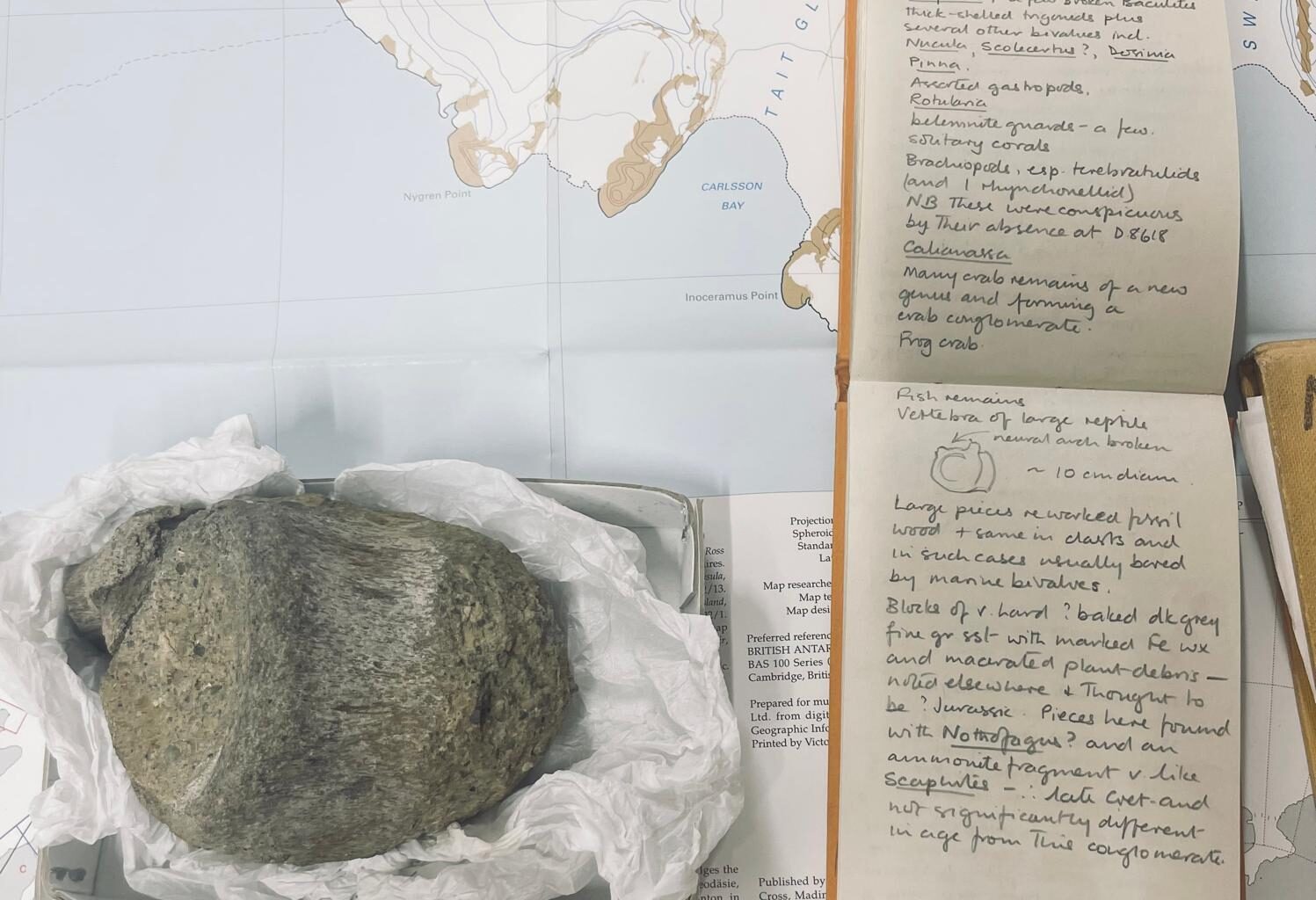
A bone collected by a British Antarctic Survey (BAS) geologist nearly 40 years ago has been formally described as the first dinosaur fossil ever found on the Antarctic continent.
The vertebra was discovered by Dr Mike Thomson, a BAS geologist, during a 1985 expedition to James Ross Island on the Antarctic Peninsula. The expedition’s aim was to map rock layers to help future geologists and palaeontologists date fossil finds across the region. At the time, Thomson recorded it as a large reptile but it has only now been formally identified as belonging to a dinosaur.
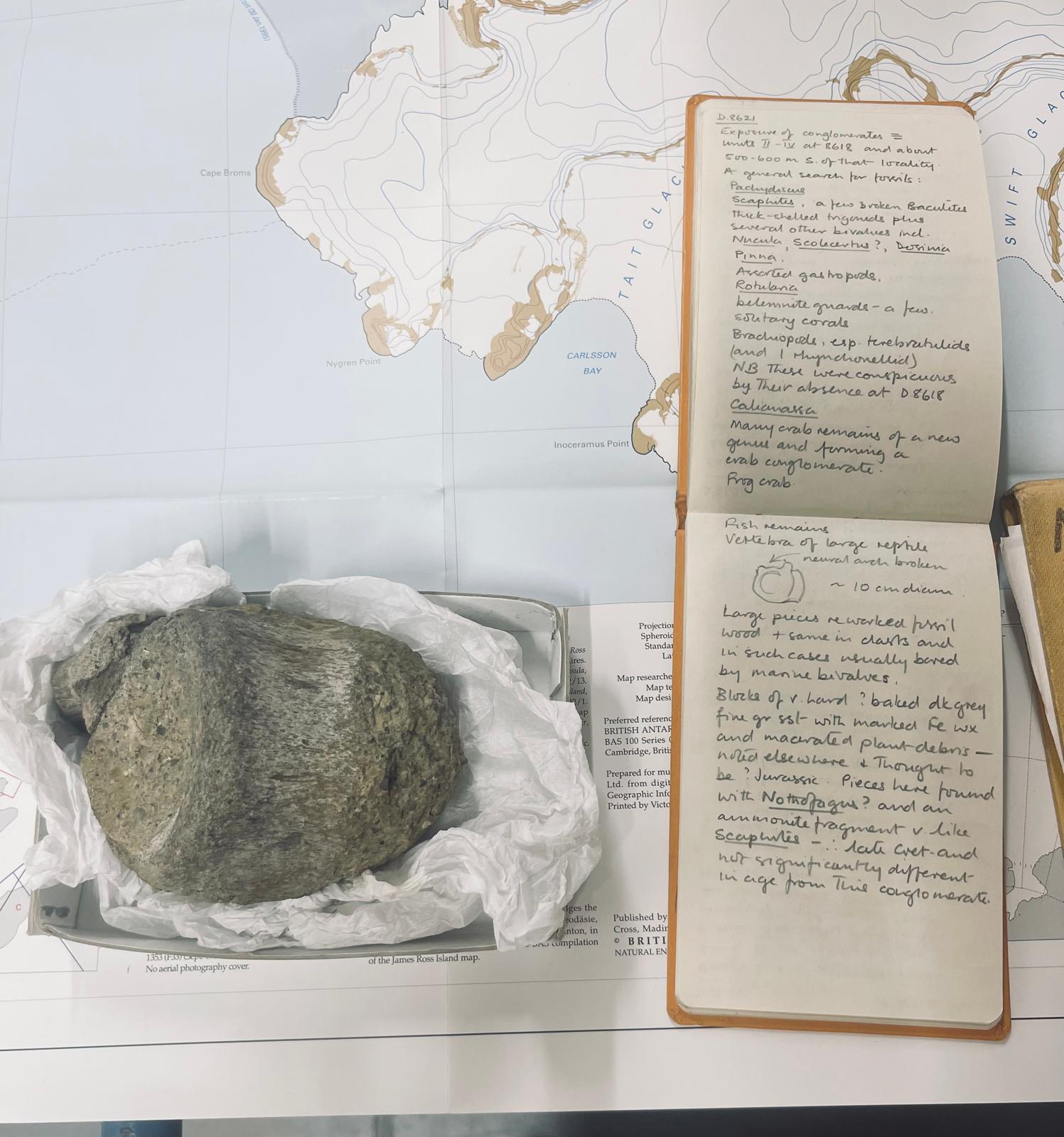
The 1985 geological field notebook belonging to Dr Mike Thomson, British Antarctic Survey next to the first ever dinosaur fossil vertebra found in Antarctica.
Finding the dinosaur bone in our collection
Dr Mark Evans, palaeontologist and manager of the geological collections and labs at BAS, said: “This fossil was found by Dr Mike Thomson, one of the true pioneers of Antarctic geology. His work helps us date all fossil finds across the Antarctic Peninsula today. When I first spotted this bone in our collections a few years ago, I suspected it was a dinosaur. After looking at it properly, I thought it was probably a titanosaur tail vertebra. Looking back at Mike’s notebooks, he knew it was a large reptile so it’s very special to confirm his find 40 years later.”
The fossil has been identified as belonging to the Titanosauria, the group that includes the largest dinosaurs ever to walk the Earth. They typically weigh more than 15 tonnes. This individual is however estimated at just 6–7 metres in length.
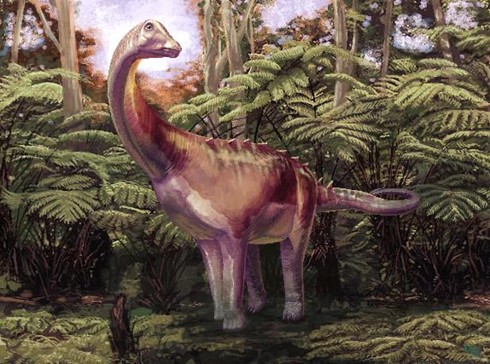
Life reconstruction of the Antarctic-sauropod. Credit: Andrew McAfee Carnegie Museum of Natural History
Spreading across the Southern continents
The vertebra was found in the Santa Marta Formation, a marine rock layer dating to the Late Cretaceous around 82 million years ago. It is the only dinosaur fossil from Antarctica to come from this formation. Scientists believe the animal likely floated out to sea after death before eventually being buried and fossilised on the seabed. The discovery adds an important piece to the puzzle of how dinosaurs spread across the southern continents.
Professor Paul Barrett, Merit Researcher at the Natural History Museum, London, said: “The find sheds further light on how dinosaurs spread across the southern continents. To date no titanosaurs have been found in Australia and there is only limited evidence of them in New Zealand. Confirmation of the presence of these animals in Antarctica makes it seem likely that they travelled on to these areas which were connected.”
At the time this animal lived, Antarctica would have been covered in lush temperate forest, warmed by heavy volcanic activity that pumped CO₂ into the atmosphere. It was a very different environment from the frozen continent BAS scientists explore today.
Antarctica still holds the sparsest dinosaur record of any continent owing to its extensive ice cover but researchers believe there is much more to be found. As ice retreats, further evidence of this ancient biodiversity may yet emerge.
The paper, A titanosaurian sauropod dinosaur from the Late Cretaceous of Antarctica, is published in the journal Acta Palaeontologica Polonica.
Antarctica’s first dinosaur fossil rediscovered after 40 years | British Antarctic Survey