Marine Ecologist and UKs CCAMLR Scientific Rep

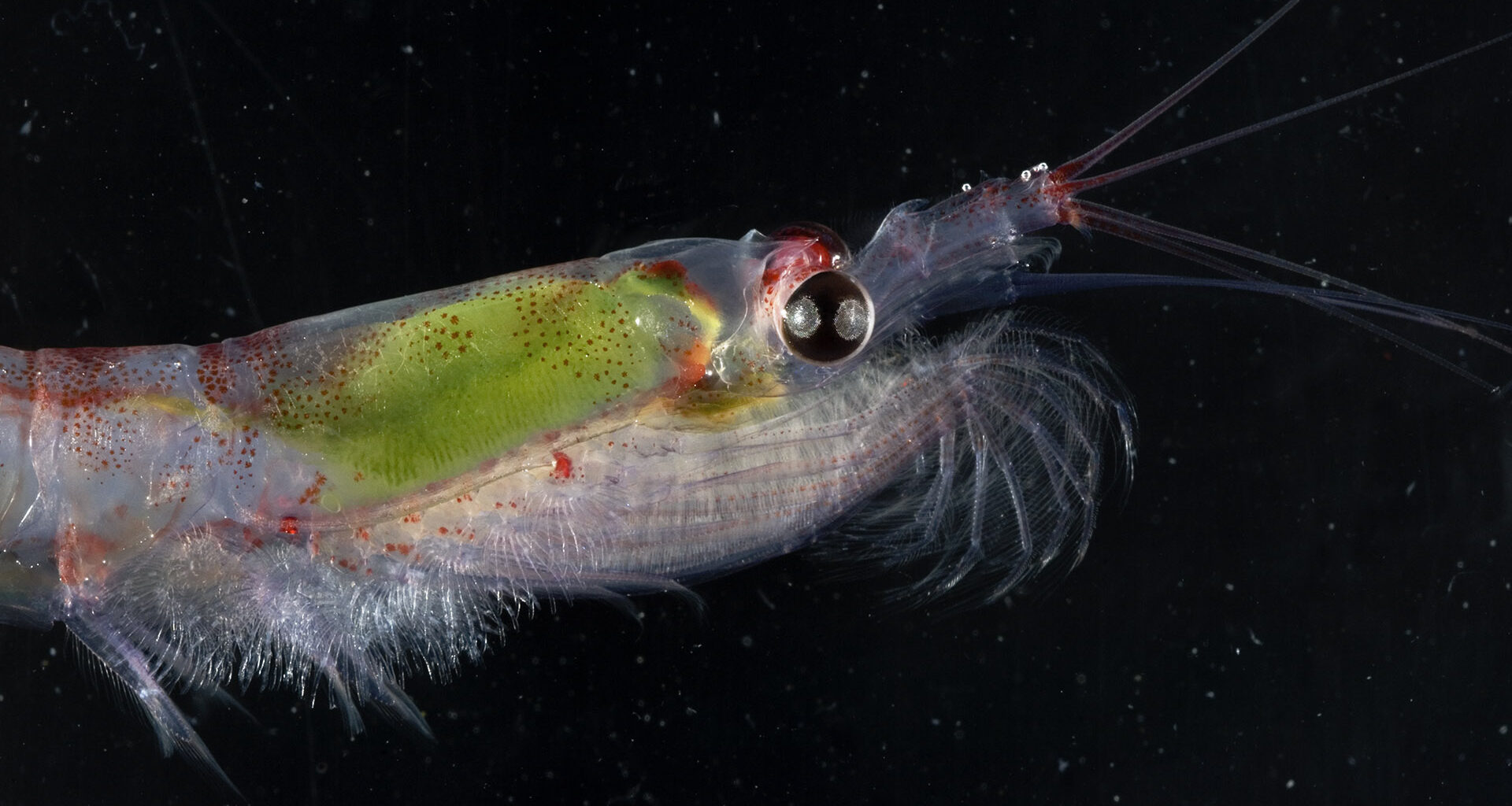
British Antarctic Survey scientists mapped both krill and the animals that depend on them during the winter fishing season around South Georgia.
Krill are small shrimp-like creatures that form the foundation of Antarctic ocean life. They’re food for everything from penguins and seals to the world’s largest whales.
Around South Georgia, a commercial fishery harvests krill for omega-3 supplements and aquaculture feed—but only during winter, when we know very little about krill populations or where predators are feeding.
If fishing boats and wildlife are competing for the same krill in the same places, it could threaten penguin colonies and whale populations. Getting this balance wrong could have cascading effects on one of the world’s most important marine ecosystems.
Our aim was to create a picture of who’s eating where so managers can set fishing limits that protect wildlife. We:
Mapped krill populations using underwater sound (like how dolphins use echolocation) from a patrol vessel to see where krill swarms are located
Followed penguins with satellite tags to see where they hunt during winter, and whether this overlaps with fishing areas
Watched for whales during surveys to understand their winter feeding patterns
Think of it as creating a dynamic map that shows where all the players are—the krill, the predators, and the fishing boats—so managers can set catch limits that leave enough food for wildlife.
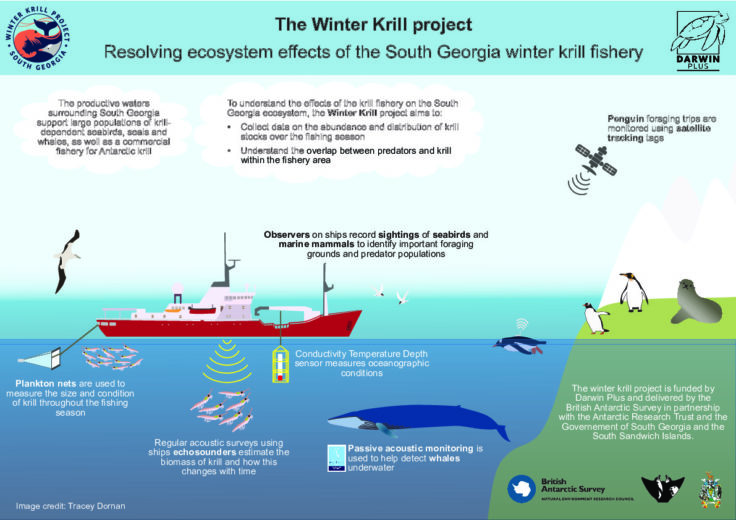
Infographic showing the key elements of the winter krill project.
The krill fishery only operates in winter, yet almost all our data comes from summer surveys. It’s like trying to manage traffic based only on weekend patterns while ignoring the Monday morning rush. Whales are returning to South Georgia in increasing numbers, and some now stay through winter, adding new competition for krill that managers haven’t fully accounted for.
By tracking gentoo penguins with satellite tags through the winter, scientists can see how far they travel to find food and whether their feeding areas overlap with the krill fishery.
This project was led by British Antarctic Survey, with support from the Government of South Georgia and the South Sandwich Islands and the Antarctic Research Trust.
Funding was provided by Darwin Plus and DEFRA.
Results feed directly into CCAMLR (the Commission for the Conservation of Antarctic Marine Living Resources), the international body that manages Antarctic fisheries.
They’re developing a more responsive management system that adjusts fishing areas based on real-time data about where predators need to feed.
Competition between fisheries and predators is a global conservation issue and mitigating it requires an ecosystem-based approach to fisheries management. Whilst the South Georgia krill fishery is restricted to winter, information on stock dynamics and predator foraging is sparse. We addressed this by:
Through this project we aimed to obtain an understanding of the winter distribution of Antarctic krill around South Georgia, and the potential impacts of the krill fishery on krill-dependent predators including penguins and cetaceans. In turn, this will facilitate ecosystems-based management of the krill fishery.
The following report provides an update on our activities during the first field season, from May to September 2022:
Marine Ecologist and UKs CCAMLR Scientific Rep
Marine Ecologist
Ecologist
Molecular Ecologist/Whale biologist
Zooplankton Ecologist
Science Leader IMP 3
Klemens Pütz (Marine Zoologist, Antarctic Research Trust)
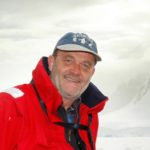
Klemens Pütz studied biology at the Universities of Berlin and Kiel, Germany. Afterwards, he joined the penguin research group at the Institute for Marine Research in Kiel. In the following years he conducted a number of expeditions to the Antarctic and to several sub-Antarctic islands. His research focussed on the foraging ecology of Emperor and King Penguins, for which he received a PhD in 1993. Between 1997 and 2001 he lived in the Falklands Islands, working as scientific fisheries observer and consultant for Falklands Conservation. During his time in the Falklands he was co-founder of the Antarctic Research Trust and is acting as trustee and scientific director since. In 2001, he returned to Germany to take up a position for two years at the Vogelwarte Hiddensee of the University of Greifswald to investigate the determinants of the migratory behaviour of Lesser Black-backed Gulls in northern Europe. Today, apart from his voluntary service for the Antarctic Research Trust, he is working free-lance. His research focusses on the migration and foraging ecology of penguins and other marine top predators in the Southern Ocean. Since over 25 years he is also working as expedition leader and lecturer on various expedition cruise vessels in the Antarctic, the Sub-Antarctic and the Arctic. More than 100 publications in peer-reviewed scientific journals and a number of appearances in national and international media are the result of his scientific career. In addition, he authored several books, including a comprehensive review of the biology of penguins and his life as a penguin researcher, a travel guide for the Antarctic Peninsula, the Falkland Islands and South Georgia, and an identification guide for Antarctic and sub-Antarctic animals.
The Antarctic Research Trust (ART) was founded in 1997 and is a charity registered in the Falkland Islands (since 1999), Switzerland (since 2002) and the USA (since 2004). The ART’s aim is to conduct and support scientific research on Antarctic and sub-Antarctic animals in order to provide baseline data for adequate conservation measures.
Publications: Google Scholar publication list
Contact: klemens.puetz@ewetel.net
Website: www.antarctic-research.org
Susannah Calderan (Consultant)
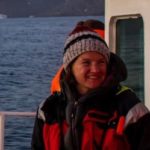
Susannah Calderan is a research fellow at the Scottish Association for Marine Science (SAMS), and specialises in large whale ecology, particularly passive acoustic monitoring. As part of Australian Antarctic Division and BAS research teams, she has developed new techniques for acoustically detecting and tracking whales in the Southern Ocean, in particular Antarctic blue whales. Susannah has participated in several Antarctic and sub-Antarctic voyages over the last ten years. She has also worked on baleen whale acoustics, including blue, fin, Bryde’s, and sei whales in the Pacific, Atlantic and Indian Oceans. Susannah also works with NGOs, Universities and governmental organisations in the UK, Europe and US, developing new visual and acoustic survey and analysis techniques for localising and tracking cetaceans at a range of spatial scales, and also working on anthropogenic impacts on whales such as fisheries bycatch, underwater noise and aquaculture.
Contact: susannah.calderan@scoter.org or susannah.calderan@SAMS.ac.uk
Russell Leaper (Consultant)

Russell Leaper studied mathematics at Oxford University before joining the IFAW research vessel Song of the Whale in 1988 to study sperm whales. He initially worked on developing acoustic methods to study and count whales. His subsequent research has covered a wide range of marine mammal conservation and welfare issues with an emphasis on survey methods and population assessment. In addition to data analysis he has conducted extensive field work from a range of vessels including several surveys around South Georgia and elsewhere in the Southern Ocean. Russell has been a member of the Scientific Committee of the International Whaling Commission since 1996 and attends as a member of the UK delegation. He has authored over 50 scientific publications and presented more than 60 papers at international conferences. He also has an MSc in Marine Resource Development and Protection from Heriot-Watt University.
Contact: russell@rcleaper.com
The second of six winter krill surveys in South Georgia and the South Sandwich Islands is underway. The first winter krill survey was completed successfully on board the South Georgia […]

Relevant papers
All data derived from the project will be archived with the UKRI Polar Data Centre (PDC). Data will also be linked to the GSGSSI Data Portal which was funded by a previous Darwin Plus grant.