Coordinator South Georgia Humpback Project

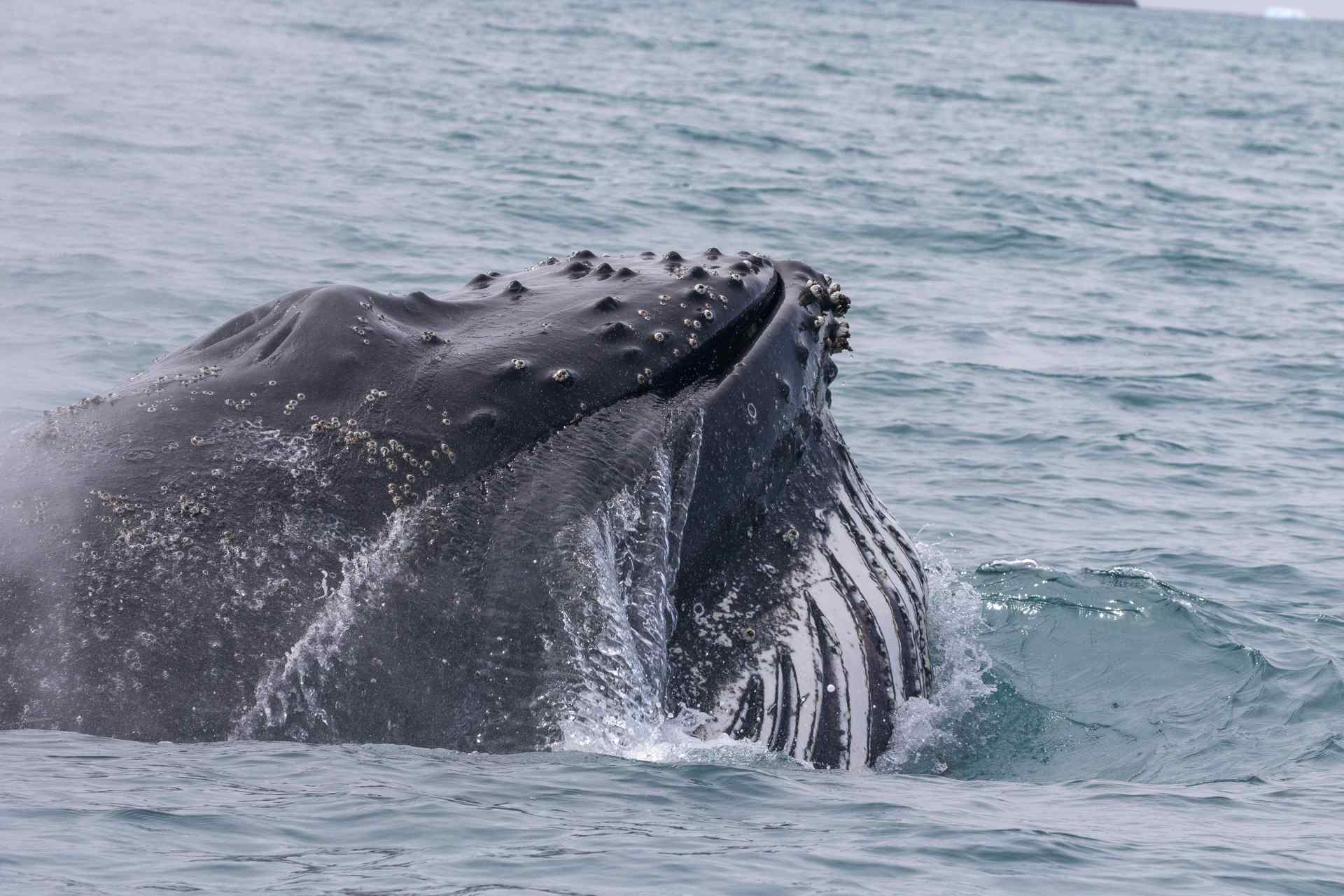
Humpback whales are the most common baleen whale to visit South Georgia in summer and they often stay there during autumn and winter, overlapping with the krill fishing season.
The Hungry Humpbacks project studies how humpback whales fed at South Georgia throughout the summer and autumn, using drone images of their body shape to look at how fast they gain weight.
These humpback whales are one of the largest predators of krill in the region, but their impact on krill stocks was not well understood.
The project aims to provide the first estimates of seasonal krill consumption by humpback whales at South Georgia. Satellite tracking also tells us how fast they feed and how long they stay in South Georgia waters.
By measuring body condition, movements and krill consumption, scientists are learning how whales affect krill populations and how feeding behaviour varies through the season. This information will give the Government of South Georgia and the South Sandwich Islands and the Commission for the Conservation of Antarctic Marine Living Resources (CCAMLR) baseline information to manage krill fisheries sustainably and understand the local ecosystem.
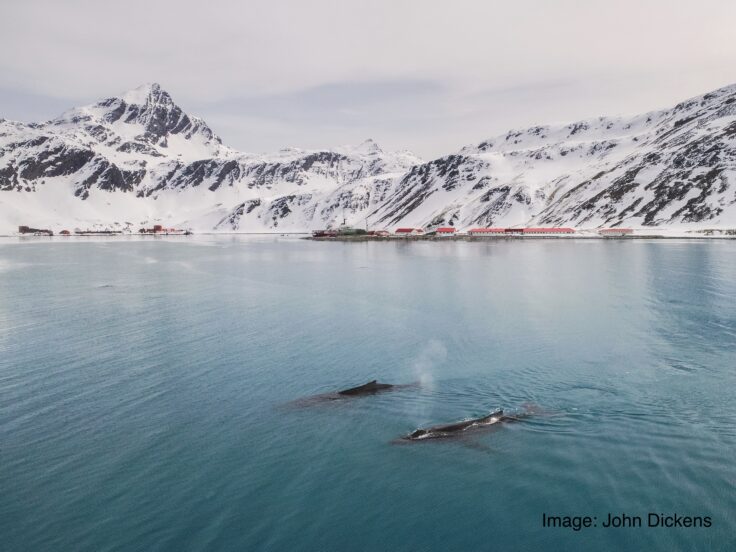
Humpback whales in Cumberland Bay, South Georgia. (Credit: John Dickens)
The project provides the first estimates of seasonal krill consumption by humpback whales at South Georgia. Satellite tracking also creates winter habitat-use models, showing where whales are feeding.
By measuring body condition, movements, and krill consumption, scientists learn how whales affect krill populations. They also see how feeding behaviour varies through the season. This gives the Commission for the Conservation of Antarctic Marine Living Resources (CCAMLR) baseline information to manage krill fisheries sustainably and understand the local ecosystem.
The team uses:
drone surveys: UAVs take aerial photos to measure whale body condition.
small-boat surveys: Teams record whale sightings, take identification photos, and collect biopsy samples.
satellite tagging: Some whales are fitted with tags to track movement and diving behaviour.
laboratory analysis: Biopsy samples are analysed for sex, pregnancy, and hormone levels.
data integration: Observations and measurements are combined to estimate krill consumption and describe whale habitat use.
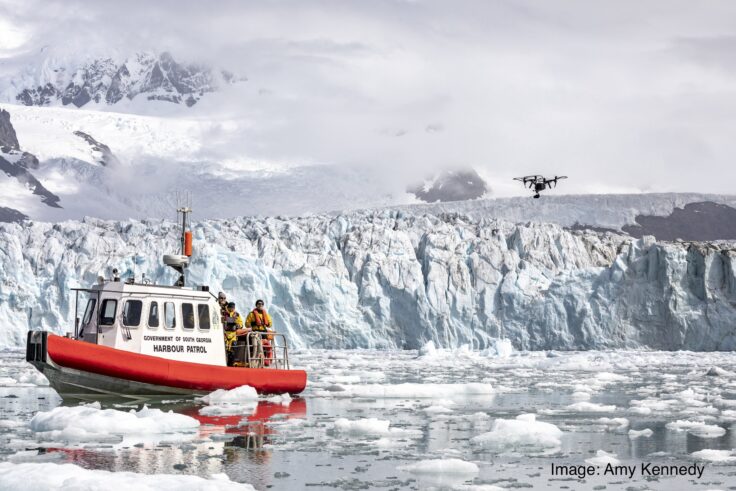
Scientists fly a UAV at South Georgia. (Credit: Amy Kennedy)
This allows scientists to estimate krill consumption during different times of the season and provide data for CCAMLR Subarea 48.3 krill quota assessments.
The project aims to:
The project is funded by:
With support from the Government of South Georgia and the South Sandwich Islands.
Fieldwork was led by BAS researchers, with project partners including UAV pilots, small-boat survey teams, and satellite tagging specialists. Partners and PhD students conducted lab analyses.
Collaborators in Brazil, Denmark, USA and the UK helped with data collection and analysis.
Whales are the largest krill-predators at South Georgia, yet their impacts on krill stocks are poorly understood. Recently, BAS whale surveys revealed high summer abundance and extended use of South Georgia waters into winter, coincident with the Antarctic krill fishery.
This project aims to measure how whale foraging intensity varies across the feeding season in South Georgia, using UAV-based measurements of body condition and satellite-tracking of diving rates to measure season-specific krill consumption.
The project will be implemented by measuring humpback demography (age, sex, pregnancy status and size) and foraging rates at South Georgia from summer to winter, using UAV overhead images of whales to measure their body condition and size across the feeding season, and using satellite tags to measure whale diving rates throughout the feeding season. Whale body condition will also be investigated on their Brazil winter breeding grounds either side of the feeding season, on migration to South Georgia from Abrolhos Bank, and on their northbound migration after the feeding season at Cabo Frio.
Body condition variation and dive rates will be used to estimate rates of krill consumption across the feeding season, providing season-specific krill consumption estimates for humpbacks to the CCAMLR krill risk assessment. Satellite tracks will also be used to produce winter habitat use models to describe winter whale distribution. Both datasets will be integrated into the Area 48.3 Krill Risk Assessment and will provide the first baseline measurements of krill consumption in SG waters by whales, across seasons.
Project progress reports to Darwin Plus can be found here.
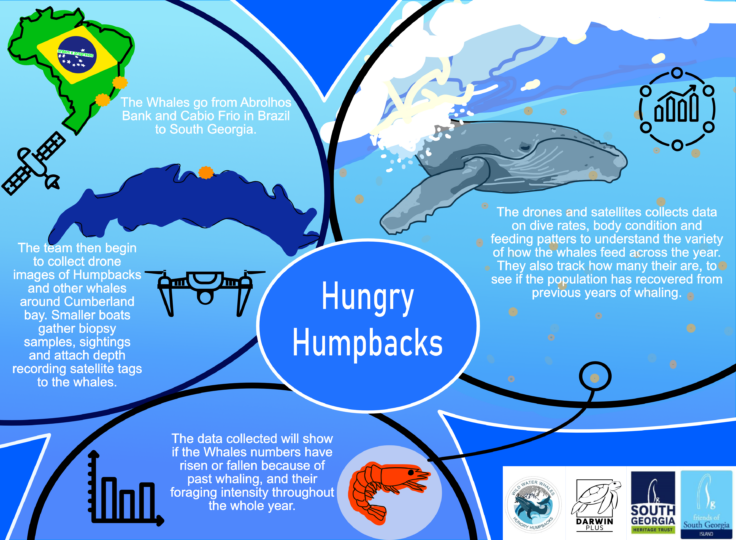
Hungry Humpbacks infographic, designed by Phoebe Ratcliffe during work experience at the British Antarctic Survey
Coordinator South Georgia Humpback Project
Molecular Ecologist/Whale biologist
Marine Ecologist and UKs CCAMLR Scientific Rep
Marine Ecologist IMP 3
PROJECT TEAM
Principal Investigator Dr Jen Jackson, British Antarctic Survey
Project Coordinator Stephanie Martin, British Antarctic Survey
UAV fieldwork and analysis
Dr Fredrik Christiansen, Aarhus University, Denmark
UAV analysis of body condition. Conducted field surveys in Abrolhos Bank, Brazil (2023) and South Georgia (Feb-March 2024)
Nicolas Lewin, Instituto de Conservación de Ballenas, Argentina. Conducted field surveys in South Georgia (Dec 2023-Jan 2024)
Maria Glarou, PhD researcher, University of Iceland. Conducted field surveys off Cabo Frio, Brazil (June-July 2024)
Penny Clarke, PhD researcher, British Antarctic Survey. Conducted field surveys in South Georgia (Dec 2023-Jan 2024).
Habitat use patterns and dive rates
Dr Amy Kennedy, University of Washington, USA
Satellite tracking of humpback and southern right whales at South Georgia, Led field surveys in South Georgia (Feb-March 2023)
Dr Alexandre Zerbini, Marine Mammal Laboratory, NOAA, USA University of Washington, Instituto Aqualie, Marecotel. Advice on satellite tracking and analysis.
Professsor Ari Friedlaender, University of California at Santa Cruz. Advice on habitat use and dive rates.
Humpback whale demography and body condition in Brazil
Dr Eduardo Camargo, Executive Director Instituto Baleia Jubarte. Lead on fieldwork off Abrolhos Bank in 2023.
Professor Rodrigo Tardin, Federal University of Rio de Janeiero. Lead on fieldwork off Cabo Frio in 2024.
Pregnancy and age analysis
Dr Joanna Kershaw, University of St Andrews, Scotland. Conducted biopsy sampling in South Georgia (Feb-March 2024). Analysing pregnancy and testosterone condition of whales during feeding season.
Henry Slesser, PhD researcher, British Antarctic Survey. Genetic profiling of individual humpback whales and epigenetic analysis of whale age.
Dr Emma Carroll, University of Auckland, New Zealand. Epigenetic analysis of whale age, advisor on genetic analysis.
Krill risk assessment at South Georgia
Sue Gregory, Senior Marine and Fisheries Manager, Government of South Georgia and the South Sandwich Islands. Advice on South Georgia fieldwork and krill risk assesment.
Dr Vicky Warwick Evans, British Antarctic Survey. Incorporating whale habitat use into Area 48.3 krill risk assessment.
Professor Martin Collins, British Antarctic Survey. UK Head of Delegation to CCAMLR. Advice on South Georgia marine ecosystem and delivery of results for krill risk assessment.
Project Leader Dr Jennifer Jackson, Project Partner and field team member Dr Joanna Kershaw, and Project Manager Stephanie Martin were invited to participate in “Whale of a Weekend” in Dundee, […]

This season, a smaller team of researchers went back at King Edward Point, doing small boat surveys and looking for humpback whales to get UAV images of body condition, track […]
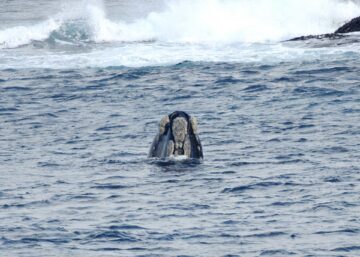
BAS PhD student Henry Slesser visited Dr Joanna Kershaw at her laboratory in Aberdeen University (she has since moved to the University of St Andrews). Jo has now analysed the […]
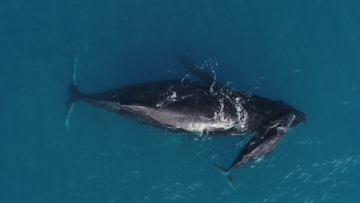
The third leg of the fieldwork took place offshore of Cabo Frio, Brazil from 4th June to 7th July 2024, recording the body condition of humpback whales at the start […]
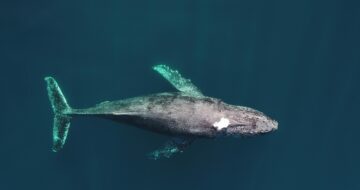
The next stage of the project was fieldwork using drones to study whales from land at Cumberland Bay, South Georgia during December 2023-January 2024. This had not been tried before […]
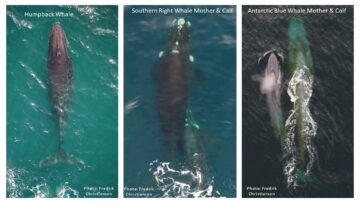
During November/December 2023, BAS PhD student Henry Slesser visited the laboratory of project collaborator Dr Emma Carroll, to learn how to estimate the ages of the humpback whales that have […]
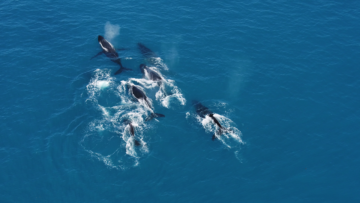
The first field leg of the project took place in Abrolhos Marine National Park, Brazil from 20 September to 17 October 2023, recording the body condition of humpback whales at […]
British Antarctic Survey scientists and support staff are coming to the end of another successful Antarctic science season. Teams are now preparing for the transition to winter operations as the austral autumn brings longer nights and challenging conditions to the continent.
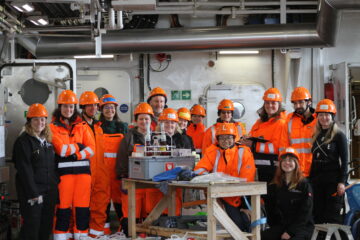
scientists are focusing on two major projects: one on whales and their consumption of krill (a shrimp-like creature that’s abundant in the Southern Ocean), and another on populations of bottom-dwelling fish.
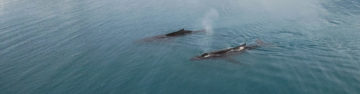
The Antarctic field season has started, with over 600 people beginning the journey South to work on over 60 projects on station and in the field.
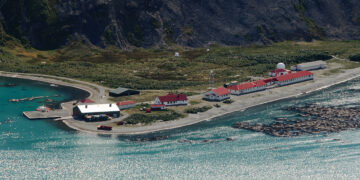
King Edward Point Research Station on South Georgia has been a centre for marine and fisheries research for 25 years.
Analysing the diversity and responses of micro-organisms