
Science Leader IMP 1
BAS Science Strategy Executive Group, Space Weather and Atmosphere team, Leadership teams, BAS Executive team


HOTRAY is a ray tracing computer code designed to trace the path of electromagnetic waves in a hot magnetised plasma. HOTRAY has been used to understand the generation and propagation of plasma waves at the Earth, Jupiter, Saturn and laboratory plasmas.
Features
The HOTRAY code calculates the ray path and the growth and decay of the wave due to plasma instabilities. The code includes several important features:
Method
The code integrates Hamilton’s equations to find the ray path and the k-vector subject to solving the hot (cold) plasma dispersion relation. The code requires as input:
The output is the ray path and wave properties such as the path integrated wave gain and the wave polarisation.
Restrictions
HOTRAY is restricted to
References
HOTRAY was written by Richard B Horne at the British Antarctic Survey. The first research paper was published in 1988 [Horne, 1988], but the key reference is Horne [1989]:
http://onlinelibrary.wiley.com/doi/10.1029/JA094iA07p08895/abstract
The code was substantially updated to include heavy ions and the key reference is Horne and Thorne [1993]
http://onlinelibrary.wiley.com/doi/10.1029/92JA02972/abstract
The code is so general it is still used today – one of the latest references is Horne [2015]:
http://onlinelibrary.wiley.com/doi/10.1002/2014GL062406/full
Availability and Contact
HOTRAY is not freely available. It may be available for joint research projects via collaboration. For more information contact Richard Horne (rh@bas.ac.uk).
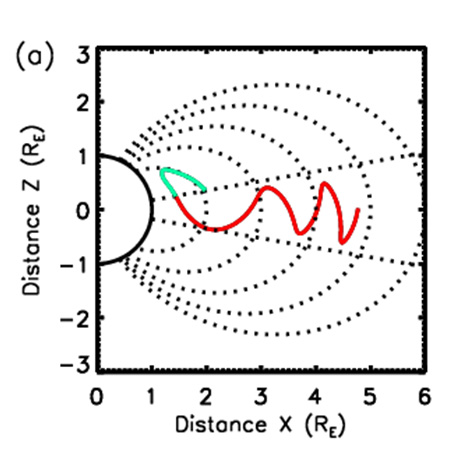
Propagation of a magnetosonic wave (red) in the Earth’s magnetosphere and its conversion into an electromagnetic ion cyclotron wave (green). These waves are responsible for the acceleration and loss of electrons from the Earth’s radiation belts