Pelagic Ecologist

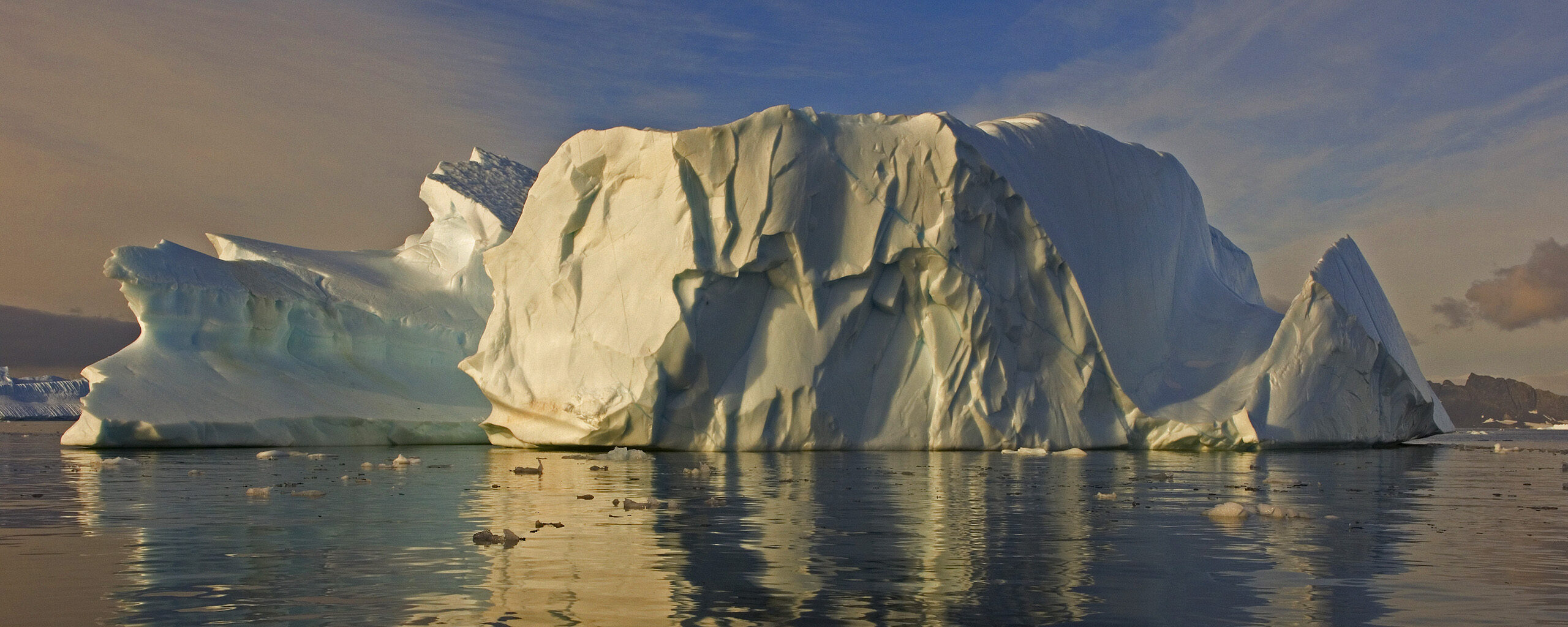
Eco-ICE studies whether making Arctic sea ice thicker could harm ocean life. We’re creating a set of safety guidelines that can be used to check if future climate projects might damage the environment.
Cutting carbon emissions is our main way to tackle climate change. But some scientists are also looking at other methods to help cool the planet. Right now, there’s no standard way to check if these methods might harm nature. Without proper checks, projects meant to help could accidentally damage ecosystems. Eco-ICE creates tools to help decision-makers work out if climate projects are safe.
The project brings together researchers from British Antarctic Survey, Oxford University, Reading University and University of East Anglia.
The team uses computer models and lab experiments to study how thickening Arctic sea ice might affect ocean life. By studying this example in detail, they’ll create an Ecological Impact Framework – a toolkit that helps people evaluate future projects.
Funding bodies, governments, conservation groups, local communities and research teams can all use this toolkit to check if planned projects are safe before they start.
Eco-ICE’s research will:
The framework will help people make informed choices, guide funders toward safer projects, and give project teams tools to check and improve their work.
The project is supported by ARIA’s Exploring Climate Cooling programme.
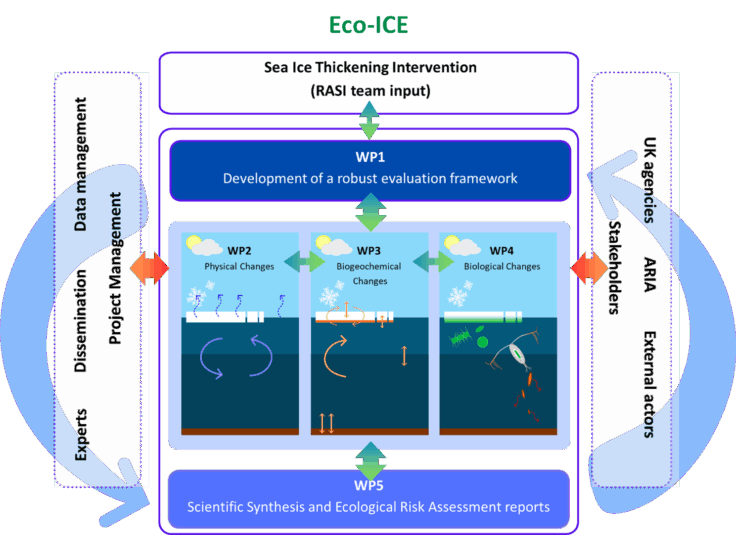
The Eco-ICE project consists of five main work packages each addressing a key project objective. The main work packages interconnect and inform each other with external expertise and stakeholders’ input at appropriate stages.
Objective 1. Design an Ecological Impact Framework (EIF), with the necessary metrics, from which a robust and thorough assessment of potential ecological impacts due to geoengineering interventions can be established.
Objective 2. Determine the physical changes that will occur in the ocean, sea-ice and atmosphere, and disentangle the geoengineering intervention impacts from background and climate driven change.
Objective 3. Using the outputs from objective 2; identify, test, model and predict shifts in biogeochemical parameters due to physical changes at both large and small spatiotemporal scales.
Objective 4. Using outputs of objective 2 and 3; identify, test, model and predict shifts in the pelagic ecosystem due to physical and biogeochemical changes at both large and small spatiotemporal scales.
Objective 5. Undertake a comprehensive Ecological Risk Assessment (ERA) of the artificial sea-ice thickening intervention to evaluate the scale, timeframe, scope and intensity of the potential ecological impact.
Pelagic Ecologist
Sea Ice Physicist
IDP Science Leader IMP 3
BAS Science Strategy Executive Group, Ice Dynamics and Palaeoclimate team
Ocean Climate Scientist
Biogeochemist
Pelagic Marine Ecologist
Ecologist
Ecosystem Scientist
Sea Ice Physicist
Water tracers in the UKESM
Scientist - Other
Environ Research and Monitoring
Physical Oceanographer
University of Oxford
PhD students at Reading
Matthew Goodwin, along with supervisors David Schroeder and Danny Feltham.
PhD student at UEA
Dimitri Hird-Lewis, along with supervisor Dorothee Bakker.