Improving how we measure Antarctic sea ice
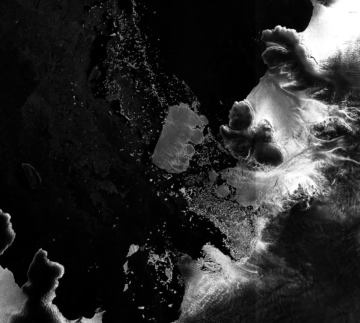
QUASAR uses AI to improve Antarctic sea ice measurements from satellites, making climate data more reliable for scientists tracking changes in polar regions.

I am a machine learning researcher in the Artificial Intelligence (AI) Lab at the British Antarctic Survey (BAS). My research primarily focusses on the application of machine learning techniques to detect features in satellite imagery, including multispectral visible and Synthetic Aperture Radar (SAR) datasets. I have recently trained a convolutional neural network, ViSual_IceD for the detection of sea ice in concurrent mutlispectral and SAR imagery. I am passionate about potential use cases for this work, including as an data source for Autonomous Marine Operations and Planning and for improving information on sea ice conditions for habitat monitoring.
I hold a PhD from the University of Cambridge, where I applied AI techniques, including convolutional neural networks, to automatically detect coastal features and land covers in satellite imagery.
I am also working on the DeepSensor project, using neural processes for cloud infilling of fine resolution multispectral imagery of sea ice conditions.
Rogers, M.S.J, Fox, M., Fleming, A., van Zeeland, L., Wilkinson, J. and Hosking, J.S., 2024. Sea ice detection using concurrent multispectral and synthetic aperture radar imagery. arXiv preprint: https://doi.org/10.48550/arXiv.2401.06009
Bojko, J., Reinke, A.W., Stentiford, G.D., Williams, B., Rogers, M.S.J and Bass, D., 2022. Microsporidia: a new taxonomic, evolutionary, and ecological synthesis. Trends in Parasitology. doi: https://doi.org/10.1016/j.pt.2022.05.007
Rogers, M. S. J., Bithell, M., Brooks, S. M and Spencer, T. 2021. VEdge_Detector: automated coastal vegetation edge detection using a convolutional neural network. International Journal of remote sensing. http://dx.doi.org/10.1080/01431161.2021.1897185
Arundell, K.L., Dubuffet, A., Wedell, N., Bojko, J., Rogers, M.S.J and Dunn, A.M., 2019. Podocotyle atomon (Trematoda: Digenea) impacts reproductive behaviour, survival and physiology in Gammarus zaddachi (Amphipoda). Diseases of aquatic organisms, 136(1), pp.51-62. https://doi.org/10.3354/dao03416
Rogers, M. 2016. Can Structure from Motion determine the efficacy of river re-meandering as a natural flood management measure? Available online: https://www.researchgate.net/profile/Martin_Rogers7
Kelly, Tom. Rogers, Martin ORCID record for Rogers, Martin. (2026) Warping Earth Observations for better ice labeling in the Marginal Marginal Ice Zone.
Rogers, Martin S.J. ORCID record for Rogers, Martin S.J.. Spencer, Tom. (2026) Holistic analysis of shoreline change and mudbank dynamics across the Guiana coastline.
Bowler, Ellen ORCID record for Bowler, Ellen. Byrne, James ORCID record for Byrne, James. Leclerc, Lisa-Marie. Roberto-Charron, Amélie. Rogers, Martin S.J. ORCID record for Rogers, Martin S.J.. Cavanagh, Rachel D. ORCID record for Cavanagh, Rachel D.. Harasimo, Jason. Lancaster, Melanie L. Chan, Ryan S.Y. Strickson, Oliver. Wilkinson, Jeremy ORCID record for Wilkinson, Jeremy. Downie, Rod. Hosking, J. Scott ORCID record for Hosking, J. Scott. Andersson, Tom R. ORCID record for Andersson, Tom R.. (2025) AI sea ice forecasts for Arctic conservation: A case study predicting the timing of caribou sea ice migrations.
Stokholm, Andreas. Buus-Hinkler, Jørgen. Wulf, Tore. Korosov, Anton. Saldo, Roberto. Pedersen, Leif Toudal. Arthurs, David. Dragan, Ionut. Modica, Iacopo. Pedro, Juan. Debien, Annekatrien. Chen, Xinwei. Patel, Muhammed. Cantu, Fernando Jose Pena. Turnes, Javier Noa. Park, Jinman. Xu, Linlin. Scott, Katharine Andrea. Clausi, David Anthony. Fang, Yuan. Jiang, Mingzhe. Taleghanidoozdoozan, Saeid. Brubacher, Neil Curtis. Soleymani, Armina. Gousseau, Zacharie. Smaczny, Michał. Kowalski, Patryk. Komorowski, Jacek. Rijlaarsdam, David. van Rijn, Jan Nicolaas. Jakobsen, Jens. Rogers, Martin Samuel James ORCID record for Rogers, Martin Samuel James. Hughes, Nick. Zagon, Tom. Solberg, Rune. Longépé, Nicolas. Kreiner, Matilde Brandt. (2024) The AutoICE Challenge.
Rogers, Martin S.J. ORCID record for Rogers, Martin S.J.. Fox, Maria ORCID record for Fox, Maria. Fleming, Andrew ORCID record for Fleming, Andrew. van Zeeland, Louisa. Wilkinson, Jeremy ORCID record for Wilkinson, Jeremy. Hosking, J. Scott ORCID record for Hosking, J. Scott. (2024) Sea ice detection using concurrent multispectral and synthetic aperture radar imagery.
Warren, Daniel A. Burgess, Amy L. Prati, Sebastian. Bacela-Spychalska, Karolina. Rogers, Martin S.J. ORCID record for Rogers, Martin S.J.. Bojko, Jamie. (2023) Histopathological screening of Pontogammarus robustoides (Amphipoda), an invader on route to the United Kingdom.
Bojko, Jamie. Reinke, Aaron W. Stentiford, Grant D. Williams, Bryony. Rogers, Martin S.J. ORCID record for Rogers, Martin S.J.. Bass, David. (2022) Microsporidia: a new taxonomic, evolutionary, and ecological synthesis.
Bowler, E., Byrne, J., Leclerc, L., Roberto-Charron, A., Rogers, M., Cavanagh, R., Harasimo, J., Lancaster, M., Chan, R., Strickson, O., Wilkinson, J., Downie, R., Hosking, J., & Andersson, T. (2025). Pan-Arctic 93-day sea ice concentration forecasts from the IceNet model and mappings between sea ice concentration and Dolphin and Union caribou sea ice crossing-start times (Version 1.0) [Data set]. NERC EDS UK Polar Data Centre. https://doi.org/10.5285/8738b3cb-52c7-4b36-aa6d-6e15c0b46ba4
QUASAR uses AI to improve Antarctic sea ice measurements from satellites, making climate data more reliable for scientists tracking changes in polar regions.
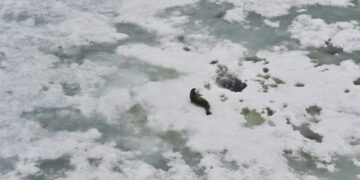
The AI for Earth Observation project develops machine learning tools to detect icebergs, sea ice, and wildlife from satellite imagery.
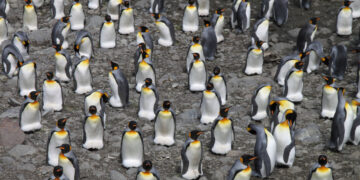
The AI for smart conservation project combines sea ice forecasts, satellite data, and GPS tracking to create early-warning systems for Arctic wildlife.
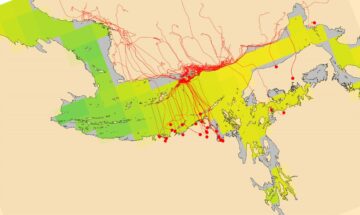
This project is developing digital twins of Antarctic and Arctic environments and resources. A digital twin makes it possible to test “what if” questions far more quickly than traditional computer models.
IceNet is a deep learning system that forecasts Arctic sea ice. The system is trained on climate simulations and observational data. It outperforms state-of-the-art dynamical models, especially for extreme sea ice events.
AI4EO Accelerator applies artificial intelligence to the large amounts of Earth Observation satellite data now available,