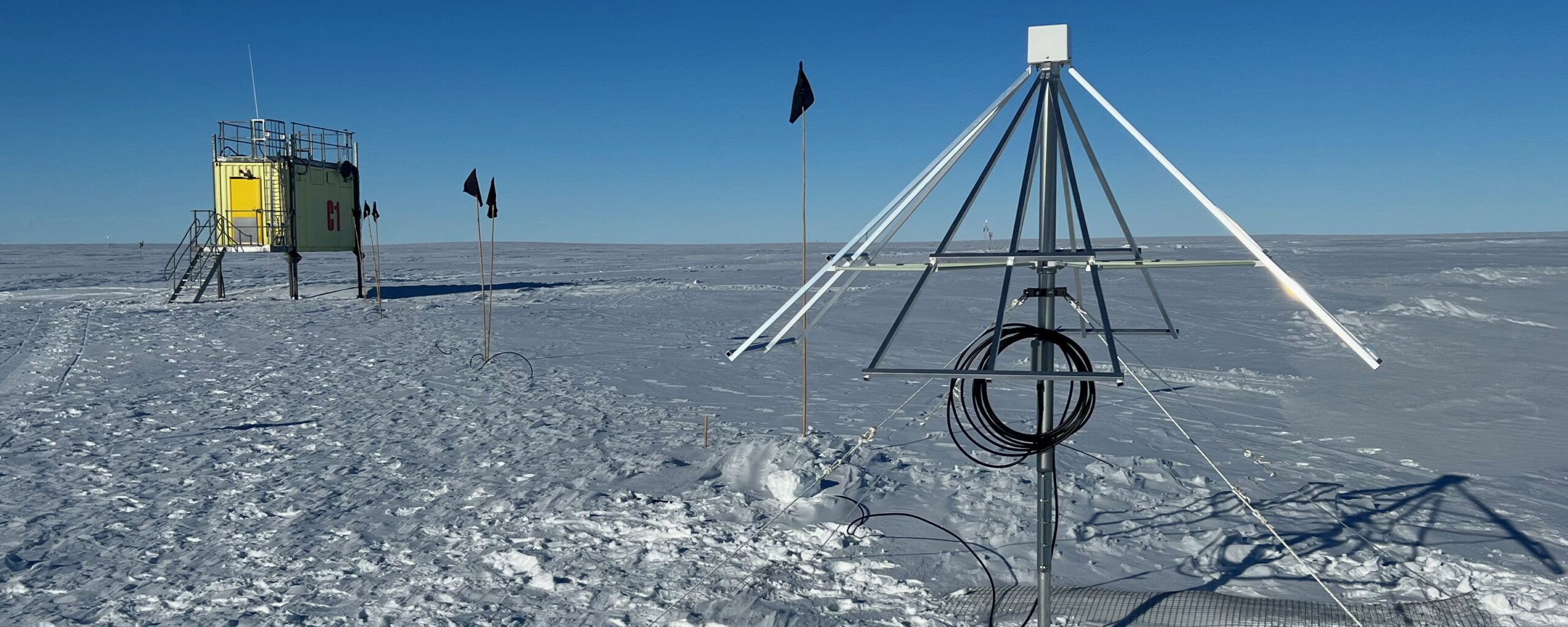
The Halley Research Station multiband riometer is a passive instrument that measures radio energy from natural astronomical sources—such as the Sun, Jupiter, the centre of the Milky Way, and other lesser sources—to study the ionosphere and space weather effects.
It operates at two frequencies:
30 MHz: Strong absorption by charged particles in the ionosphere, blocking radio energy.
38.2 MHz: A protected radio band where the magnitude of change is less.
The riometer uses a Quiet Day Curve (QDC) to establish a baseline signal—representing cosmic background noise on a day with no ionospheric absorption or interference. When ionospheric ionisation increases (e.g., during particle precipitation), the riometer measured signal deviates from the QDC. This deviation, measured in decibels (dB), indicates the level of ionospheric absorption.
The riometer can give important insight into the geophysical processes going on during solar storms. It indicates the presence of the aurora directly over Halley (even during daylight hours) and the levels by which local radio wave propagation conditions could be affected.