
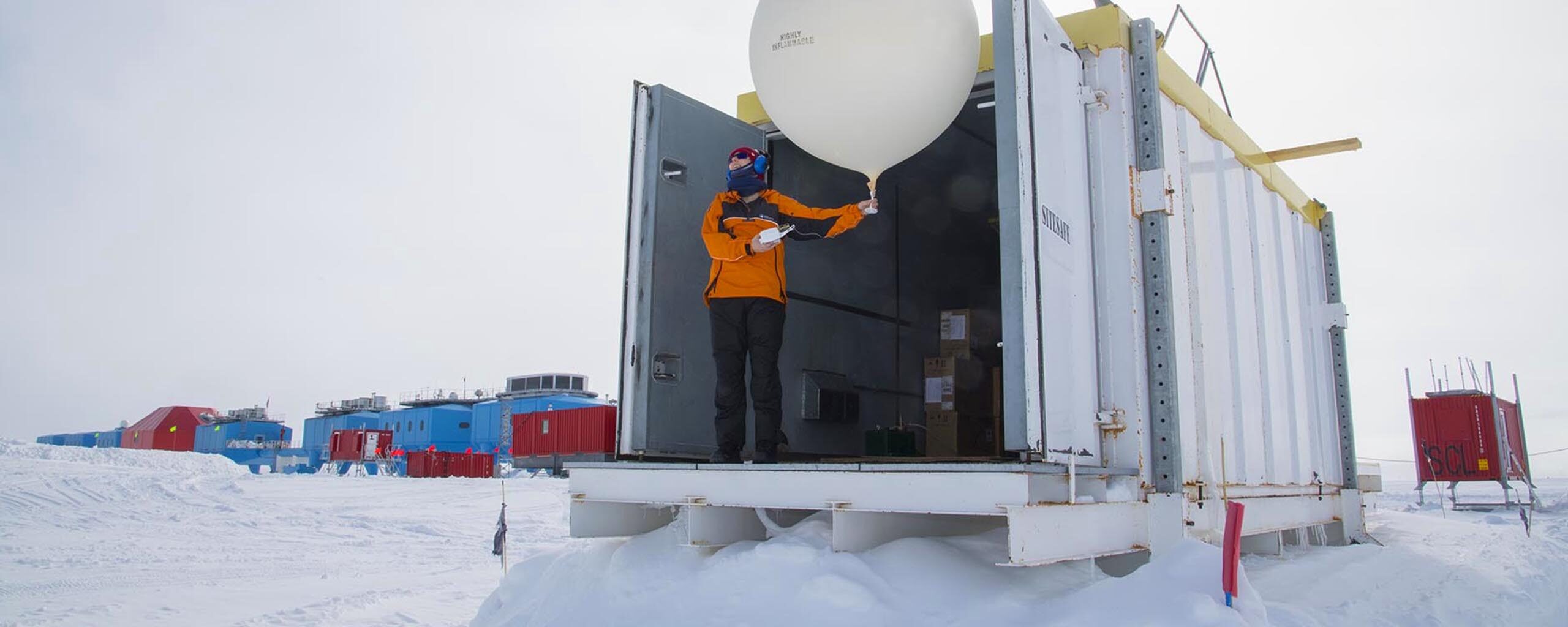
Halley Research Station is a hub for scientific instruments and facilities dedicated to studying the Earth’s atmosphere, the space around it, and the impact of climate change on our planet.
Glaciological Monitoring
Our Ice Dynamics and Palaeoclimate team at Halley Research Station studies how glaciers and ice sheets respond to climate change to improve predictions of sea level rise. The team analyses ice cores, and models past and present ice sheet movement.
The RIFT-TIP project studies cracks in ice shelves and iceberg calving – when large chunks of ice break off from an ice sheet or glacier at the coast and become icebergs.
Researchers use seismic, radar, and GPS data to investigate how cracks evolve on the Brunt Ice Shelf. They model the history and predict the future evolution of these cracks.
Scientists at the station use a network of GPS instruments, satellite imagery, ground-penetrating radar, and drones to track these changes. Computer models then predict the calving of large icebergs and inform us about the safety of the station.
Recent research, led by Dr. Oliver Marsh, used GPS and radar to track movements on the Brunt Ice Shelf. It showed that cracks leading to calving often happen during strong spring tides. This discovery helps to accurately forecast how quickly the Antarctic ice sheet is shrinking, which impacts projections of global sea level rise.
Monitoring the atmosphere
Researchers use a suite of meteorology instruments to continuously monitor the local weather conditions.
Once a day, researchers launch weather balloons carrying instruments called radiosondes. These measure temperature, humidity, wind speed, and wind direction, providing data for weather forecasting and climate research.
The station’s Clean Air Sector Laboratory (CASLab) measures trace gases in the atmosphere, including ozone-depleting substances and greenhouse gases. The lab’s location in a “clean air sector” ensures that the measurements are not contaminated by local pollution.
The Dobson spectrophotometer measures the amount of ozone in the atmosphere. Measurements at the station led to the discovery of the Antarctic ozone hole in the 1980s and subsequent international action.
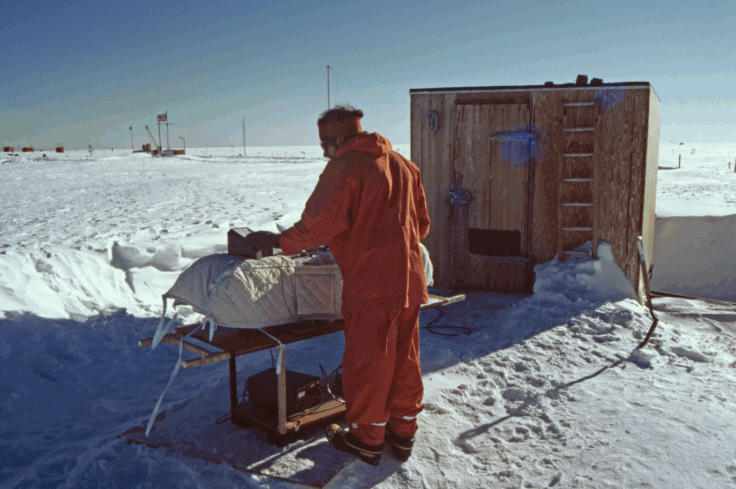
Jon Shanklin in outdoor clothing, using Dobson spectrophotometer outside, Halley, 22 Jan 1982.
The système d’analyse par observations zénithales (SOAS) also measures ozone and other atmospheric gases by analysing the sunlight spectrum.
Exploring space weather
Researchers at Halley Station are experts in ‘space weather’. They monitor how radiation from the surface of the sun interacts with the Earth’s upper atmosphere and affects our weather.
Magnetometers measure the Earth’s magnetic field and its fluctuations. The data help us understand the interaction between the solar wind and the Earth’s magnetic field, which can affect satellites and communication systems.
The VLF receiver detects very low frequency (VLF) radio waves, which are used to study the Earth’s ionosphere, a layer of the atmosphere affected by solar activity.
The Riometer measures the absorption of radio waves in the ionosphere. It provides information about the density of electrons in the ionosphere, which can be affected by solar flares and other space weather events.
The optical caboose houses instruments, such as cameras and spectrometers, used to study the Southern Lights (aurora Australis).