
Science Leader IMP 3

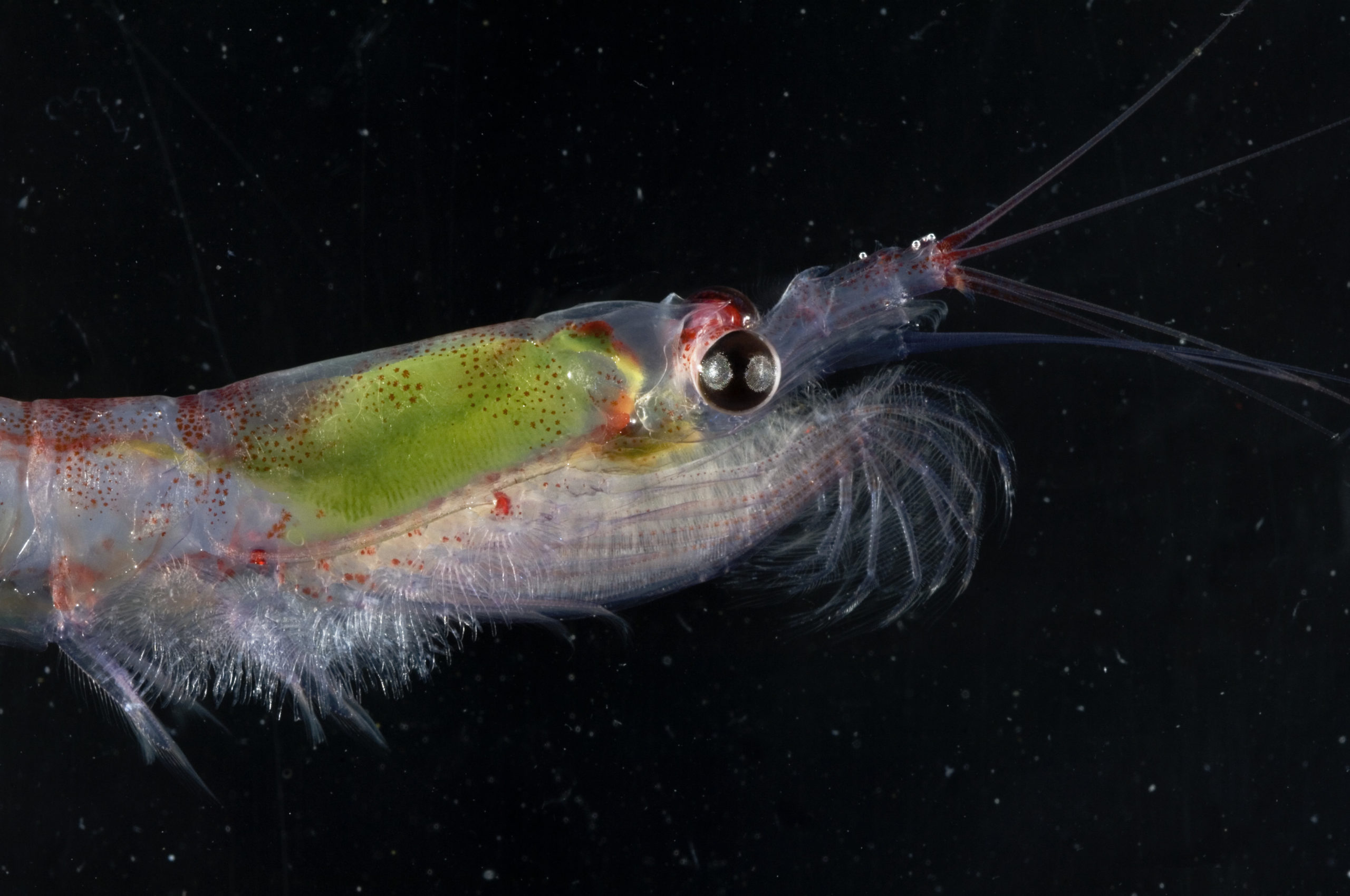
ParaKrill investigates parasites in Antarctic krill.
Krill are a keystone species in Antarctic ecosystems. They are prey for fish, seals, penguins, and whales, and they play a key role in carbon and nutrient cycling.
Parasites are one factor that may influence krill populations, but little is known about them. They are hard to detect in krill and were long thought to be rare. Emerging genetic tools have revealed that parasites may infect as many as one in ten krill in certain areas and seasons.
The project generates data on the types, distributions, and impacts of parasites on krill.
Researchers aim to understand how parasites affect individual krill, krill populations, and broader ecosystem processes. For example, parasite infections may influence how carbon and nutrients move through the Southern Ocean.
ParaKrill also tests whether parasites can act as natural “tags” to track how different krill groups interact around Antarctica. This is important for managing krill fisheries. If krill mix freely across regions, fishing pressure in one area has less impact. If krill stay in separate groups, overfishing in one location could cause local depletion.
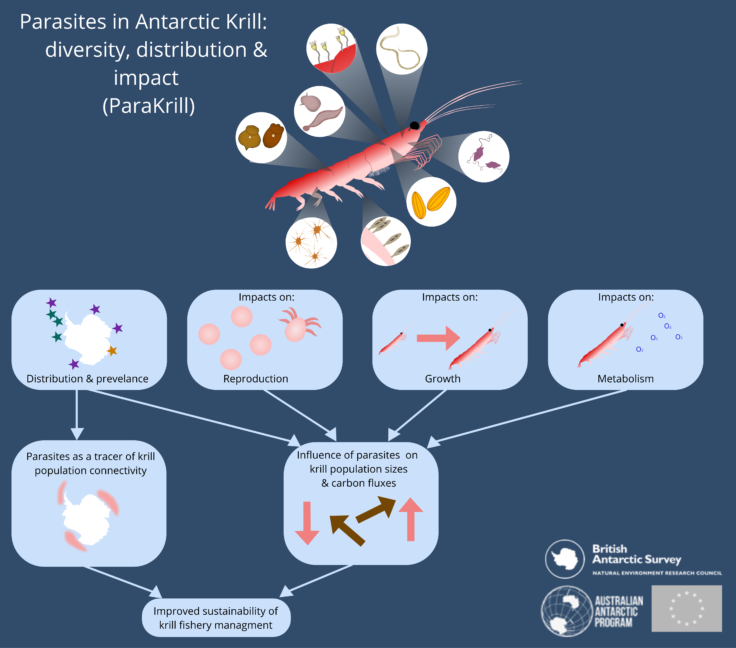
A schematic illustration of the research components in ParaKrill.
The project is conducted in partnership between BAS and the Australian Antarctic Programme.
Understanding krill-parasite interactions helps predict krill population dynamics. It also improves models of Antarctic ecosystem function. This knowledge is vital for sustainable management of krill fisheries and the conservation of Antarctic food webs.
Parasites may provide a new tool for tracking krill movement and interactions. This has implications for both fisheries management and ecosystem monitoring.
It will:
Science Leader IMP 3
Krill Ecologist