
Science Leader
BAS Science Strategy Executive Group, Atmosphere, Ice and Climate team

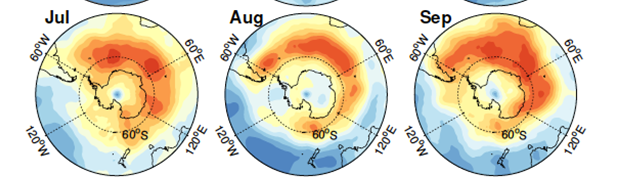
DRAGON-WEX (the DRake pAssaGe and sOuthern oceaN – Wave EXperiment) is a NERC funded standard grant between the University of Bath and the British Antarctic Survey. We will implement and exploit an exceptionally powerful new 3D satellite analysis method we have developed. Our method detects individual gravity waves in the stratosphere and determines their amplitude, propagation direction, wavelengths and, critically, directional momentum flux – all using just a single satellite. It thus offers a transformational increase in capability over previous methods. The centrepiece of our proposal is the first comprehensive use of this method to detect ~100,000 individual gravity waves over the Drake Passage and Southern Ocean near 60°S. This is a region where “missing” gravity-wave momentum flux in Global Circulation Models gives rise to the significant stratospheric “cold-pole” problem and one where wave fluxes, sources and intermittency (variability) are very poorly known. We will measure the wave climatology, fluxes and intermittency and investigate their sources. We will complement these measurements with data from radiosondes in the troposphere/lower-stratosphere and from two meteor radars sounding the mesosphere, one at Rothera on the Antarctic Peninsula and one which is the first such radar on the remote mountainous island of South Georgia, located at King Edward Point.
The meteor radars detect the ionised trails of meteors drifting with the winds of the upper mesosphere in a region ~ 300 km in diameter centred over each radar. The radars use these drifts to determine zonal and meridional winds at heights of 80 – 100 km with height and time resolutions of ~ 2 km and 1 hour. Both the radars can make continuous measurements over periods of many years and so are ideally suited to studies of winds, tides and waves. Statistical techniques applied to the individual meteor drifts allow us to determine the variances and momentum fluxes of gravity waves.
The data tab will show the daily winds and meteor distributions from the meteor radars at Rothera and South Georgia.
Gravity waves are atmospheric waves that can be generated by winds blowing over mountains, storms, unstable jet streams and strong convection. As the waves ascend from their sources in the lower atmosphere, into the stratosphere and mesosphere, they transport momentum in a “momentum flux”. When the waves become unstable they “break”, rather like ocean surface waves breaking on a beach. This acts to transfer their momentum into the atmosphere, exerting a “drag force” that dramatically influences the global atmospheric circulation.
Computer General Circulation Models (GCMs) used for numerical weather prediction and climate research must represent these waves realistically if they are to predict the behaviour of the real atmosphere. However, the GCMs display “biases” in which the behaviour they predict does not match that revealed by observations. The largest biases in nearly all GCMs occur in the winter and springtime Antarctic stratosphere. There, they produce a polar region, the “polar vortex”, that when compared to observations, is too cold by 5-10 K, has winds that are too strong by about 10 m/s and that persists some 2-3 weeks too long into spring before it breaks up. These significant biases are known as the “cold pole” problem.
It is now realised that the biases arise because the GCMs are missing large amounts of gravity-wave flux that must occur in the real atmosphere at latitudes near 60 degrees S. These latitudes include the stormy Southern Ocean and the Drake Passage. However, the nature, sources, variability and fluxes of these “missing” waves are currently very uncertain. In DRAGON-WEX (DRake pAssaGe sOuthern oceaN – Wave EXperiment) we will use satellites, radiosondes and radars to directly measure the waves over the Southern Ocean and Drake Passage near 60 S, determine their properties and investigate their role in coupling together the troposphere, stratosphere and mesosphere. Our results will thus help resolve the cold pole problem.
We will apply a very powerful novel 3D method we have developed for analysing satellite data. With our method, we can detect individual gravity waves in the stratosphere in 3D and measure their momentum fluxes. Importantly, because it is a fully 3D method we can do this without the needing the assumptions that critically limit earlier 1D and 2D methods. We will use our method to identify an estimated 100,000 individual gravity waves near 60 S.
We will combine the satellite observations with measurements of gravity waves made by radiosondes (“weather balloons”) and radars to characterise the “missing” gravity waves, determining their short-term and seasonal variability and investigate their sources – in particular, the contributions made to the waves by the mountains of the Southern Andes and Antarctic Peninsula, storms over the Southern Ocean/Drake Passage, unstable jet streams and by waves propagating into the 60 S region from latitudes to the North or South.
We will use a unique combination of meteor radars, one in the Antarctic and a new radar on the remote mountainous island of South Georgia to measure the winds, waves and tides of the mesosphere. We will determine the degree to which fluctuations in the waves we measure in the stratosphere drive the variability of the mesosphere and, in particular, the role of waves in driving anomalous events recently observed at heights near 90 km in the polar mesosphere, when the Northward winds of the general circulation appeared to briefly cease and when the occurrence frequency of polar mesospheric clouds was greatly reduced.
We will use meteor radars on the island of South Georgia and at Rothera in the Antarctic to investigate recent suggestions that waves generated by mountains can propagate to heights of 90 km or more – effectively the edge of space.
We will also work closely with the Met Office to use our results to test and improve their Unified Model GCM.
We will make measurements of gravity waves in the stratosphere and mesosphere at latitudes near 60 degrees S where nearly all current Global Circulation Models (GCMs) significantly under-represent the wave momentum fluxes, resulting in the most serious biases found anywhere in the models. We will use an exceptionally powerful new satellite data-analysis method to deliver the most sophisticated climatology of gravity-wave momentum fluxes achieved to date. We will combine these observations with measurements made by radiosondes and meteor radar to provide additional measurements of the gravity-wave fields in the stratosphere and mesosphere respectively. These measurements will be a major asset for future GCM development. We will use our observations to determine the impact of these waves on the mesosphere and to search for orographic waves at these heights.
Specifically, we will:
Prof Nick Mitchell (University of Bath)
Dr Neil Hindley (University of Bath)
Dr Corwin Wright (Royal Society Research Fellow based at University of Bath)
Most recent data plots from the King Edward Point (South Georgia) and Rothera Skiymet wind radars. The Rothera radar data is below the King Edward Point plots.
We show the total distribution of meteors for a given day across all height bins and also the meridional and zonal winds across 82 km – 96 km altitude.
The data for these plots (and previous days) can be found at the link below. If you wish to use the data or require previous days plots then please contact the grant PIs: Prof Nick Mitchell or Dr Tracy Moffat-Griffin.
http://psddb.nerc-bas.ac.uk/data/access/coverage.php?menu=4&source=1&class=58&script=1.