Sedimentologist

The biggest uncertainty in predictions of sea-level rise is what the contribution will be from the great ice sheets on Antarctica and Greenland as climate warms. The West Antarctic Ice Sheet and the Antarctic Peninsula Ice Sheet are the cause of greatest concern, as they are showing signs of significant ice loss and there are theoretical reasons for expecting them to be most vulnerable.
Important sources of information for helping to predict how these ice sheets will change as climate warms are records of their response to past climate changes contained in sea bed sediments around Antarctica. Such records extend further back in time than ice cores from the ice sheets themselves. They can also show how the margins of the ice sheets interacted with changes in ocean temperature and circulation, which recent studies have identified as having an important influence on ice sheets.
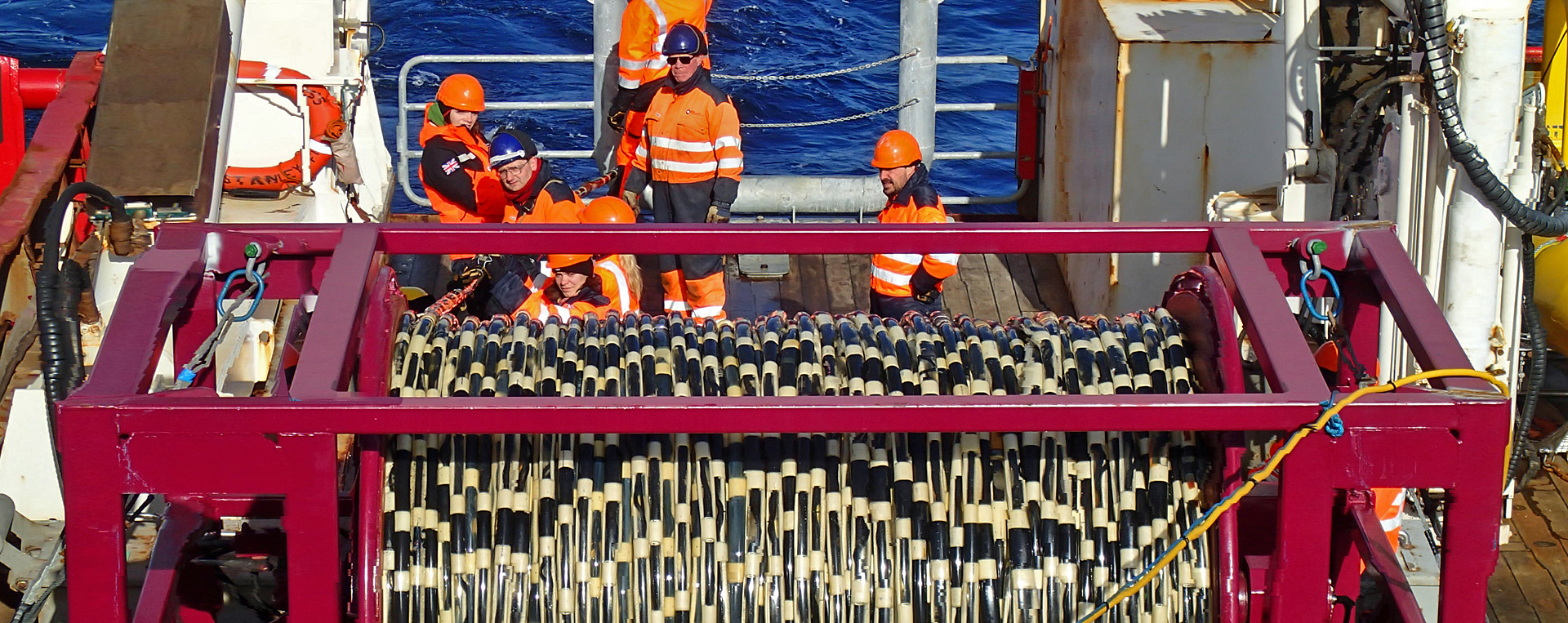
Although sedimentary records in the shallow seas close to Antarctica have been periodically disturbed or removed by past advances of the ice sheets, there are places in the nearby deep ocean where sediments have accumulated continuously over millions of years. The international Integrated Ocean Drilling Program has given scientific approval to a proposal to send the JOIDES Resolution drill ship to collect long sediment cores from some of these places. However, in order to optimise the effectiveness of this drilling expedition additional survey data are needed to refine the choice of drilling sites that will provide the most continuous, detailed records and to make sure that it will be safe to drill those sites. The main purpose of this project is to provide these essential survey data. We collected nearly 2000 line-km of multichannel seismic survey data on RRS James Clark Ross Cruise JR298 between January-March 2015, and those data are now being processed.
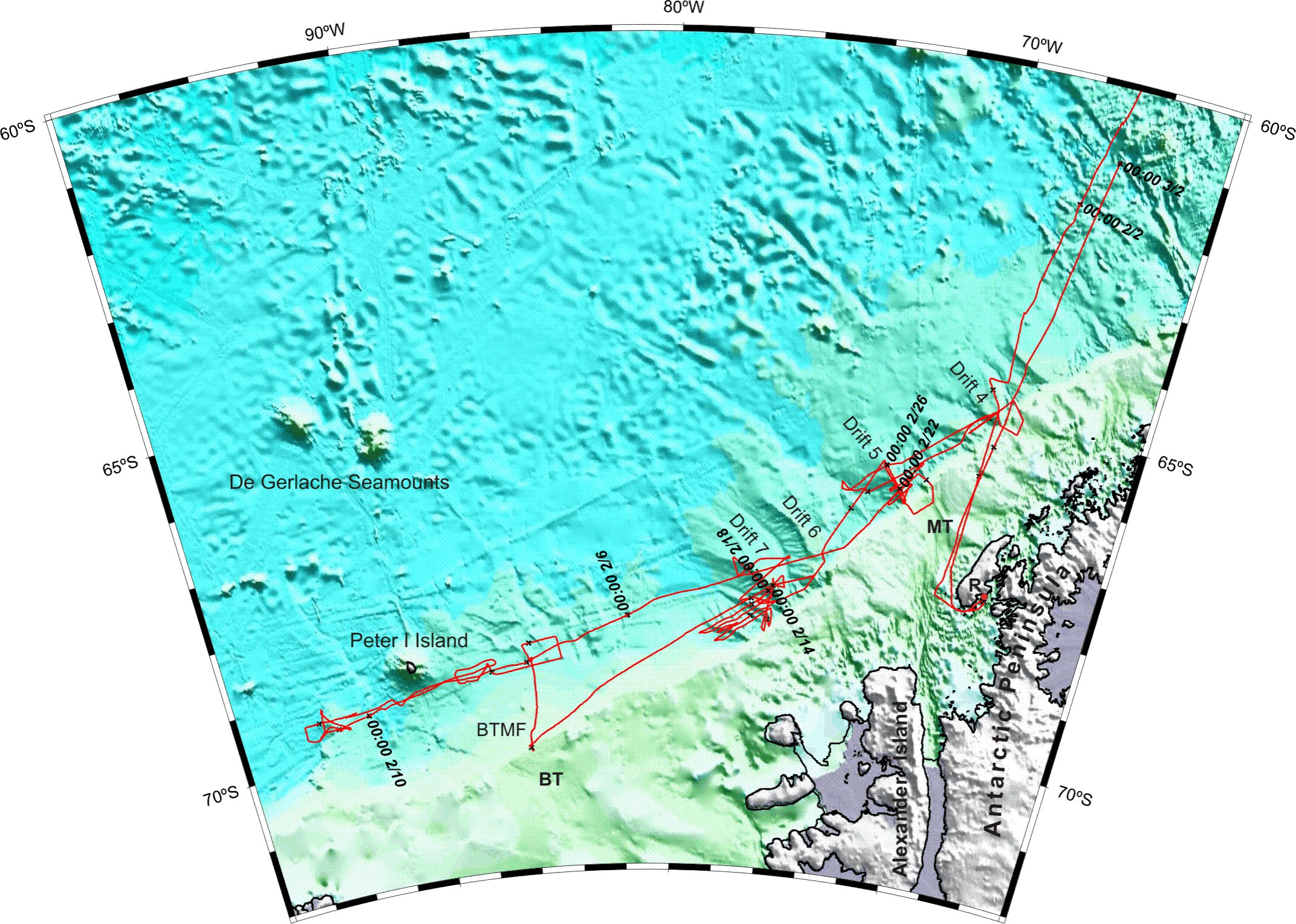
Track of IODP site survey cruise JR298 (red line) in West Antarctica
On the same expedition we also collected short sediment cores for pilot studies to confirm that the analytical methods we intend to apply to the longer drill cores will provide reliable information about sediment ages, past climate and past ice sheet behaviour. One of the major difficulties in studying sediment records from the sea bed around Antarctica has been obtaining reliable ages from the sediments. This is because the types of microfossils that are analysed to determine sediment ages in drill cores from most of the world’s oceans are rare or absent in many sediment cores collected near Antarctica. With our new survey data and through studying the cores we collected we aim to identify sites where there are sufficient numbers of these microfossils to apply the standard dating techniques.
We also plan to test whether a new method of dating sediments that is based on analysis of their magnetic properties will work in the area of the proposed drill sites. It has recently been shown that in many places analysis of the magnetic properties of sea bed sediments can provide records of past changes in the intensity of the Earth’s magnetic field, and comparison of these records to well-dated reference records allows ages to be assigned to sediments throughout a core. By comparing ages obtained using this method with ones obtained from microfossils, where they are present, we will be able to find out how well the magnetic dating method works in the study area. If the magnetic method works well, we will be able to establish detailed age models for drill cores without dependence on microfossils, which will greatly extend the area that can be studied by drilling and allow more detailed records of past changes to be derived from the drill cores.
Sedimentologist
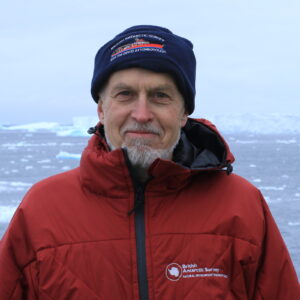
Dep Science Leader of Palaeo Environments IMP 3
BAS Science Strategy Executive Group, Palaeo Environments, Ice Sheets and Climate Change team
Co-Investigators
David Hodell (University of Cambridge)
Alastair Graham (University of Exeter)
Project Partners
Jim Channell (University of Florida, USA)
Javier Hernández-Molina (Royal Holloway University of London)
Michele Rebesco (Instituto Nazionale di Oceanografia e di Geofisica Sperimatale, Trieste, Italy)
Karsten Gohl (Alfred Wegener Institute for Polar and Marine Research, Bremerhaven, Germany)
Gabriele Uenzelmann-Neben (Alfred Wegener Institute for Polar and Marine Research, Bremerhaven, Germany)
Colm Ó Cofaigh (Durham University) and Jenny Horrocks (Durham University/BAS PhD student) – NERC Collaborative Gearing Scheme project (CGS-98) Structural characterisation of Late Quaternary sedimentary sequences recovered from West Antarctic contourite drifts by using three-dimensional X-ray imaging (CT-scanning)
Alex Piotrowski (University of Cambridge) and Tom Williams (BAS/University of Cambridge PhD student) – NERC Collaborative Gearing Scheme project (CGS-100) Tracing and reconstructing the neodymium and carbon isotopic composition of circum-Antarctic waters
Carys Cook (University of Florida) – Antarctic Science Bursary project Tracing the Quaternary evolution of the Antarctic Peninsula and West Antarctic Ice Sheets using lead isotopes in ice-rafted feldspar mineral grains
Nicky White (University of Cambridge) and Kathryn Gunn (University of Cambridge PhD student) – PhD project component on Seismic imaging of oceanographic structures and processes in the Southern Ocean south of the Polar Front
Tom Jordan (BAS) – Collaborative project between BAS science teams on Modelling crustal structure across the Bellingshausen Gravity Anomaly and oceanic fracture zones formed at the Antarctic-Phoenix Ridge through integration of marine potential field and seismic data
Chuang Xuan (University of Southampton) – working with Jim Channell on deriving relative palaeomagneitc intensity records from the sediment cores collected on cruise JR298
Lara Pérez (now at Geological Survey of Denmark and Greenland) – working with Javier Hernández-Molina on seismic stratigraphic interpretation of contourite drift deposits
Elanor Gowland (NERC Polar Data Centre) – data management
Ricarda Pietsch (PhD student at Alfred Wegener Institute for Polar and Marine Research, Bremerhaven, Germany) – working with Gabriele Uenzelmann Neben and Karsten Gohl on seismic data interpretation
R.D. Larter BAS Chief Scientist
C.-D. Hillenbrand BAS Marine Geologist
K.A. Hogan BAS Marine Geophysicist
T.A.R.M. Jordan BAS Geophysicist
E.J. Gowland BAS Data Manager
J.E.T. Channell Univ. Florida Palaeomagnetist
C. Cook Univ. Florida Marine Geologist/Geochemist
A.G.C. Graham Univ. Exeter Marine Geophysicist
F.J. Hernández-Molina RHUL Marine Geophysicist
L. Pérez Univ. Granada Marine Geophysicist
A.M. Piotrowski Univ. Cambridge Palaeoceanographer
C. Xuan Univ. Southampton Palaeomagnetist
K.L. Gunn Univ. Cambridge PhD student (Marine Geophysicist)
J. Horrocks Univ. Durham/BAS PhD student (Marine Geologist)
R. Pietsch AWI PhD student (Marine Geophysicist)
T.J. Williams BAS/Univ. Cambridge PhD student (Palaeoceanographer)
S.D. Polfrey BAS AME (Mechanical Engineer)
M.O. Preston BAS AME (Electronic Engineer)
P.E. Morgan BAS AME (Electronic Engineer)
A. England BAS ICT (Computing Engineer)
J.C. Hancock EEL Seismic Systems Engineer
I. Miller EEL Airgun Mechanic
S.G. Paterson EEL Seismic Systems Engineer
BAS = British Antarctic Survey; AWI = Alfred Wegener Institute; RHUL = Royal Holloway University of London; AME = BAS Antarctic & Marine Engineering Section; ICT = BAS Information Communications Technology Section; EEL = Exploration Electronics Ltd
New season tackles ambitious science and logistical challenges The British Antarctic Survey (BAS) 2015/16 field season is underway with dozens of scientists and support staff – together with planes and tonnes […]
The largest British Antarctic facility is a centre for biological research and a hub for supporting deep-field science.