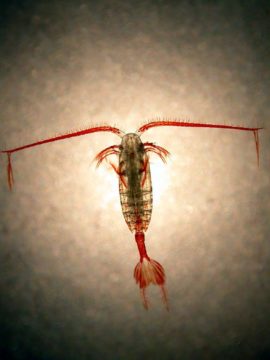
Zooplankton Ecologist


The four-year COMICS project, is led by the National Oceanography Centre, is a collaboration between the British Antarctic Survey and the universities of Queen Mary London, Liverpool, Oxford and Southampton.
New data and new technologies from two research cruises will enable our research teams to build on previous research and shed light on carbon transport processes in the ‘twilight zone’ – the part of the ocean between 100m and 1000m below the sea surface, where only a small amount of light from the sun can still penetrate. It is currently known that the efficiency of carbon transport from the atmosphere through this zone is key to regulating atmospheric CO2 levels
Research teams will make observations at sea of particle flux and quantify interior biological processes using stable isotopes. They will apply organic geochemical and molecular biological techniques to samples collected using nets and traps.
Scientists know that without ocean biology atmospheric CO2 levels would be 50% higher that they are today. A key goal for this project is to gerenated a deeper understanding of the biological carbon pump that regulates the Earth’s climate. This new knowledge isdeeply relevant to society and critically important for developing policies and strategies for a sustainable future.
Research outcomes from this project will contribute directly to the next IPCC (Intergovernmental Panel for Climate Change) Assessment.
Follow the team blog here
The processes that control the efficiency of biological storage of carbon in the deep ocean are not well known, which is an obstacle to predicting how they may change. By investigating carbon dynamics in the ocean interior, COMICS will:
Zooplankton Ecologist

Marine Ecologist
Science Leader IMP 3
 |
As above |
 |
Richard Sanders
Stephanie Henson |
| University of Southampton | Mark Moore Phyllis Lam |
| University of Liverpool | George Wolff |
| University of Oxford | Samar Khatiwala |
| Queen Mary University, London | Mark Trimmer |
Today the royal research ship RRS Discovery will depart Southampton for an ambitious science expedition to the ocean around South Georgia. This expedition will take place almost 100 years after […]