Whole Atmosphere Climate Change
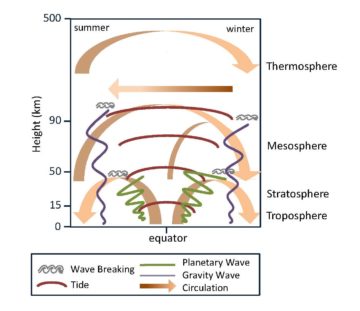
Whole Atmosphere Climate Change project investigated how human-driven climate change in the lower atmosphere affects upper atmosphere conditions up to 500 km altitude.

Profile
I am an Independent Research Fellow within the Space Weather and Atmosphere team at BAS. My research focuses on the climate of the upper atmosphere and interactions between the lower and upper atmosphere using numerical models. Alongside my own research, I offer modelling support to projects led by others as well as expertise on upper atmosphere climate. I also provide stakeholders in the space industry with information on long-term changes in the upper atmosphere and impacts on space debris.
Key areas of expertise
Biography
In 2005 I received a Master of Science degree from Utrecht University (The Netherlands) in the field of Earth Sciences, with a specialization in geophysics. As part of this, I did an internship at the European Space Agency, studying the Sun and its effects on the Earth’s atmosphere as it would have been around the orgin of life, 3.5 billion years ago. This ignited my interest in solar-terrestrial physics as well as a love for research in general, especially in an international setting. It set me on the path of a PhD at the University of Leicester (Leicester, UK; 2006-2008), where I studied climate change in the upper atmosphere (~90-500 km altitude) and in particular the the effects of changes in the Earth’s magnetic field on the ionosphere, the charged portion of the upper atmosphere. After a first post-doctoral position at the British Antarctic Survey (BAS; Cambridge, UK; 2009-2010) studying troposphere-stratosphere coupling, I continued to study the role of the Earth’s magnetic field in the climate of the upper atmosphere in further research posts at the National Center for Atmospheric Research (NCAR; Boulder, USA; 2011-2012), BAS (2013-2015) and the German Center for Geosciences (Potsdam, Germany; 2016). This has included its role in long-term (climatic) changes as well as systematic asymmetries between the Northern and Southern polar regions. I have been an Independent Research Fellow (IRF) at BAS since Dec 2018, funded by the Natural Environment Research Council (NERC). My fellowship focuses on the effects of climate change in the lower and middle atmosphere (0-90 km altitude) on the upper atmosphere (90-500 km altitude), using the Whole Atmosphere Community Climate Model eXtension (WACCM-X).
Lastovicka, Jan. Qian, Liying. Añel, Juan A. Brown, Matthew K. Cnossen, Ingrid ORCID record for Cnossen, Ingrid. Elias, Ana G. Jacobi, Christoph. Li, Tao. Sofieva, Viktoria. (2026) Scenario of global climate change in the Stratosphere-Mesosphere-Thermosphere-Ionosphere system.
Peña-Asensio, Eloy. Vida, Denis. Cnossen, Ingrid ORCID record for Cnossen, Ingrid. Ferrer, Esteban. (2025) Century-scale effect of climate change on meteorite falls.
Añel, Juan A. Cnossen, Ingrid ORCID record for Cnossen, Ingrid. Antuña‐Marrero, Juan Carlos. Beig, Gufran. Brown, Matthew K. Doornbos, Eelco. Osprey, Scott. Mutschler, Shaylah Maria. Pérez Souto, Celia. Šácha, Petr. Sofieva, Viktoria. de la Torre, Laura. Zhang, Shun‐Rong. Mlynczak, Martin G. (2025) The Need for Better Monitoring of Climate Change in the Middle and Upper Atmosphere.
Cnossen, Ingrid ORCID record for Cnossen, Ingrid. Emmert, John T. Garcia, Rolando R. Elias, Ana G. Mlynczak, Martin G. Zhang, Shun-Rong. (2024) A review of global long-term changes in the mesosphere, thermosphere and ionosphere: a starting point for inclusion in (semi-)empirical models.
Brown, M.K. Lewis, H.G. Kavanagh, A.J. ORCID record for Kavanagh, A.J.. Cnossen, I. ORCID record for Cnossen, I.. Elvidge, S. (2024) Future Climate Change in the Thermosphere Under Varying Solar Activity Conditions.
Brown, M.K. Elvidge, S. Themens, D.R. Lewis, H.G. Kavanagh, A.J. ORCID record for Kavanagh, A.J.. Cnossen, I. ORCID record for Cnossen, I.. (2023) Days to Decades: Forecasting Neutral Densities in Low Earth Orbit.
Coyle, S.E. Hartinger, M.D. Clauer, C.R. Baker, J.B.H. Cnossen, I. ORCID record for Cnossen, I.. Freeman, M.P. ORCID record for Freeman, M.P.. Weygand, J.M. (2023) The 2021 Antarctic Total Eclipse: Ground Magnetometer and GNSS Wave Observations from the 40 Degree Magnetic Meridian.
Zhang, Shun-Rong. Cnossen, Ingrid ORCID record for Cnossen, Ingrid. Laštovička, Jan. Elias, Ana G. Yue, Xinan. Jacobi, Christoph. Yue, Jia. Wang, Wenbin. Qian, Liyang. Goncharenko, Larisa. (2023) Long-term geospace climate monitoring.
Cnossen, I. ORCID record for Cnossen, I.. (2022) A realistic projection of climate change in the upper atmosphere into the 21st century.
Shutler, Jamie D. Yan, Xiaoyu. Cnossen, Ingrid ORCID record for Cnossen, Ingrid. Schulz, Leonard. Watson, Andrew J. Glaßmeier, Karl-Heinz. Hawkins, Naomi. Nasu, Hitoshi. (2022) Atmospheric impacts of the space industry require oversight [Comment].
Brown, M.K. Lewis, H.G. Kavanagh, A.J. ORCID record for Kavanagh, A.J.. Cnossen, I. ORCID record for Cnossen, I.. (2021) Climate change in space: Thermospheric density reductions in LEO and the impact on the debris environment.
Brown, M.K. Lewis, H.G. Kavanagh, A.J. ORCID record for Kavanagh, A.J.. Cnossen, I. ORCID record for Cnossen, I.. (2021) Future decreases in thermospheric neutral density in low Earth orbit due to carbon dioxide emissions.
Cnossen, I. ORCID record for Cnossen, I.. (2020) Analysis and attribution of climate change in the upper atmosphere from 1950 to 2015 simulated by WACCM-X.
Soares, Gabriel B. Yamazaki, Yosuke. Cnossen, Ingrid ORCID record for Cnossen, Ingrid. Matzka, Jürgen. Pinheiro, Katia. Morschhauser, Achim. Alken, Patrick. Stolle, Claudia. (2020) Evolution of the geomagnetic daily variation at Tatuoca, Brazil, from 1957 to 2019: a transition from Sq to EEJ.
Cnossen, I. ORCID record for Cnossen, I.. Maute, A. (2020) Simulated trends in ionosphere-thermosphere climate due to predicted main magnetic field changes from 2015 to 2065.
Cnossen, I. ORCID record for Cnossen, I.. Ridley, A.J. Goncharenko, L.P. Harding, B.J. (2019) The response of the ionosphere-thermosphere system to the August 21, 2017 solar eclipse.
Aryal, Saurav. Geddes, George. Finn, Susanna C. Mrak, Sebastijan. Galkin, Ivan. Cnossen, Ingrid ORCID record for Cnossen, Ingrid. Cook, Timothy. Chakrabarti, Supriya. (2019) Multi-spectral and multi-instrument observation of TIDs following the Total Solar Eclipse of August 21, 2017.
Perlongo, N.J. Ridley, A.J. Cnossen, I. ORCID record for Cnossen, I.. (2018) A year long comparison of GPS TEC and global ionosphere-thermosphere models.
Cnossen, Ingrid ORCID record for Cnossen, Ingrid. (2016) The impact of century-scale changes in the core magnetic field on external magnetic field contributions.
Laundal, K.M. Cnossen, I. ORCID record for Cnossen, I.. Milan, S.E. Haaland, S.E. Coxon, J. Pedatella, N.M. Forster, M. Reistad, J.P. (2016) North-South asymmetries in Earth’s magnetic field.
Cnossen, Ingrid ORCID record for Cnossen, Ingrid. Liu, Hanli. Lu, Hua ORCID record for Lu, Hua. (2016) The whole-atmosphere response to changes in the Earth’s magnetic field from 1900 to 2000: an example of “top-down” vertical coupling.
Cnossen, Ingrid ORCID record for Cnossen, Ingrid. Forster, Matthias. (2016) North-South asymmetries in the polar thermosphere-ionosphere system: solar cycle and seasonal influences.
Cnossen, Ingrid ORCID record for Cnossen, Ingrid. Laštovička, Jan. Emmert, John T. (2016) Introduction to special issue on “Long-term changes and trends in the stratosphere, mesosphere, thermosphere and ionosphere”.
Emmert, John. T. Marsh, Daniel R. Cnossen, Ingrid ORCID record for Cnossen, Ingrid. (2015) Investigating Climate Change from the Stratosphere to Space.
Cnossen, Ingrid ORCID record for Cnossen, Ingrid. Franzke, Christian. (2014) The role of the Sun in long-term change in the F2 peak ionosphere: new insights from EEMD and numerical modelling.
Cnossen, Ingrid ORCID record for Cnossen, Ingrid. (2014) The importance of geomagnetic field changes versus rising CO2 levels for long-term change in the upper atmosphere.
Forster, Matthias. Cnossen, Ingrid ORCID record for Cnossen, Ingrid. (2013) Upper atmosphere differences between the high-latitude Northern and Southern Hemisphere: the role of magnetic field asymmetry.
de Haro Barbas, Blas F. Elias, Ana G. Cnossen, Ingrid ORCID record for Cnossen, Ingrid. Zossi de Artigas, Marta. (2013) Long-term changes in solar quiet (Sq) geomagnetic variations related to Earth’s magnetic field secular variation.
Lu, Hua ORCID record for Lu, Hua. Pancheva, Dora. Mukhtarov, Plamen. Cnossen, Ingrid ORCID record for Cnossen, Ingrid. (2012) QBO modulation of traveling planetary waves during northern winter.
Cnossen, Ingrid ORCID record for Cnossen, Ingrid. Lu, Hua ORCID record for Lu, Hua. (2011) The vertical connection of the quasi-biennial oscillation- modulated 11 year solar cycle signature in geopotential height and planetary waves during Northern Hemisphere early winter.
Cnossen, I. ORCID record for Cnossen, I.. Lu, H. ORCID record for Lu, H.. Bell, C.J. Gray, L.J. Joshi, M.M. (2011) Solar signal propagation: The role of gravity waves and stratospheric sudden warmings.
Cnossen, I. (2015). Coupled Magnetosphere-Ionosphere-Thermosphere simulations for March equinox, June solstice and December solstice for solar maximum and minimum conditions (Version 1.0) [Data set]. NERC EDS UK Polar Data Centre. https://data.bas.ac.uk/full-record.php?id=GB/NERC/BAS/PDC/00830
Whole Atmosphere Climate Change project investigated how human-driven climate change in the lower atmosphere affects upper atmosphere conditions up to 500 km altitude.
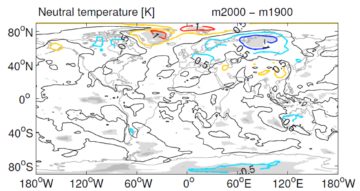
The effects of long-term changes in the Earths magnetic field on the atmosphere understanding the past predicting the future.
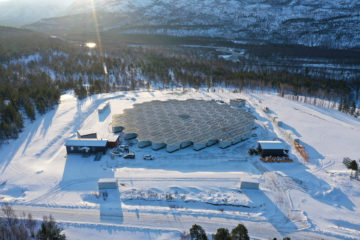
DRIIVE researches how polar ionosphere changes affect satellite orbits, communications, and space weather forecasts.
NERC Independent Research Fellowship ““Impacts of Climate Change in the Troposphere, Stratosphere, and Mesosphere on the Thermosphere and Ionosphere”
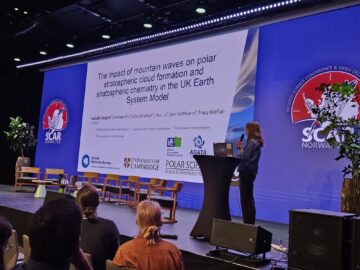
Our Antarctic experts attend the SCAR Open Science Conference in Oslo, sharing their latest findings and shaping plans for future collaboration.
Satellites face greater chances of collision with space debris as a result of reduced density in the upper atmosphere. Increasing levels of CO2 in the Earth’s atmosphere will result in […]

Earth’s magnetic field is important for climate change at high altitudes New research, published this week, has provided scientists with greater insight into the climatic changes happening in the upper […]