Understanding Greenland’s changing ice
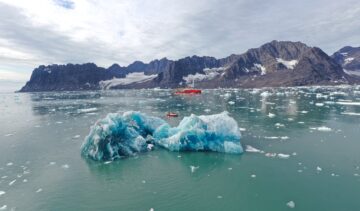
GIANT is a pioneering science project that will test the potential for early warning of a critical climate tipping point.

I am an ice sheet modeller specialising in combining physics-based models with remote and field observations and machine learning. I am interested in improving projections of the future of Antarctica by bringing together data assimilation and a deeper understanding of the important physical processes within the ice sheet and its interactions with the ocean and atmosphere. I am part of the International Thwaites Glacier Collaboration MELT project and the NERC-funded ENSO-WAIS project, which aims to quantify the retreat of the West Antarctic Ice Sheet in the context of both anthropogenic change and natural variability. Previously at BAS I have worked on NERC-funded projects to investigate the propagation of ocean-driven ice-shelf thinning and consequences for the interior of Antarctica and global sea level, and on model initialisation as part of the EU funded ice2sea programme.
I am a mathematician by training and have previously worked on constructing, modifying and evaluating mathematical models of biological systems. Projects I have worked on include modelling the collective swimming behaviour of microorganisms and constructing a dynamical model of hydrogen production from green algae.
Current and recent grants:
2024-2028: Co-Investigator and Work Package lead (PI: Professor Tony Payne), Interacting ice Sheet and Ocean Tipping – Indicators, Processes, Impacts and Challenges (ISOTIPIC), NERC Highlight Topic.
2022-2026: Co-Investigator and Work Package Lead (PI: Dr Louise Sime), SURface FluxEs In AnTarctica (SURFEIT), NC-International.
2021-2022: Co-Investigator (PI: Dr Scott Hosking), Towards an Antarctic Digital Twin for instantaneous decision-making . NERC feasibility study (5 months),
2019-2024: Co-Investigator (PI: Dr Robert Arthern), West Antarctic Ice Sheet retreat in the context of ENSO variability (ENSO-WAIS), NERC Standard Grant.
2018-2025: (PIs: Dr Keith Nicholls and Professor David Holland) Melting at Thwaites grounding zone and its control on sea level, International Thwaites Glacier Collaboration (ITGC-MELT). NSF/NERC.
Hank, Kevin. Arthern, Robert J. ORCID record for Arthern, Robert J.. Williams, C. Rosie ORCID record for Williams, C. Rosie. Brisbourne, Alex M. ORCID record for Brisbourne, Alex M.. Smith, Andrew M. ORCID record for Smith, Andrew M.. Smith, James A. ORCID record for Smith, James A.. Wåhlin, Anna. Anandakrishnan, Sridhar. (2026) Inferring the ice sheet sliding law from seismic observations: A Pine Island Glacier case study.
Williams, C. Rosie ORCID record for Williams, C. Rosie. Thodoroff, Pierre. Arthern, Robert J. ORCID record for Arthern, Robert J.. Byrne, James ORCID record for Byrne, James. Hosking, J. Scott ORCID record for Hosking, J. Scott. Kaiser, Markus. Lawrence, Neil D. Kazlauskaite, Ieva. (2025) Calculations of extreme sea level rise scenarios are strongly dependent on ice sheet model resolution.
Bradley, Alexander T. ORCID record for Bradley, Alexander T.. Arthern, Robert J. ORCID record for Arthern, Robert J.. Bett, David T. ORCID record for Bett, David T.. Williams, C. Rosie ORCID record for Williams, C. Rosie. Byrne, James ORCID record for Byrne, James. (2024) WAVI.jl: Ice Sheet Modelling in Julia.
Bradley, Alexander T. ORCID record for Bradley, Alexander T.. Bett, David T. ORCID record for Bett, David T.. Holland, Paul R. ORCID record for Holland, Paul R.. Williams, C. Rosie ORCID record for Williams, C. Rosie. Arthern, Robert J. ORCID record for Arthern, Robert J.. De Rydt, Jan. (2024) A framework for estimating the anthropogenic part of Antarctica’s sea level contribution in a synthetic setting.
Bett, David T. ORCID record for Bett, David T.. Bradley, Alexander T. ORCID record for Bradley, Alexander T.. Williams, C. Rosie ORCID record for Williams, C. Rosie. Holland, Paul R. ORCID record for Holland, Paul R.. Arthern, Robert J. ORCID record for Arthern, Robert J.. Goldberg, Daniel N. (2023) Coupled ice–ocean interactions during future retreat of West Antarctic ice streams in the Amundsen Sea sector.
Bradley, Alexander T. ORCID record for Bradley, Alexander T.. Williams, C. Rosie ORCID record for Williams, C. Rosie. Jenkins, Adrian. Arthern, Robert ORCID record for Arthern, Robert. (2022) Asymptotic analysis of subglacial plumes in stratified environments.
Cornford, Stephen L. Seroussi, Helene. Asay-Davis, Xylar S. Gudmundsson, G. Hilmar. Arthern, Robert ORCID record for Arthern, Robert. Borstad, Chris. Christmann, Julia. Dias dos Santos, Thiago. Feldmann, Johannes. Goldberg, Daniel. Hoffman, Matthew J. Humbert, Angelika. Kleiner, Thomas. Leguy, Gunter. Lipscomb, William H. Merino, Nacho. Durand, Gaël. Morlighem, Mathieu. Pollard, David. Rückamp, Martin. Williams, C. Rosie ORCID record for Williams, C. Rosie. Yu, Hongju. (2020) Results of the third Marine Ice Sheet Model Intercomparison Project (MISMIP+).
Arthern, Robert J. ORCID record for Arthern, Robert J.. Williams, C. Rosie ORCID record for Williams, C. Rosie. (2017) The sensitivity of West Antarctica to the submarine melting feedback.
Arthern, Robert J. ORCID record for Arthern, Robert J.. Hindmarsh, Richard C.A. ORCID record for Hindmarsh, Richard C.A.. Williams, C. Rosie ORCID record for Williams, C. Rosie. (2015) Flow speed within the Antarctic ice sheet and its controls inferred from satellite observations.
McEwan, W. A. Hauler, F. Williams, C. R. ORCID record for Williams, C. R.. Bidgood, S. R. Mallery, D. L. Crowther, R. A. James, L. C. (2014) Regulation of Virus Neutralization and the Persistent Fraction by TRIM21.
Williams, C. Rosie ORCID record for Williams, C. Rosie. Hindmarsh, Richard C.A. ORCID record for Hindmarsh, Richard C.A.. Arthern, Robert J. ORCID record for Arthern, Robert J.. (2014) Calculating balance velocities with a membrane stress correction.
Williams, C. R. ORCID record for Williams, C. R.. Bees, M. A. (2013) Mechanistic modeling of sulfur-deprived photosynthesis and hydrogen production in suspensions of Chlamydomonas Reinhardtii.
Barrand, Nicholas E. Hindmarsh, Richard C.A. ORCID record for Hindmarsh, Richard C.A.. Arthern, Robert J. ORCID record for Arthern, Robert J.. Williams, C. Rosie ORCID record for Williams, C. Rosie. Mouginot, Jérémie. Scheuchl, Bernd. Rignot, Eric. Ligtenberg, Stefan R.M. Van Den Broeke, Michiel R. Edwards, Tamsin L. Cook, Alison J. Simonsen, Sebastian B. (2013) Computing the volume response of the Antarctic Peninsula ice sheet to warming scenarios to 2200.
Williams, C. Rosie ORCID record for Williams, C. Rosie. Hindmarsh, Richard C.A. ORCID record for Hindmarsh, Richard C.A.. Arthern, Robert J. ORCID record for Arthern, Robert J.. (2012) Frequency response of ice streams.
Hank, K., Arthern, R., & Williams, C. (2025). Acoustic impedance misfits and basal sliding law probabilities for Pine Island Glacier (Version 1.0) [Data set]. NERC EDS UK Polar Data Centre. https://doi.org/10.5285/c560ce43-7aa0-4474-90ed-d4ee5f5768ea
Bett, D., Bradley, A., Williams, R., Holland, P., Arthern, R., & Goldberg, D. (2024). Amundsen Sea sector MITgcm/WAVI coupled model output forced with idealised ocean boundary conditions over 180 years (Version 1.0) [Data set]. NERC EDS UK Polar Data Centre. https://doi.org/10.5285/baa5097e-5139-4d8b-8986-3cc84c3319b7
Arthern, R., Williams, R., Hindmarsh, R., & Pritchard, H. (2022). Fields and parameters related to the flow of ice in the Antarctic Ice Sheet recovered using inverse methods and satellite data (Version 1.0) [Data set]. NERC EDS UK Polar Data Centre. https://doi.org/10.5285/5f0ac285-cca3-4a0e-bcbc-d921734395ab
GIANT is a pioneering science project that will test the potential for early warning of a critical climate tipping point.
SURFEIT unites UK and international scientists to study Antarctic ice and atmosphere interactions, improve sea-level projections, and support climate action.
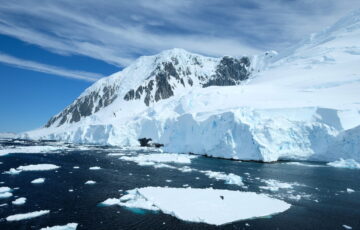
This project is developing digital twins of Antarctic and Arctic environments and resources. A digital twin makes it possible to test “what if” questions far more quickly than traditional computer models.
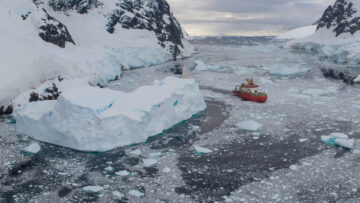
The International Thwaites Glacier Collaboration unites global scientists to study Antarctica’s most vulnerable glacier, predict sea-level rise, and inform climate action worldwide.
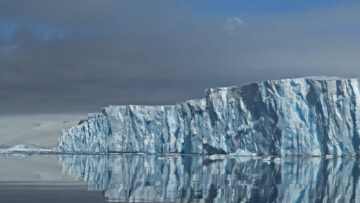
Antarctica Live Lessons – a new and exciting learning resource, launches today (13 November). Aimed at engaging and inspiring the imaginations of young learners, the platform introduces an array of live, interactive lessons about Antarctica, offering a unique opportunity for students to hear from leading ice experts.