PRESCIENT
PRESCIENT supports long-term, strategically important measurements and capabilities for the wider science community.

I am the Deputy Science Leader of the Space Weather and Atmosphere Team at BAS, and a member of the NERC supported UK EISCAT Support Group (UKESG).
I started at BAS in January 2012 as part of the Middle Atmosphere Dynamics group in the climate program. I worked on projects involving the dynamics of the middle and upper atmosphere using a variety of instruments, but concentrating on the two Medium Frequency (MF) radars that BAS operated at our research stations at Halley and Rothera. With the restructure of the BAS science programs I joined the newly formed Space Weather and Atmosphere Team.
Being a Space Weather scientist means that I have been lucky enough to spend time in both the Arctic and Antarctic during my career; the polar regions are the primary gateways by which space weather interacts with the Earth’s atmosphere. I am currently the PI for the MF radar at Rothera, which I use to study the coupling of the atmosphere to the space environment.
In my career to date I have worked on a number of projects related to understanding the Sun-Earth system, these have includes studies of the aurora, HF radio absorption, particle dynamics, geomagnetic pulsations, plasma heating and mesospheric dust. I was very lucky to take part in experiments that generated artificial aurora and be the project scientist for a VLF receiver mounted on a Yorkshire school roof that formed part of the AARDDVARK network.
I study how the layers of the atmosphere and the near-Earth space environment couple together – known as vertical coupling.
My main interests are:
Each of these is important for our understanding of space weather events and how they impact our lives.
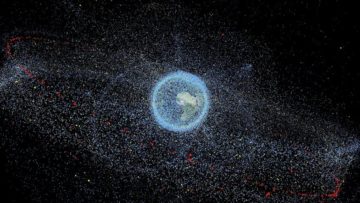
There is growing evidence that changes in the solar wind can lead to temperature changes in the polar regions. Waves the transfer energy and momentum into the upper atmosphere can modify conditions that affect satellite signal fade-out & scintillation, and the behaviour of electric current systems. Space weather events lead to heating of the upper atmosphere which in turn affects the lifetime of satellites and space debris in Low Earth Orbit (LEO). This is important to understand since LEO is becoming very crowded and collisions with debris can seriously damage satellites.
Part of the EISCAT Science Support Group working with colleagues at RAL Space
Middle & Upper Atmosphere
Energetic Precipitation
Substorms
Ionosphere and Aurora
Walach, Maria-Theresia. Lam, Mai Mai ORCID record for Lam, Mai Mai. Themens, David R. Aruliah, Anasuya L. Kavanagh, Andrew ORCID record for Kavanagh, Andrew. Matsuo, Tomoko. Baddeley, Lisa. Desai, Ravindra. Marsh, Daniel R. (2026) Challenges for ionosphere-thermosphere science.
Reidy, Jade A. ORCID record for Reidy, Jade A.. Kavanagh, A.J. ORCID record for Kavanagh, A.J.. Häggström, I. Themens, D.R. Wild, M. (2025) Generating electron density archives using mainland EISCAT data between 2001-2021 at 10 minute and 1 hour integration.
Themens, David R. Elvidge, Sean. McCaffrey, Anthony. Jayachandran, P. T. Coster, Anthea. Varney, Roger H. Galkin, Ivan. Goodwin, Lindsay V. Watson, Chris. Maguire, Sophie. Kavanagh, Andrew J. ORCID record for Kavanagh, Andrew J.. Zhang, Shun‐Rong. Goncharenko, Larisa. Bhatt, Asti. Dorrian, Gareth. Groves, Keith. Wood, Alan G. Reid, Ben. (2024) The High Latitude Ionospheric Response to the Major May 2024 Geomagnetic Storm: A Synoptic View.
Scott, Christopher John. Wild, Matthew N. Barnard, Luke Anthony. Yu, Bingkun. Yokoyama, Tatsuhiro. Lockwood, Michael. Mitchell, Cathryn. Coxon, John. Kavanagh, Andrew ORCID record for Kavanagh, Andrew. (2024) Calibrating estimates of ionospheric long-term change.
Walach, M. -T. Soobiah, Y. Carter, J. A. Whiter, D. K. Kavanagh, A. J. ORCID record for Kavanagh, A. J.. Hartinger, M. D. Oksavik, K. Salzano, M. L. Archer, M. O. (2024) SMILE Winter Campaign.
Collinson, Glyn A. Glocer, Alex. Pfaff, Robert. Barjatya, Aroh. Conway, Rachel. Breneman, Aaron. Clemmons, James. Eparvier, Francis. Michell, Robert. Mitchell, David. Imber, Suzie. Akbari, Hassanali. Davis, Lance. Kavanagh, Andrew ORCID record for Kavanagh, Andrew. Robertson, Ellen. Swanson, Diana. Xu, Shaosui. Miller, Jacob. Cameron, Timothy. Chornay, Dennis. Uribe, Paulo. Nguyen, Long. Clayton, Robert. Graves, Nathan. Debchoudhury, Shantanab. Valentine, Henry. Ghalib, Ahmed. The Endurance Mission Team,. (2024) Earth’s ambipolar electrostatic field and its role in ion escape to space.
Brown, M.K. Lewis, H.G. Kavanagh, A.J. ORCID record for Kavanagh, A.J.. Cnossen, I. ORCID record for Cnossen, I.. Elvidge, S. (2024) Future Climate Change in the Thermosphere Under Varying Solar Activity Conditions.
Parker, William E. Freeman, Mervyn ORCID record for Freeman, Mervyn. Chisham, Gareth ORCID record for Chisham, Gareth. Kavanagh, Andrew John ORCID record for Kavanagh, Andrew John. Siew, Peng Mun. Rodriguez-Fernandez, Victor. Linares, Richard. (2024) Influences of Space Weather Forecasting Uncertainty on Satellite Conjunction Assessment.
Narayanan, V.L. Wright, C. Mlynczak, M. Hindley, N. Kavanagh, A. ORCID record for Kavanagh, A.. Moffat-Griffin, T. ORCID record for Moffat-Griffin, T.. Noble, P. (2024) Observations of mesospheric gravity waves generated by geomagnetic activity.
Salice, Josephine. Nesse, Hilde. Partamies, Noora. Kilpua, Emilia. Kavanagh, Andrew ORCID record for Kavanagh, Andrew. Decotte, Margot. Babu, Eldho. Smith-Johnsen, Christine. (2024) The high-energy tail of energetic electron precipitation: solar wind drivers and geomagnetic responses.
Brown, M.K. Elvidge, S. Themens, D.R. Lewis, H.G. Kavanagh, A.J. ORCID record for Kavanagh, A.J.. Cnossen, I. ORCID record for Cnossen, I.. (2023) Days to Decades: Forecasting Neutral Densities in Low Earth Orbit.
Carter, J.A. Dunlop, M. Forsyth, C. Oksavik, K. Donovon, E. Kavanagh, A. ORCID record for Kavanagh, A.. Milan, S.E. Sergienko, T. Fear, R.C. Sibeck, D.G. Connors, M. Yeoman, T. Tan, X. Taylor, M.G.G.T. McWilliams, K. Gjerloev, J. Barnes, R. Billet, D.D. Chisham, G. ORCID record for Chisham, G.. Dimmock, A. Freeman, M.P. ORCID record for Freeman, M.P.. Han, D.-S. Hartinger, M.D. Hsieh, S.-Y.W. Hu, Z.-J. James, M.K. Juusola, L. Kauristie, K. Kronberg, E.A. Lester, M. Manuel, J. Matzka, J. McCrea, I. Miyoshi, Y. Rae, J. Ren, L. Sigernes, F. Spanswick, E. Sterne, K. Steuwer, A. Sun, T. Walach, M.-T. Walsh, B. Wang, C. Weygand, J. Wild, J. Yan, J. Zhang, J. Zhang, Q.-H. (2023) Ground-based and additional science support for SMILE.
Chisham, Gareth ORCID record for Chisham, Gareth. Kavanagh, Andrew J. ORCID record for Kavanagh, Andrew J.. Cobbett, Neil. Breen, Paul ORCID record for Breen, Paul. Barnes, Tim ORCID record for Barnes, Tim. (2023) High-time-resolution analysis of meridional tides in the upper mesosphere and lower thermosphere at mid-latitudes measured by the Falkland Islands SuperDARN radar.
Sato, Kaoru. Tomikawa, Yoshihiro. Kohma, Masashi. Yasui, Ryosuke. Koshin, Dai. Okui, Haruka. Watanabe, Shingo. Miyazaki, Kazuyuki. Tsutsumi, Masaki. Murphy, Damian. Meek, Chris. Tian, Yufang. Ern, Manfred. Baumgarten, Gerd. Chau, Jorge L. Chu, Xinzhao. Collins, Richard. Espy, Patrick J. Hashiguchi, Hiroyuki. Kavanagh, Andrew J. ORCID record for Kavanagh, Andrew J.. Latteck, Ralph. Lübken, Franz‐Josef. Milla, Marco. Nozawa, Satonori. Ogawa, Yasunobu. Shiokawa, Kazuo. Alexander, M. Joan. Nakamura, Takuji. Ward, William E. (2023) Interhemispheric Coupling Study by Observations and Modelling (ICSOM): Concept, Campaigns, and Initial Results.
Collinson, Glyn. Glocer, Alex. Pfaff, Rob. Barjatya, Aroh. Bissett, Scott. Blix, Kolbjørn. Breneman, Aaron. Clemmons, Jim. Eparvier, Francis. Gass, Ted. Michell, Robert. Mitchell, David. Imber, Suzie. Ghalib, Ahmed. Akbari, Hassanali. Ansted, Glen. Baddeley, Lisa. Bahr, Håvard. Bain, Gary. Bonsteel, Brian. Borgen, Henry. Bowden, Daniel. Bowker, Dave. Cameron, Tim. Campbell, Meredith. Cathell, Philip. Chornay, Dennis. Clayton, Robert. Conser, Larry. Davis, Lance. Donohue, Sean. Eilertsen, Leif Jonny. Etheridge, Charles. Graves, Nathan. Häggstrøm, Ingemar. Hanssen, Preben. Haugh, Herbert. Helgesen, Espen. Henderson, Jordan. Herseth, Kim Roar. Hickman, John. Jensen, Kent-Gøran. Jester, Travis. Johnson, Eric. Johnson, Hunter. Kavanagh, Andrew ORCID record for Kavanagh, Andrew. King, Max. Knight, David. Laman, Russell. Lankford, Trevor. Lien, Rolf. Lester, Mark. Marsh, Gordon. Martin, Steve. Morris, Norman. Nguyen, Long. Nelson, Richard. Ogundere, Wale. Osbakk, Karl Henning. Page, Dave. Polidan, Joe. Raley, Devon. Raymond, Richard. Robertson, Ellen. Rosanova, Giovanni. Rosnack, Traci. Serabian, Belinda. Simonsen, Roger. Søreng, Jan Arne. Sveen, Jostein. Swanson, Diana. Swift, Robert. Uribe, Paulo. Valentine, Henry. Waters, Frank. West, Libby. Wilson, Tim. (2022) The Endurance Rocket Mission: Gauging Earth’s Ambipolar Electric Potential.
Kavanagh, Andrew J. ORCID record for Kavanagh, Andrew J.. Ogawa, Yasunobu. Woodfield, Emma E. ORCID record for Woodfield, Emma E.. (2022) Two techniques for determining F-region ion velocities at meso-scales: Differences and impacts on Joule heating.
Woodfield, E.E. ORCID record for Woodfield, E.E.. Glauert, S.A. ORCID record for Glauert, S.A.. Menietti, J.D. Horne, R.B. ORCID record for Horne, R.B.. Kavanagh, A.J. ORCID record for Kavanagh, A.J.. Shprits, Y.Y. (2022) Acceleration of electrons by whistler-mode hiss waves at Saturn.
Brown, M.K. Lewis, H.G. Kavanagh, A.J. ORCID record for Kavanagh, A.J.. Cnossen, I. ORCID record for Cnossen, I.. (2021) Climate change in space: Thermospheric density reductions in LEO and the impact on the debris environment.
Brown, M.K. Lewis, H.G. Kavanagh, A.J. ORCID record for Kavanagh, A.J.. Cnossen, I. ORCID record for Cnossen, I.. (2021) Future decreases in thermospheric neutral density in low Earth orbit due to carbon dioxide emissions.
Reidy, J.A. ORCID record for Reidy, J.A.. Fear, R.C. Whiter, D.K. Lanchester, B.S. Kavanagh, A.J. ORCID record for Kavanagh, A.J.. Price, D.J. Chadney, J.M. Zhang, Y. Paxton, L.J. (2020) Multiscale observation of two polar cap arcs occurring on different magnetic field topologies.
Gibbins, Maude. Kavanagh, Andrew ORCID record for Kavanagh, Andrew. (2020) Mesospheric winds measured by MF radar with full correlation analysis: error properties and impacts on studies of wind variance.
Fritts, David C. Iimura, Hiroyuki. Janches, Diego. Lieberman, Ruth S. Riggin, Dennis M. Mitchell, Nicholas J. Vincent, Robert A. Reid, Iain M. Murphy, Damian J. Tsutsumi, Masaki. Kavanagh, Andrew J. ORCID record for Kavanagh, Andrew J.. Batista, Paulo P. Hocking, Wayne K. (2019) Structure, variability, and mean-flow interactions of the January 2015 quasi-two-day wave at middle and high southern latitudes.
Reidy, Jade A. ORCID record for Reidy, Jade A.. Fear, R.C. Whiter, D.K. Lanchester, B. Kavanagh, Andrew J. ORCID record for Kavanagh, Andrew J.. Milan, S.E. Carter, J.A. Paxton, L.J. Zhang, Y. (2018) Interhemispheric survey of polar cap aurora.
Kavanagh, Andrew J. ORCID record for Kavanagh, Andrew J.. Cobbett, Neil. Kirsch, Peter ORCID record for Kirsch, Peter. (2018) Radiation belt slot-region filling events: sustained energetic precipitation into the mesosphere.
Newnham, David A. ORCID record for Newnham, David A.. Clilverd, Mark A. ORCID record for Clilverd, Mark A.. Rodger, C.J. Hendrickx, K. Megner, L. Kavanagh, Andrew J. ORCID record for Kavanagh, Andrew J.. Seppälä, A. Verronen, P.T. Andersson, M.E. Marsh, D.R. Kovács, T. Feng, W. Plane, J.M.C. (2018) Observations and modelling of increased nitric oxide in the Antarctic polar middle atmosphere associated with geomagnetic storm driven energetic electron precipitation.
Denton, M.H. Kivi, R. Ulich, T. Rodger, C.J. Clilverd, M.A. ORCID record for Clilverd, M.A.. Horne, R.B. ORCID record for Horne, R.B.. Kavanagh, A.J. ORCID record for Kavanagh, A.J.. (2017) Solar proton events and stratospheric ozone depletion over northern Finland.
Reidy, J.A. ORCID record for Reidy, J.A.. Fear, R.C. Whiter, D.K. Lanchester, B.S. Kavanagh, A.J. ORCID record for Kavanagh, A.J.. Paxton, L.J. Zhang, Y. Lester, M. (2017) Multi-instrument observation of simultaneous polar cap auroras on open and closed magnetic field lines.
Moffat-Griffin, Tracy ORCID record for Moffat-Griffin, Tracy. Taylor, Mike J. Nakamura, Takuji. Kavanagh, Andrew J. ORCID record for Kavanagh, Andrew J.. Hosking, J. Scott ORCID record for Hosking, J. Scott. Orr, Andrew ORCID record for Orr, Andrew. (2017) 3rd ANtarctic Gravity Wave Instrument Network (ANGWIN) science workshop.
Rao, N. Venkateswara. Espy, P.J. Hibbins, R.E. Fritts, D.C. Kavanagh, A.J. ORCID record for Kavanagh, A.J.. (2015) Observational evidence of the influence of Antarctic stratospheric ozone variability on middle atmosphere dynamics.
Rodger, Craig J. Kavanagh, Andrew J. ORCID record for Kavanagh, Andrew J.. Clilverd, Mark A. ORCID record for Clilverd, Mark A.. Marple, Steve R. (2013) Comparison between POES energetic electron precipitation observations and riometer absorptions; implications for determining true precipitation fluxes.
Moffat-Griffin, T. ORCID record for Moffat-Griffin, T.. Jarvis, M.J. Colwell, S.R. Kavanagh, A.J. ORCID record for Kavanagh, A.J.. Manney, G.L. Daffer, W.H. (2012) Seasonal variations in lower stratospheric gravity wave energy above the Falkland Islands.
Reidy, J., Kavanagh, A., & Wild, M. (2025). Data from the EISCAT UHF and VHF between 2001- 2021, integrated at 10 minutes and 1 hour between 50-200km (Version 1.0) [Data set]. NERC EDS UK Polar Data Centre. https://doi.org/10.5285/7d907fd0-8f08-45a6-ab91-89f6f0221b10
Woodfield, E., Glauert, S., Menietti, J., Horne, R., Kavanagh, A., & Shprits, Y. (2022). Acceleration of electrons by whistler-mode hiss waves at Saturn (Version 1.0) [Data set]. NERC EDS UK Polar Data Centre. https://doi.org/10.5285/c6202511-d70b-45ae-9b72-ff30f4888f5f
PRESCIENT supports long-term, strategically important measurements and capabilities for the wider science community.
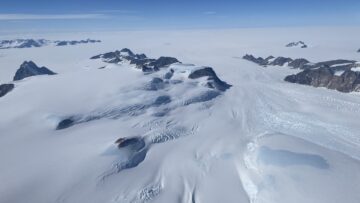
MesoS2D uses powerful radars and satellites to study a little-understood layer of the atmosphere, the mesosphere.
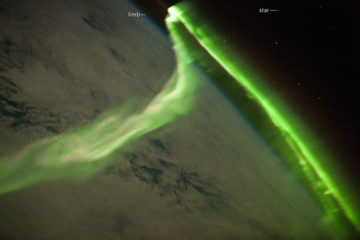
SWIGS investigated how space weather drives geomagnetically induced currents in power grids, pipelines, and railways.
Joule Heating investigated how space weather affects the upper atmosphere’s ability to slow down orbiting satellite debris.
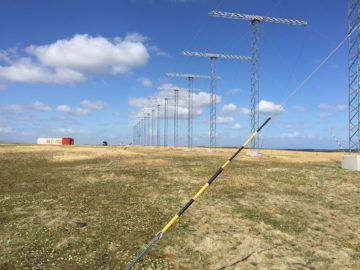
The Super Dual Auroral Radar Network (SuperDARN) has been operating as an international co-operative organisation for over 25 years, and has proved to be one of the most successful tools for studying dynamical processes in the Earth’s magnetosphere, ionosphere, and neutral atmosphere.
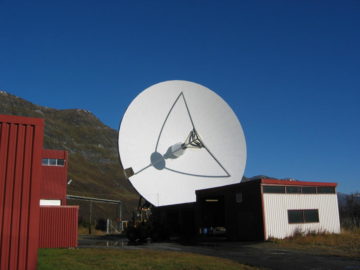
The UK EISCAT support group (UKESG) is a collaboration between the British Antarctic Survey and the Rutherford Appleton Laboratory, funded via the National Centre for Atmospheric Science (NCAS).
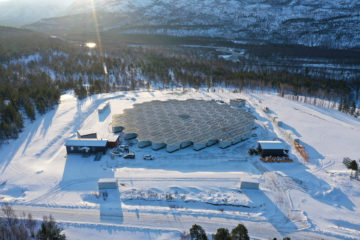
DRIIVE researches how polar ionosphere changes affect satellite orbits, communications, and space weather forecasts.
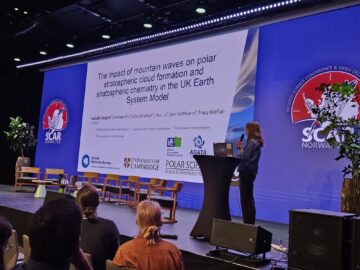
Our Antarctic experts attend the SCAR Open Science Conference in Oslo, sharing their latest findings and shaping plans for future collaboration.
An international team of scientists, including a researcher from British Antarctic Survey (BAS) has, for the first time, successfully measured a planet-wide electric field thought to be as fundamental to Earth as its gravity and magnetic fields.
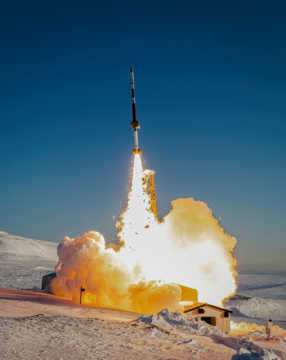
Dr Andrew Kavanagh of the British Antarctic Survey (BAS) Space Weather team has supported a new National Aeronautics and Space Administration (NASA) rocket experiment which aims to uncover unique features of our atmosphere that enable life on Earth.
A new project to improve scientists understanding of the impact of space weather and climate change on the atmosphere starts this month (January 2022). A team from British Antarctic Survey, […]
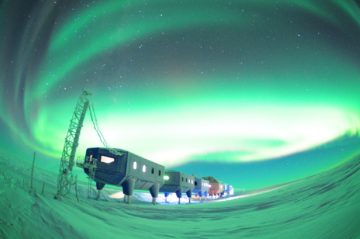
The Halley Research Station multiband riometer is a passive instrument that measures radio energy from natural astronomical sources.
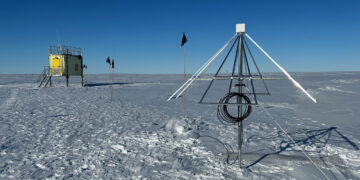
A meteor radar that uses the scatter from meteor trails to estimate horizontal neutral winds between 80 and 110 km
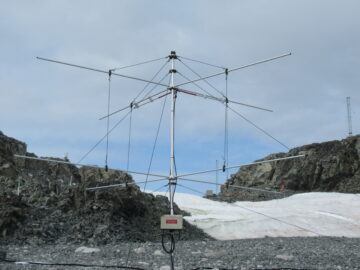
The Medium Frequency (MF) radar at Rothera Research Station measures an altitude profile of the horizontal wind in the mesosphere, between 55 and 95 km.
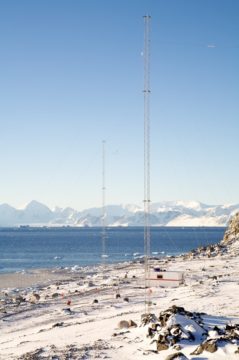
The MF radar at Halley measures an altitude profile of the horizontal wind in the mesosphere, between 55 and 95 km.
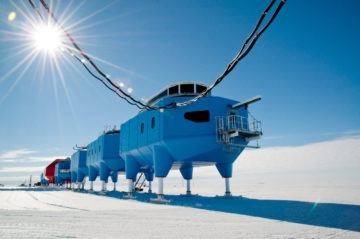
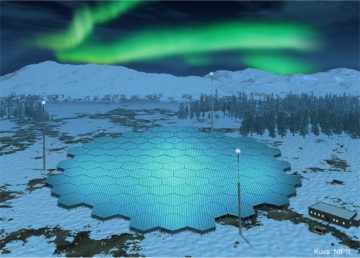
The most advanced space weather radar in the world is to be built in the Arctic by an international partnership including the UK, thanks to new investment, including in the […]