
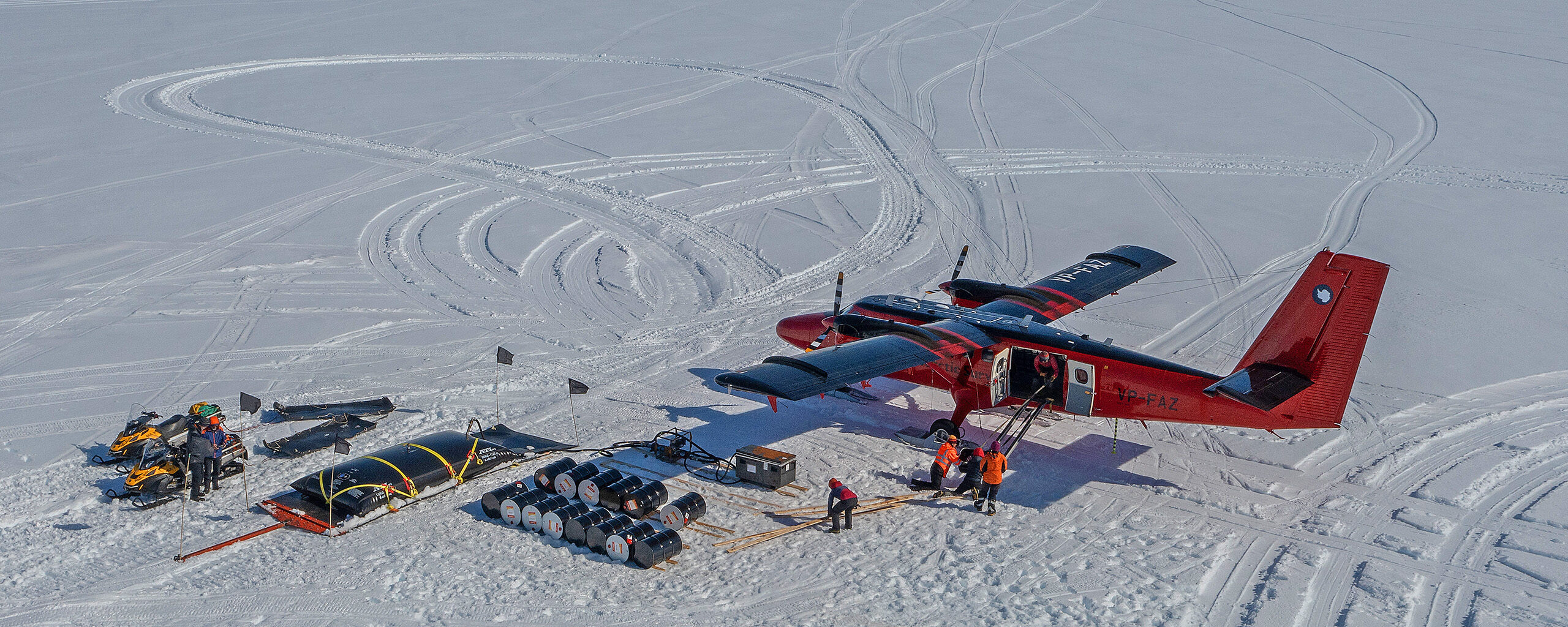
British Antarctic Survey (BAS) operates a fleet of 5 specialised aircraft to support its scientific research and logistical operations in the polar regions.
Our air fleet comprises a De Havilland Canada Dash-7, and four De Havilland Canada Twin Otters. They are not merely for transport, but essential platforms for scientific discovery. They enable teams to access remote locations, conduct complex surveys, and sustain the UK’s presence in the Antarctic.
Twin Otters
The four Twin Otters are the versatile workhorses of BAS’s deep-field operations. These high-wing, twin-engine, turbo-props are ruggedly built, reliable, and can perform short take-offs and landings. Equipped with wheel/ski undercarriage, they can land on snow, ice, or hard runways.
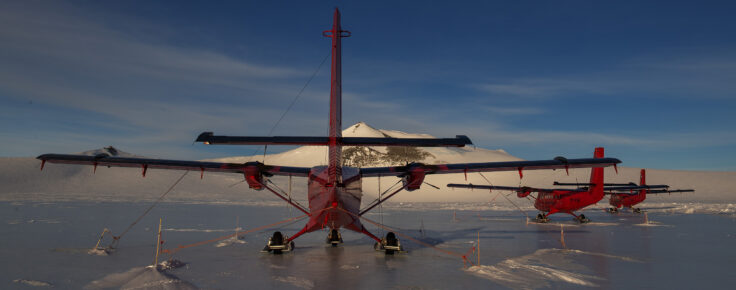
Twin Otter’s at Sky Blu runway, Antarctica
From October to March each year, the Twin Otters’ primary role is to transport people, fuel, skidoos, sledges, and scientific equipment to remote field camps.
The aircraft also lay fuel depots and stockpiles of supplies, ensuring that field science parties have everything they need to operate safely and effectively.
The Twin Otters can be modified with long-range fuel tanks and instrument racks, to support a range of scientific missions.
Dash-7
The De Havilland Canada Dash-7 is a larger, four-engined aircraft.
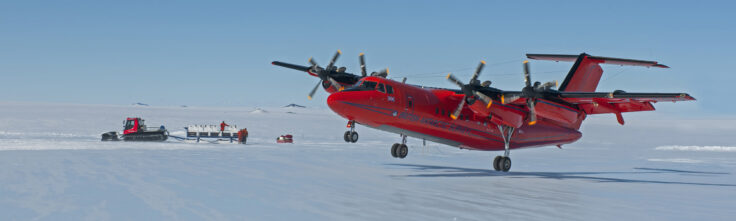
Dash7 blue ice landing
Modified with long-range fuel tanks, a large cargo door, and a strengthened floor, the Dash-7 conducts regular flights between Punta Arenas in Chile and Antarctica. Its reliability, fuel efficiency, and short take-off and landing capabilities make it ideal for this mission.
The Dash-7 can carry up to 16 passengers or 2,000kg of cargo. It significantly reduces travel time for scientists, and ensures a consistent supply of spares, urgent supplies, and fresh food.
The aircraft can also land on ice runways, making it a regular visitor to the Sky-Blu field station.
Airborne science
BAS’s aircraft are sophisticated flying laboratories. The National Capability programme provides the scientific community with access to these facilities. The Air Unit team is instrumental in installing, certifying, and maintaining science survey equipment on both the Twin Otter and Dash-7 aircraft.
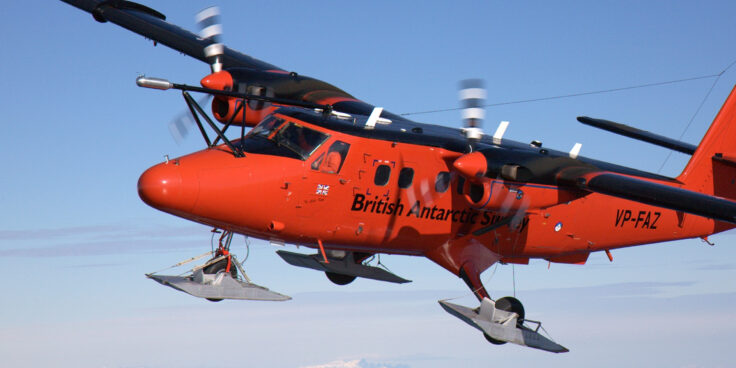
Science probes seen on a BAS Twin Otter aircraft
The Twin Otters are particularly important for two main areas of airborne science:
- Meteorological airborne science instrumentation (MASIN). One of the Twin Otters is equipped with a suite of atmospheric instruments that measures everything from temperature and water vapor to atmospheric turbulence and radiation. This provides data for understanding weather patterns and atmospheric processes in the polar regions.
- Airborne Geophysics. The Twin Otters are fitted with a core suite of instruments for collecting and processing aerogeophysical data. Instruments include a gravimeter, magnetometers, and polarimetric ice-penetrating radar. This equipment allows scientists to study the structure of land, ice, and sea, and to gain insights into geological processes. BAS is also developing uncrewed aerial vehicles (UAVs or drones) for smaller geophysical and remote sensing tasks. These are cheaper to run than crewed aircraft.
Air Unit
The aircraft are managed by the BAS Air Unit, an expert team responsible for all aspects of air operations, from airworthiness and safety to the integration of advanced scientific instrumentation.
The Air Unit provides the environmental science community with a worldwide capability, offering access to airborne platforms and state-of-the-art instrumentation.
Rothera air facility
The Rothera Air Facility on Adelaide Island is the operational hub for all BAS’s airborne activities. This has a 900m gravel runway, and serves as the central hub for BAS’s air fleet and supports all deep-field research.
Pilots and ground crew
BAS pilots undergo specialist training and carry emergency supplies. They are prepared for the unpredictable polar weather. A core principle of all air operations is safety, a necessity in such a remote and challenging environment.
The pilots and engineers ensure that all aircraft are maintained to the highest safety standards.