
As the world descends on Brazil for COP30, a familiar figure has beaten the masses to it. Far from her usual icy runways, Ice Cold Katy, one of British Antarctic Survey’s Twin Otter aircraft, has been facilitating groundbreaking climate science over the Amazon Rainforest. Tabby Taylor Buck spoke to Dan Beeden, Dr Alexandra Weiss and Dr Freya Squires about their research at one of Earth’s most critical environmental frontiers.
The mission for this science team couldn’t be more urgent. Recent studies suggest the Amazon, once the Earth’s reliable green lung that absorbs carbon from our atmosphere, may now be releasing more than it stores due to deforestation, forest degradation, and intensifying drought and fire activity.
The Amazon Basin is a significant ‘tipping point’ region for Earth’s climate system. Knowing what’s changing and how is of critical importance. This shift from climate protector to climate threat first hit the headlines in 2021, based on airborne surveys by the Brazilian National Institute for Space Research (INPE). Now, the task is to eliminate as much uncertainty as possible about this shift, and its future progression.
That’s where Ice Cold Katy comes in. Usually found ferrying scientists across Antarctica, this aircraft from the British Antarctic Survey (BAS) fleet has been transformed into a flying laboratory, carrying sophisticated instruments to capture real-time atmospheric data on this environmental tipping point.
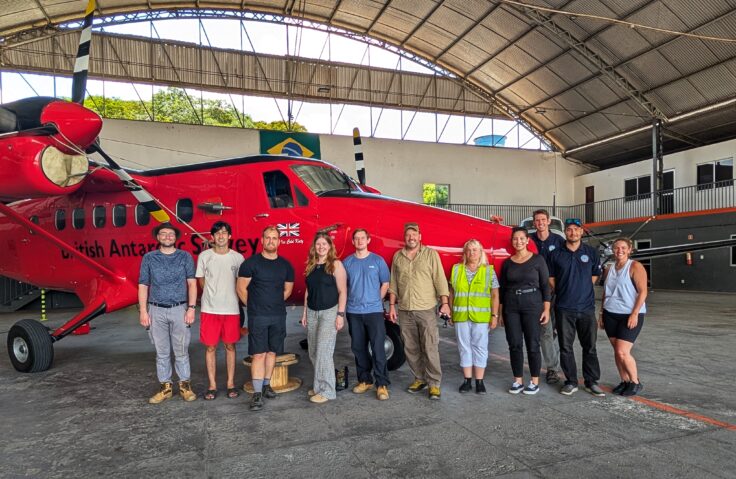
Ice Cold Katy and the team in Santarem. Credit: Martin Wooster
The CarbonARA project (Carbon-Atmosphere Research in the Amazon) is funded by the European Space Agency – ESA and is coordinated by the Earth Observation and Wildfire Research Group, and the National Centre for Earth Observation, at King’s College London. It is also being delivered in collaboration with Brazilian partners, including the leaders of the 2021 study National Institute for Space Research (INPE), and Universidade Federal Do Oeste Do Para. The project brings together scientists, engineers, and specialists from across the UK, Europe, and Brazil – including some of the BAS team. An unlikely pairing, on paper – but who better to tackle the extreme flying conditions of the Amazon rainforest than people with experience in the opposite extreme of Antarctica?
Leading the planning is Dan Beeden, whose childhood dreams of flying with the Air Force were quashed by the frankly remarkable length of his legs. From that setback, however, came what he now calls his perfect career: “something that combined aviation and science”. As Operations Manager for the BAS Air Unit, he faces the formidable task of deploying Antarctic research aircraft to conduct cutting-edge science anywhere in the world.
He’s joined by atmospheric scientist Dr Alexandra Weiss, whose early research on mountain turbulence and mixing processes in the Alps inspired her to specialise in the boundary layer of the atmosphere. Another scientist on the project is Dr Freya Squires, an atmospheric chemist whose passion was sparked during lectures at the University of York. She was drawn to working at BAS because she’s “always loved being in the field and making atmospheric measurements in challenging locations”.
Getting Brazil on board
The process of preparing for this sort of campaign takes longer than conducting the science itself. Dan spoke with colleagues and partner organisations who had previously worked in Brazil, and they said that obtaining permission for airborne remote sensing and Earth observation could be challenging.
What Dan discovered through the process is that “everything in Brazil is built on trust.” If you are well liked, doors will open; if you are not, those doors remain firmly closed. Building trust was important because what they were proposing would be the first time a foreign registered aircraft had done Earth observation science over the Amazon Rainforest since the early 90s.
The relationships built were key to securing final diplomatic approval, which was granted in early September. However, the logistical planning and preparation had been underway for more than a year by that point. As Dan explains:
“There’s a huge amount of kit that has to be prepared, tested, packaged up and then shipped to Brazil. We had to ship that stuff in July because people had said to us that you need to expect quite significant delays with customs.”
Therefore, the team knew that there was a chance their planning could be for nothing if permission had not been granted.
Getting Ice Cold Katy to Brazil was an adventure in itself. Carrying a crew of two, she set out from Calgary, Canada, on an unconventional route. The journey spanned 4,622 nautical miles, with overnight stops in South Dakota, Alabama, Florida, the US Virgin Islands, and Grenada, before touching down in Santarém, Brazil after six days of flying.
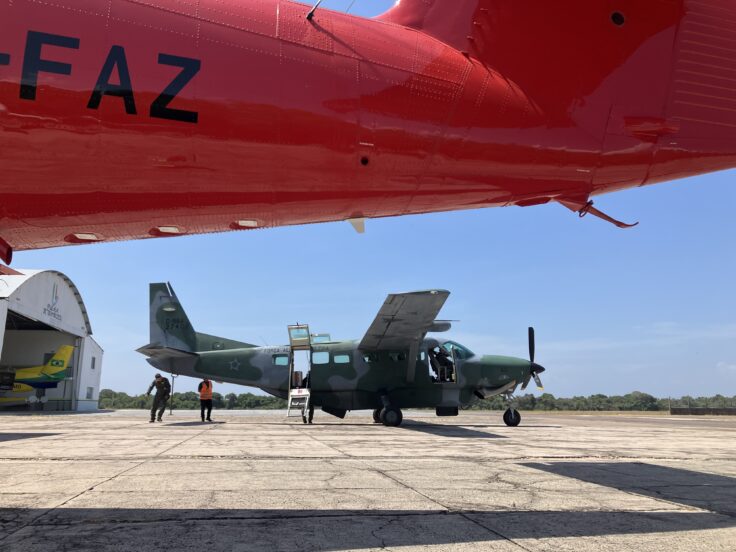
Twin Otter in the foreground and Brazilian Air Force aircraft in the background. Credit: Daniel Beeden
A Twin Otter transformation
Next came the task of turning an aircraft designed for ferrying into a research platform used for atmospheric science. The first step was removing the fuel tanks, essential for long journeys but unnecessary for the CarbonARA project’s four to five-hour flights. Then the Twin Otter underwent a weeklong transformation into what Dan describes as a “flying laboratory.”
The comprehensive science at the heart of this project becomes clear when Alexandra details the equipment they carried. “From the BAS side, we used a fast-responding Picarro gas analyser and other gas analysers to measure CO₂, CH₄ and H₂O in real time,” she explains.
Alongside the gas measurements, the team deployed their ‘mini-MASIN’ instruments to capture meteorological data such as wind speed, temperature, moisture, and pressure. These instruments allow Alexandra and her fellow scientists to understand the structure of the atmosphere and which gases are being transported between the surface and the atmosphere. King’s College London and partner institutions also added sensors, including hyperspectral cameras for vegetation structure, aerosol and radiation measurements, and other instruments linking surface conditions with atmospheric observations.
If you’re imagining an air conditioned, business class flight then think again – because the working conditions are far from comfortable. Alexandra describes the aircraft interior as “hot, noisy, and humid” with little room to move among the three scientists, Brazilian observer, pilot, and all the equipment. Not so much Ice Cold Katy, as Incredibly Clammy Katy.
The heat took no prisoners, and one particular feature of the Twin Otter, originally designed for Antarctic survival, actively worked against them in Brazil. The aircraft’s black-painted top, perfect for standing out against snow and preventing ice formation, became, as Dan says, a “huge heat absorber, even though it’s already super-hot.”
The humidity was just as relentless, affecting instruments and people alike. Dan recalls how stepping from air-conditioned rooms into the tropical air instantly made the skin clammy, “in the same way that, with my camera, I take it out of a cold room and then immediately the lens fogs up.” People adapted quickly – and as he puts it with a laugh, you’re already sweating all the time.
Despite these challenges, when the Brazilian Air Force came to inspect the transformed aircraft, their response was wholly positive. Dan recalls the moment with evident warmth:
“I think his words to me were something like, ‘What you’ve got in the back of the aircraft is absolutely awesome, and I wish you all the best.’”
The science section
Once the preparation was complete, the science took centre stage. The urgency of their mission is clear in Freya’s stark assessment:
“There is recent evidence that shows that the Amazon rainforest’s ability to remove carbon from the atmosphere is declining. Some studies even go as far as to say that parts of the Amazon could be a net source of carbon to the atmosphere, because the photosynthetic uptake of carbon does not offset what’s released during wildfires.”
There is still uncertainty about the magnitude of these greenhouse gas fluxes and how they might change in the future, made worse by a lack of observations in areas of the Amazon region.
This is where the CarbonARA project comes in. One key aim was to observe the greenhouse gas fluxes over different landscapes in the Amazon region – for example primary forest, and agricultural land. Another aim of the flights was to observe emissions from wildfires.
“A typical working day for me in Brazil isn’t so different from one in Antarctica,” explains Alexandra. The team start by checking the weather.
“During some of our flights we would want to sample fires, and some we wanted to avoid fires,” adds Freya, “so we would also be checking satellite imagery for evidence of recent fires and adapt routes accordingly.”
Once airborne, the science becomes dynamic and responsive. “During a flight we monitor the data coming in from instrumentation and we may change plans slightly based on what the data says”, Freya continues, “We may need to alter the altitude we fly over the forest, or we may need to alter our heading based on wind direction to get the best possible data. We carry out calibrations of instrumentation during the flight which allow us to correct data after the flights as required.”
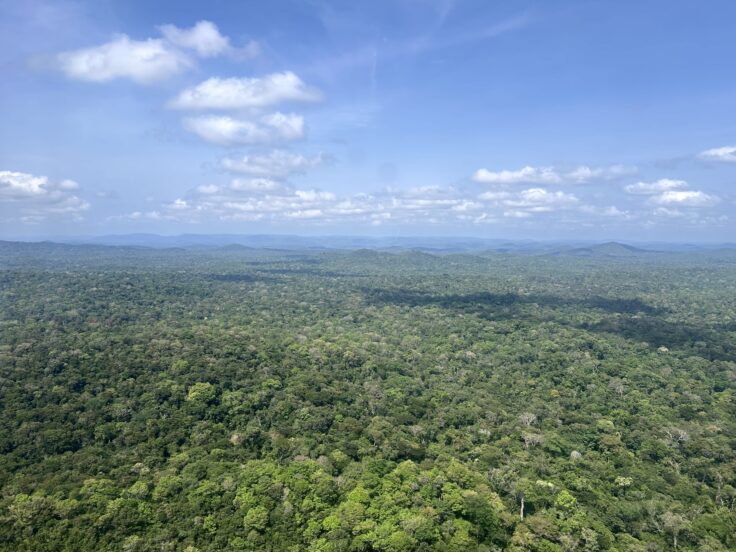
Photo taken on survey flight. Credit: Caroline Bresciani
When asked why this research is important right now, Alexandra says, “the Amazon is reaching a tipping point”. Understanding when and where this transformation is happening helps scientists predict future climate impacts and guide conservation efforts – with the ultimate goal of supporting global climate commitments, like the Paris Agreement, through better planetary data.
The research has far-reaching implications across multiple scales. Locally, the findings help Brazilian communities and scientists understand how deforestation and fires are transforming the Amazon, supporting improved conservation and land management decisions. On a national level, the data enhances Brazil’s carbon inventories and climate reporting capabilities. Perhaps most significantly, the results feed into global climate models and policies that affect everyone on the planet. As Alexandra puts it:
“This research doesn’t just describe some physical processes in the Amazon, it helps the world understand how our actions influence the planet’s carbon balance.”
Awe-inspiring Amazon
Their work in the Amazon offers the team far more than research opportunities – it provides moments of profound wonder. “From the air, the forest stretches endlessly,” says Alexandra, “with winding rivers and, here and there, a single house or a sandy road. But parts of the landscape are now fields, and at times you see smoke plumes from fires.”
The sheer scale of the region has left a lasting impression on all three members of the team. “I don’t think anybody, unless they’ve been there, has any appreciation of how vast the Amazon is,” Dan reflects.
He speaks with genuine awe about the meeting of waters at Santarém, where the Tapajós and Amazon rivers converge yet remain visibly distinct. The clearer Tapajós appears darker, while the sediment-rich Amazon runs muddy brown and “it takes them a while before they actually merge properly.”
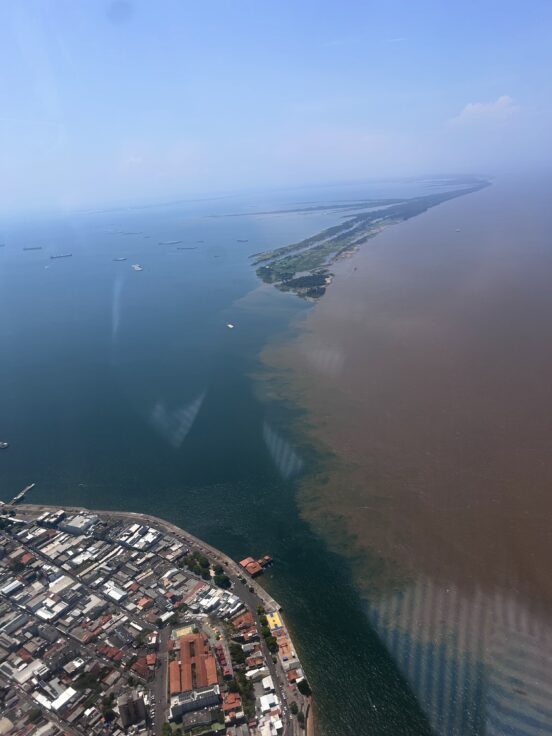
Converging of the Tapajos and Amazon rivers. Credit: Caroline Bresciani
Beyond the aerial perspectives, the team also experienced the Amazon at ground level. Dan recalls a boat trip with the owner of the hangar where Ice Cold Katy was housed, travelling to a remote white sand beach with no signs of human presence. The tranquillity was punctuated by the eerie calls of howler monkeys, making the whole forest sound ‘alive’.
For Alexandra, the experience was both inspiring and sobering. She describes being deeply moved by the sheer richness of the landscape:
“The sound of birds and animals, even around our accommodation, and the sight of the forest canopy from above during the flights. It’s a place that makes you feel both small and responsible. At the same time, it was heart-breaking to see fires burning in parts of the rainforest or larger areas without forest anymore. Flying over those areas, you could see how much beauty and biodiversity had been lost.”
Beyond Antarctica
“Whilst in some respects, the Amazon Rainforest couldn’t be more different to Antarctica and the Southern Ocean, there are striking similarities,” explains Freya. “Both the Amazon Rainforest and Southern Ocean are globally important carbon sinks and are experiencing rapid changes due to climate change. Both these environments are challenging to access and therefore understudied, and both need to be studied to provide critical information for climate action.”
Her point highlights how the Amazon, much like Antarctica, plays a vital role in regulating Earth’s climate. Alexandra agrees, adding:
“If the Amazon shifts from absorbing carbon to releasing it, then the world is losing one of its biggest natural defences against climate change. For the next generation, that could mean more warming, more extreme weather, and less stability in global rainfall and food systems.”
“The Amazon affects all of us,” she says. “It regulates our climate and stores vast amounts of carbon. That’s why it’s so important to understand what’s happening now, so the science can guide real action to protect it for the future”.