
Artist Rowan Huntley and British Antarctic Survey Geochemist Dr Jo Johnson have been working together to translate polar science into art. Their exhibition at the Scott Polar Research Institute is Huntley’s creative response to Johnson’s research into glaciers, ice sheets, and the geology of Antarctica.
This collaboration comes at a critical moment. The climate crisis is no longer a distant threat, yet scientific data can be overwhelming, and abstract numbers can leave people feeling disconnected rather than motivated to act. Art offers another way in, transforming the science into something tangible, emotional, and open to questioning. It invites audiences to engage with the realities of climate change on different, more human terms.
This article is a quick summary of the full discussion on the Beyond the Ice podcast. Listen to the whole episode here:
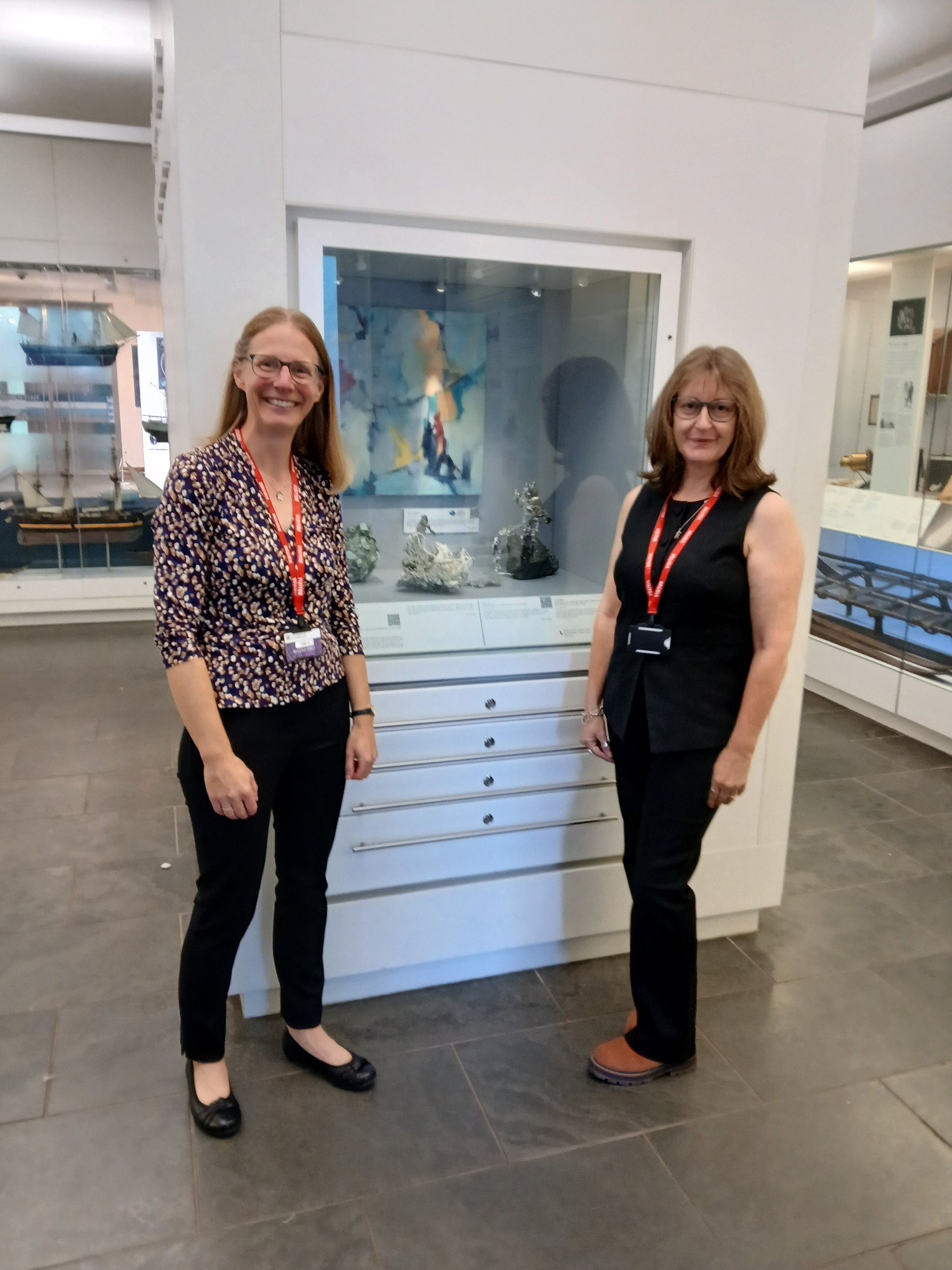
BAS Geochemist Dr Joanne Johnson (Left) and artist Rowan Huntley (Right)
When Rowan Huntley first travelled to Antarctica in 2010 as part of the Friends of Scott Polar Research Institutes Artists in Residence Programme, the experience changed her fundamentally as an artist.
“Once you’ve been to Antarctica, you’re kind of changed forever,” she explains. “You feel very small. You feel very human. You’re in awe of the forces down there and the size of the landscape itself.”
After returning, she found that simply painting what she’d observed wasn’t enough. She wanted to involve the landscape itself in her work – and that meant learning about Antarctic geology. So she contacted British Antarctic Survey, and geochemist Dr Jo Johnson answered the call.
“I remember sitting at a meeting and someone said, ‘Who would like to chat with an artist?’ So I said, I’ll do it. I like art.”
What started as a casual conversation became a five-year collaboration, interrupted by Covid but ultimately resulting in Through Ice and Fire, now showing at the Polar Museum in Cambridge.
The science behind the art
Jo’s research focuses on understanding how Antarctica’s ice sheets have changed over time. She studies cobbles (boulders or rocks) that were carried to sites by ice and left behind as it retreated. By measuring special isotopes in quartz grains, she can determine when ice last covered a location.
“We crush the rocks, we have to extract out the quartz grains and then put them through various different chemical and physical processes,” Jo explains. “It sounds super complicated, but Rowan’s managed to pick up on lots of different aspects of this whole process.”
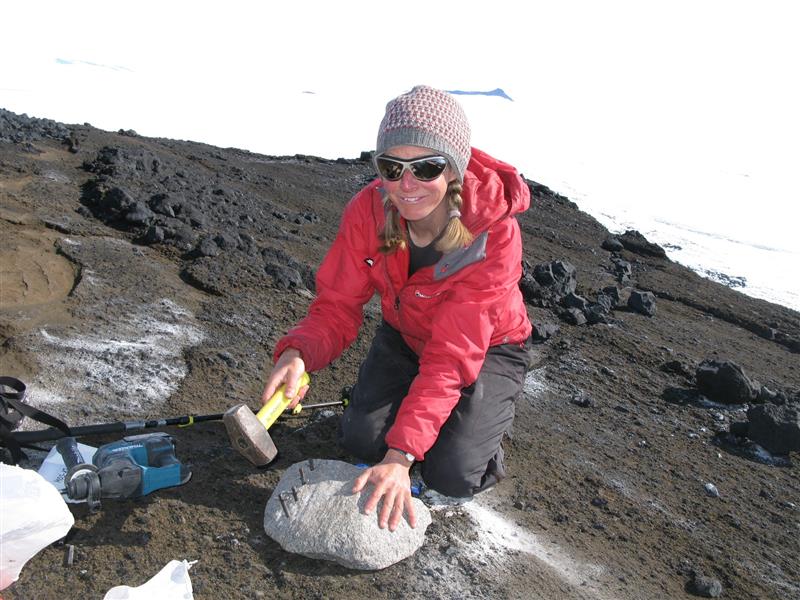
Dr Joanne Johnson at work in Antarctica, breaking open a glacial ‘cobble’ for analysis.
Rowan was fascinated by these techniques and began incorporating similar processes into her art – working with a kiln, blowtorch and freezer, and using local materials from her home on the Gower Peninsula in Wales.
“I discovered that Jo was looking for cobbles in Antarctica that were largely granitic. So I decided to see what was local to me,” Rowan says. “I decided to use those materials along with some intense heat and also freezing.”
Rising Seas
One striking work in the exhibition, called Rising Seas, is designed to change over time. Made from pewter, canvas, ice and sea water, it has been slowly disintegrating over the two years since Rowan created it.
“That’s the idea really, these things disintegrate.” She says. “Everything, if it’s left, will eventually break down.”
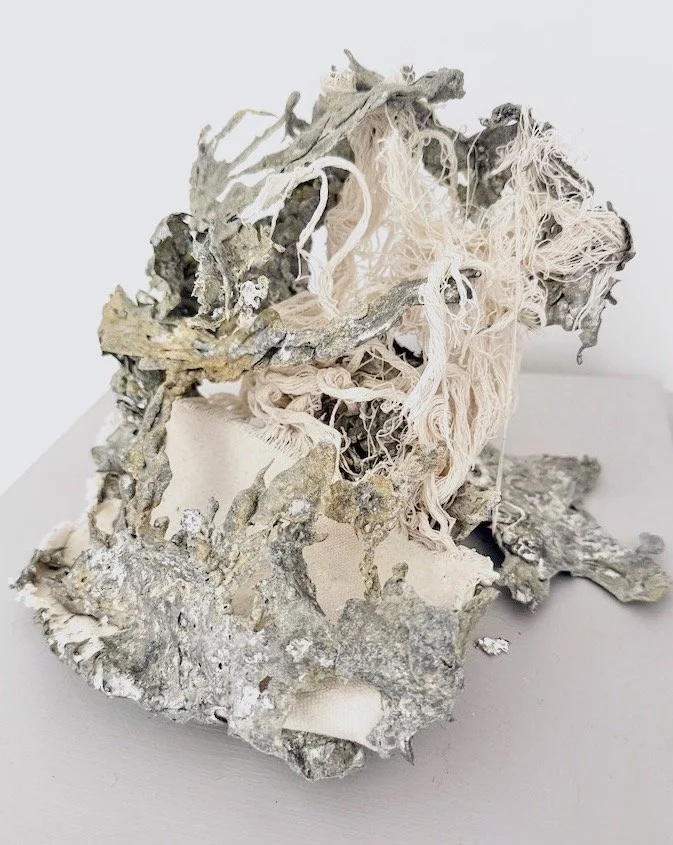
Rowan’s artwork ‘Rising Seas’
The piece connects to Jo’s wider research context. As she explains:
“The Antarctic ice sheet contains enough water to raise global sea level by 58 metres. Now, that’s the whole of the Antarctic ice sheet – it’s not going to happen in our lifetime for sure, but we do know that rising sea levels are already affecting people around the world, and Antarctica has a big role in that.”
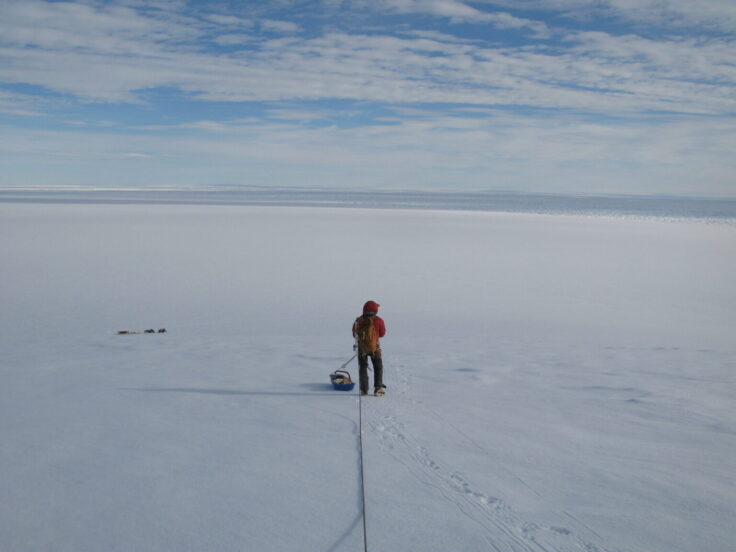
Dr Joanne Johnson in the field in Antarctica.
Atoms in Motion
One of Rowan’s most complex pieces, Atoms in Motion, represents a mass spectrometer – the instrument Jo uses to measure isotopes. It’s an assembled sculpture with moving parts, including a handle that turns cogs, a foot pump that blows coloured balls around a glass jar, and a small drawer containing green ceramic “atoms” that have been “separated out.”
“People are fascinated by that,” Rowan says. “I’ve had a grown gentleman ask me the other day if it really did that [separated the ‘atoms’]. And I had a three-year-old ask me as well.”
The piece also incorporates Rowan’s local history – copper pipework referencing the industrial heritage of South Wales, and wooden posts salvaged from the Gower coastal path.
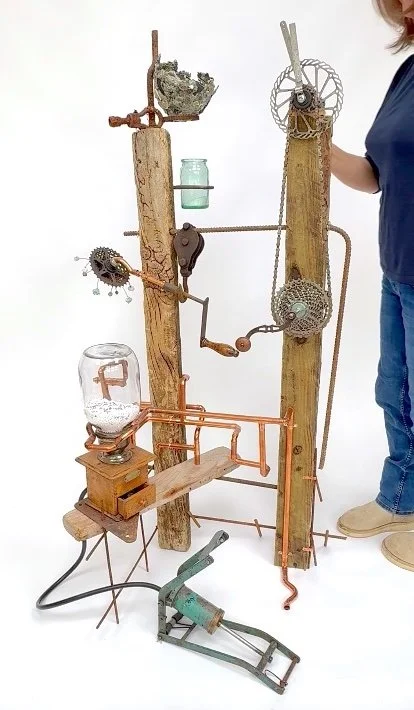
Rowan’s artwork Atoms in Motion
Finding common ground
Despite working in very different fields, Jo and Rowan found surprising parallels in their approaches.
“There’s traces of creativity in what I do in my science,” Jo reflects. “I get my data, and then I’ve got to think about how I interpret that and how I present it. There’s no throwing out bits of data that don’t fit, because they’re actually often the ones that tell us something important.”
For Jo, the collaboration offers something valuable: a way to reach audiences who might be put off by conventional scientific communication.
“It means that we can hopefully communicate some of the science to people who we wouldn’t normally, as scientists, come into contact with – people who are put off by data and plots. It’s really important to engage with everybody if we can.”
Rowan sees her work as a conversation starter:
“Behind it all is a hope that people will be able to latch onto something and get a foot in the door, either scientifically or artistically or both. To start asking questions – whatever those questions may be, they’re valid.”

Dr Joanne Johnson (Left) and artist Rowan Huntley (Right)
Visit the exhibition
Through Ice and Fire is at the Polar Museum at the Scott Polar Research Institute in Cambridge until June 2026. Entry is free, and the museum is open Tuesday to Saturday, 10am to 4pm.
Rowan Huntley is an artist based on the Gower Peninsula. Dr Jo Johnson is a geochemist at British Antarctic Survey who studies the history of Antarctic ice sheets.