
Our starting point
Changes in Earth’s climate have impacts from ground level to the inner edge of space, with consequences for the places people live.
Rising sea levels
Climate change causes polar ice to melt and raise sea levels. The speed at which this is happening and how far it will go are uncertain. But flooding and erosion threaten an estimated 600 million people worldwide, who live in coastal areas.
Rising sea levels threaten, not just where people live, but infrastructure, such as nuclear power plants.
The role of British Antarctic Survey (BAS) is to provide up-to-date research to help governments and communities understand, prepare for and reduce these impacts.
Space debris
Climate change is also causing the Earth’s atmosphere at the edge of space to contract. This increases how long defunct satellites and other space junk stays in orbit. Space debris threatens the satellites we rely on for navigation, timing, communications, and remote sensing. There are now over 130 million pieces of debris in orbit. Each one could disable a satellite.
With thousands more satellites launching soon, understanding these risks is critical. The polar regions offer the best vantage point for monitoring these changes.
Our science
BAS scientists are uniquely placed to address the threats from rising sea levels and space debris. We have a track record of world-leading research in ice-sheet change, sea-level rise, and space weather.
Our work:
-
leads international research on ice loss that informs sea level predictions
-
contributes to major climate reports like the Intergovernmental Panel on Climate Change (IPCC) assessments
-
manages international space weather monitoring networks
-
provides space weather forecasts for the European Space Agency and UK Met Office
-
advises government on climate and space weather impacts
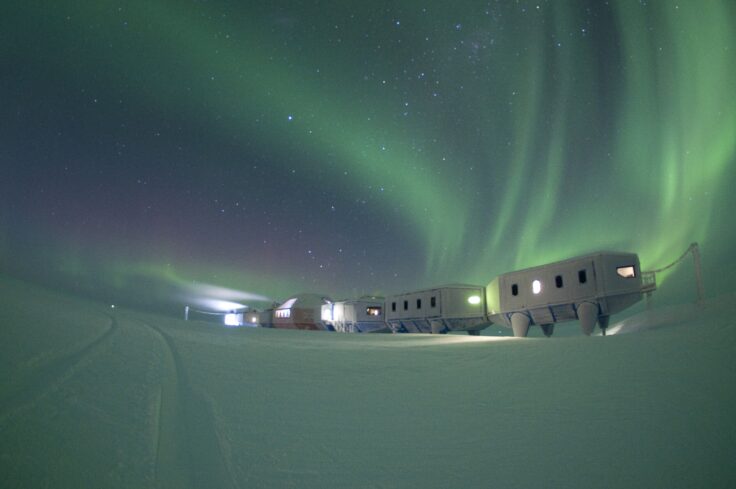
Aurora at the Halley Research Station, a world leader in space weather research (Credit: Antony Dubber)
Our research contributions
Sea level research:
-
improve predictions of sea level rise
-
understand how oceans and atmosphere drive ice loss
-
study how geology and warming affect ice sheet movement
-
use past climate records to predict future ice changes
Space weather research:
- protect satellites from space weather and debris collisions
- model Earth’s radiation belts to safeguard satellites
- track upper atmosphere changes to assess collision risks
- identify when space weather threatens power grids