
Our starting point
Climate change is the biggest challenge that humanity faces.
Globally, our environment, livelihoods, culture and societies are increasingly threatened by extreme weather.
British Antarctic Survey’s (BAS) research reveals complex climate processes, which enables policymakers to plan for and prepare for the impacts – as happened with the ozone hole discovery in the 1980s.
Polar influence
The polar regions help to control the climate in every place and for everyone around the world. They have a big influence, acting as a brake on global warming:
-
the Southern Ocean absorbs heat and carbon dioxide from the atmosphere
-
sea ice and snow act as a mirror reflecting sunlight back into space.
The impacts of climate change can be more severe at the poles. For example, shifting southern hemisphere wind patterns:
-
affect ocean currents which can make ice shelves unstable
-
influence the ocean’s capacity to absorb heat and carbon dioxide
-
increase the intensity of storms so that ice breaks up, drifts north and melts in warmer waters.
In both polar regions, less rain and snow are falling, so more solar radiation is heating the ground.
Our science
The polar regions are among the most difficult places in the world to do research. They are remote and often inhospitable. And their interconnected processes are difficult to recreate accurately in computer models.
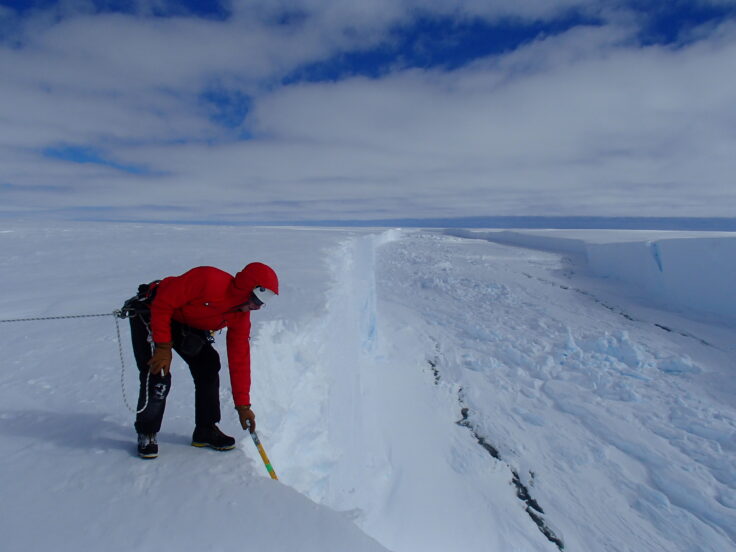
Field Guide assessing the lip and side of Halloween Crack at Halley Research Station (Credit: Tom Sylvester)
Consequently, many polar processes are poorly understood. We can’t yet be certain about the future of these regions and their wider impacts on Earth.
Humanity needs to close these knowledge gaps, so that international policies can minimise and adapt to climate change and its negative impacts.
We’re at the forefront of this scientific effort. We have the world-leading capability to measure, model and apply innovative techniques. So we’re working with national and international partners to provide the research the world needs.
Our research contributions
- understand the physical, chemical and biological processes that govern polar and global climate
- measure the role of the polar regions in the carbon cycle
- improve our predictions about climate change by refining our mathematical models
- track the consequences of changes in the way the oceans and atmosphere circulate
- use past polar records to better predict global climate change
- provide actionable predictions of climate change.