
Science services
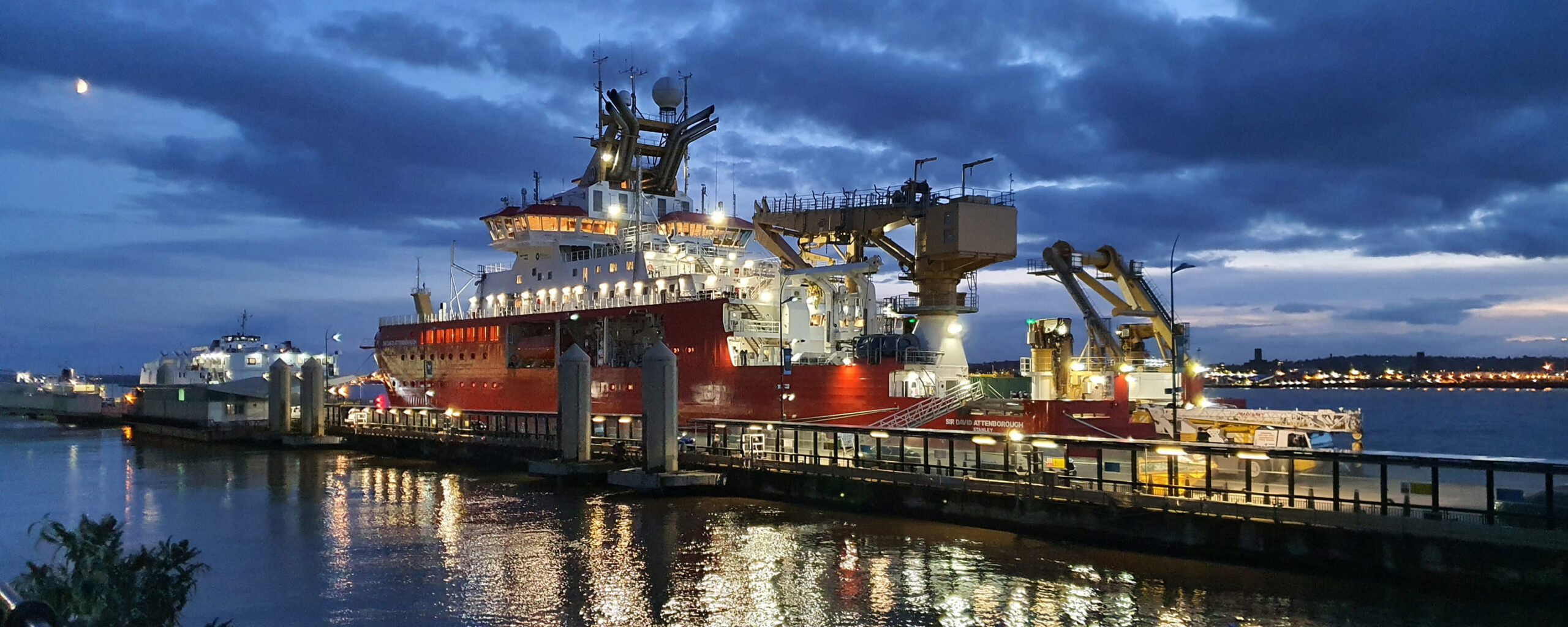
British Antarctic Survey (BAS) has developed many laboratories and facilities to support its world-leading polar research. We make some of these available to our national and international collaborators and fellow researchers through our science services offering.
We have extensive labs and workshops onboard RSS Sir David Attenborough. And at our Cambridge headquarters we operate:
- ice core analysis lab
- geology lab
- aquarium
- herbarium.
RSS Sir David Attenborough
Our research vessel RRS Sir David Attenborough is designed to accommodate over 750m² of state-of-the-art laboratory and workshop facilities. Much of this is multipurpose space, so it can be configured to suit specific research projects.
The ship also has space for at least 10 standard 20ft ISO containers adapted to support science. Two can be placed in the hangar. Two can open directly into the wet lab close to where marine samples are brought onboard.
Sir David Attenborough has 29 container positions and can accommodate up to 17 containers at once.
Multifunctional facilities include ‘wet’ labs, ‘dry’ labs and temperature-controlled ‘cold’ labs for biological, chemical and physical analysis.
The ship also has labs for trace metal chemistry, atmospheric and sea water analysis. There is a walk-in -20°C freezer and several -80°C ultra-low temperature freezer units.
Ice core lab
Our ice core gas laboratory specialises in measuring the concentration and composition of greenhouse gases (such as methane and carbon dioxide) captured in ice cores.
We also develop and run a variety of simple carbon cycle models for simulating the concentration of greenhouse gases in Earth’s atmosphere in the ancient past.
We want to understand how climate and the carbon cycle have interacted in the past, which can tell us about what may happen in the future. For example:
- will carbon stored in soil act as a source or a sink for carbon dioxide?
- can changes in sea-ice around Antarctica affect the ability of the ocean to absorb human-generated carbon dioxide?
We work closely with the Godwin Lab at the University of Cambridge where we have access to a suite of gas-source mass spectrometers and other laser-based instruments.
Geology lab
We keep one of the largest collections of Antarctic rocks and fossils in the world. The collections contain over 200,000 specimens from Antarctica and the sub-Antarctic Islands collected over the last 75 years.
Lab facilities include:
- preparation for geochemical analysis
- analysis of sediment cores and grains
- fossil analysis, replication and photography
- microscopy.
Aquarium
The BAS marine aquarium at Cambridge is the only low-temperature research aquarium in the UK, and one of only 3 globally to regularly hold Antarctic species over extended periods.
We’ve maintained marine animals collected from Antarctic waters since 1973.
The aquarium provides:
- 12 tanks maintained at temperatures between -0.2°C and 0°C and air temperature at -2°C
- 3 experimental rooms – one maintained at the same temperature as the aquarium, 2 where the temperature can be raised up to 25°C
- fine-scale analyses on Antarctic species
- year-round access to biological specimens
- ability to conduct long-term research projects.
Herbarium
The plant collections held in the British Antarctic Survey’s herbarium comprises over 40,000 plant specimens from over 2000 species growing in Antarctica itself, sub-Antarctic Islands and nearby continents (such as Patagonia).
The collections are mostly mosses, liverworts and lichens with smaller collections of vascular plants, macro-algae and macro-fungi.
Our Antarctic plant database has details of the specimens. The database also holds:
- 12,000 field records of specimens from South Georgia which were collected and identified, but not preserved.
- information on over 15,000 specimens collected from relevant regions that are held in some 50 other herbaria worldwide.
Our specimens are available for loan to recognised institutions. We encourage anyone who would like to use the specimens to visit our herbarium with its supporting information and resources.