
Artificial Intelligence for Stable Isotope Tracers
- Start date:
- 1 October, 2025
- End date:
- 1 April, 2026
What AISIT does
Artificial Intelligence for Stable Isotope Tracers (AISIT) is creating a standardised, machine-readable database of Arctic freshwater tracers and related environmental data.
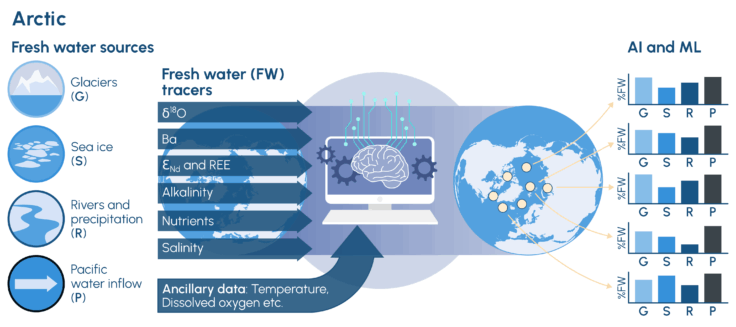
The project brings together data on stable oxygen isotopes (e.g. δ18O), other freshwater tracers like barium, and key nutrient data.
By harmonising these datasets, AISIT makes Arctic freshwater data easier to access, compare, and use.
Using AI and machine learning, the project helps scientists uncover new insights from previously scattered data.
Why this matters
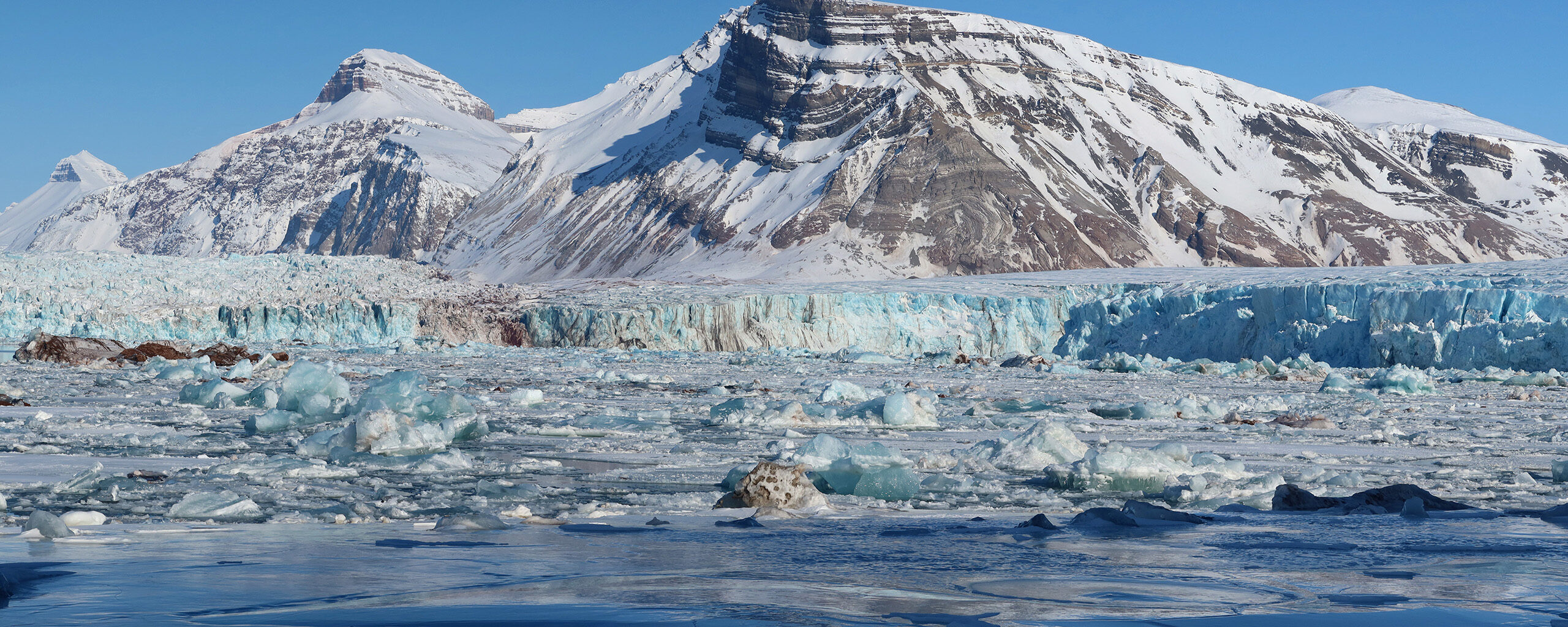
The Arctic is warming, causing glaciers to melt faster, rivers to change, and sea ice to retreat quickly. These changes add large amounts of freshwater to the Arctic Ocean, affecting ocean circulation, nutrients, and ecosystems both locally and globally.
How the project works
Different sources of freshwater have unique chemical signatures. Tracers like stable oxygen isotopes, trace metals, and rare earth elements help scientists track where water comes from. When combined with temperature and salinity measurements, they reveal how water moves through the Arctic.
Collecting and interpreting this data is challenging. Harsh conditions, short field seasons, and complex analyses leave gaps. Current datasets are scattered and inconsistent.
AISIT is addressing these issues by bringing the data together and standardising it for large-scale analysis.
Science objectives
The project will:
- provide the first complete view of freshwater sources and flows in and out of the Arctic Ocean
- improve understanding of changes in the Arctic and their effects on the wider Earth system
Data governance
All datasets will clearly identify their original sources. The database will be published openly online following FAIR principles (Findable, Accessible, Interoperable, Reusable) with a Digital Object Identifier. All data contributors will be credited in the citation.
The data will be available under the Open Government Licence v.3.
National Oceanography Centre:
-
Yevgeny Aksenov
-
Adrian Martin
-
Eric Orenstein
-
Jonathan Coney
UK Centre for Ecology & Hydrology
-
Ezra Kitaon
-
Phillip Taylor
-
Bryan Spears