PRESCIENT
PRESCIENT supports long-term, strategically important measurements and capabilities for the wider science community.

I did a Masters degree in Natural Sciences at Churchill College, Cambridge after which I was awarded a PhD in Space Plasma Physics from the University of Leicester in 2002. After graduating I was awarded a prestigious postdoctoral fellowship at the National Center for Atmospheric Research in Boulder, USA in the Advanced Study Program where I continued my research in ionospheric and magnetospheric physics.
I returned to the UK in 2004 to work in the Earth and Ocean Sciences Dept at the University of Liverpool as a member of the GEOSPACE consortium working on the characterisation of the contamination of geomagnetic field models by electrical currents in the ionosphere and magnetosphere.
I moved to Lancaster University in 2007 to work on the Rainbow All Sky Camera auroral imaging system in Iceland and the Faeroe Islands.
I’ve been working at BAS as a radiation belt modeller since 2012 investigating the role of wave particle interactions in the acceleration of electrons in the Radiation Belts of Jupiter and Saturn.
My primary research involves modelling of the radiation belts of Jupiter and Saturn with complementary interests in Solar-Terrestrial Physics and Space Weather.
Clark, George ORCID record for Clark, George. Kollmann, P. Kinnison, J. Kelly, D. Haapala, A. Li, W. Jaynes, A. N. Blum, L. Marshall, R. Turner, D. Cohen, I. Ukhorskiy, A. Mauk, B. H. Roussos, E. Nénon, Q. Drozdov, A. Woodfield, Emma ORCID record for Woodfield, Emma. Dunn, W. Berland, G. Kraft, R. Williams, P. K. G. Smith, H. T. Hospodarsky, G. Wu, X. Hulsman, J. O’Brien, T. P. Looper, M. Sorathia, K. Sciola, A. Sicard, A. Donegan, M. Clare, B. Emmell, D. Wirzburger, J. Sepulveda, D. Roufberg, L. Perry, J. Schellhase, J. Pergosky, D. Able, E. O’Neill, M. Fernandes, C. Chattopadhyay, D. Bibelhauser, S. Kijewski, S. Pulkowski, J. Furrow, M. Feldman, C. Nichols, J. Carr, N. Verma, H. Lindsay, S. Bunce, E. Parry, B. Martindale, A. (2026) Comprehensive Observations of Magnetospheric Particle Acceleration, Sources, and Sinks (COMPASS): A Mission Concept to Explore the Extremes of Jupiter’s Magnetosphere [Special Communication].
Drozdov, A.Y. Kollmann, P. Hao, Y. Wang, D. Woodfield, E.E. ORCID record for Woodfield, E.E.. (2025) Electron Acceleration and Zebra Stripe Formation in Saturn’s Radiation Belts.
Hao, Y.‐X. ORCID record for Hao, Y.‐X.. Shprits, Y.Y. ORCID record for Shprits, Y.Y.. Menietti, J.D. Averkamp, T. ORCID record for Averkamp, T.. Wang, D.D. ORCID record for Wang, D.D.. Kollmann, P. ORCID record for Kollmann, P.. Hospodarsky, G.B. ORCID record for Hospodarsky, G.B.. Drozdov, A. ORCID record for Drozdov, A.. Saikin, A. Roussos, E. ORCID record for Roussos, E.. Krupp, N. ORCID record for Krupp, N.. Horne, R.B. ORCID record for Horne, R.B.. Woodfield, E.E. ORCID record for Woodfield, E.E.. Bolton, S.J. ORCID record for Bolton, S.J.. (2024) Acceleration of Energetic Electrons in Jovian Middle Magnetosphere by Whistler‐Mode Waves.
Hao, Yixin. Shprits, Yuri Y. Menietti, Doug. Liu, Z.-Y. Averkamp, Terrance F. Wang, Dedong. Kollmann, Peter. Hospodarsky, George Blair. Drozdov, Alexander Yurievich. Roussos, Elias. Krupp, Norbert. Horne, Richard B. ORCID record for Horne, Richard B.. Woodfield, Emma E. ORCID record for Woodfield, Emma E.. Bolton, Scott J. (2024) Jupiter’s Whistler-mode Belts and Electron Slot Region.
Sanchez-Cano, B. Woodfield, E. ORCID record for Woodfield, E.. Rennie, S. Moral Pombo, D. (2024) A bigger broader Autumn MIST [Specialist Discussion Meeting Report].
Woodfield, Emma ORCID record for Woodfield, Emma. Smith, Andy. Daggitt, Thomas ORCID record for Daggitt, Thomas. Turner, Harriet. (2023) MIST reunited.
Kavanagh, Andrew J. ORCID record for Kavanagh, Andrew J.. Ogawa, Yasunobu. Woodfield, Emma E. ORCID record for Woodfield, Emma E.. (2022) Two techniques for determining F-region ion velocities at meso-scales: Differences and impacts on Joule heating.
Woodfield, E.E. ORCID record for Woodfield, E.E.. Glauert, S.A. ORCID record for Glauert, S.A.. Menietti, J.D. Horne, R.B. ORCID record for Horne, R.B.. Kavanagh, A.J. ORCID record for Kavanagh, A.J.. Shprits, Y.Y. (2022) Acceleration of electrons by whistler-mode hiss waves at Saturn.
Roussos, E. Allanson, O. Andre, N. Bertucci, B. Branduardi-Raymont, G. Clark, G. Dialynas, K. Dandouras, I. Desai, R.T. Futaana, Y. Gkioulidou, M. Jones, G.H. Kollmann, P. Kotova, A. Kronberg, E.A. Krupp, N. Murakami, G. Nenon, Q. Nordheim, T. Palmaerts, B. Plainaki, C. Rae, J. Santos-Costa, D. Sarris, T. Shprits, Y. Sulaiman, A. Woodfield, E. ORCID record for Woodfield, E.. Wu, X. Yao, Z.H. (2021) The in-situ exploration of Jupiter’s radiation belts.
Yao, Zhonghua. Dunn, William R. Woodfield, Emma E. ORCID record for Woodfield, Emma E.. Clark, George. Mauk, Barry H. Ebert, Robert W. Grodent, Denis. Bonfond, Bertrand. Pan, Dongxiao. Rae, I. Jonathan. Ni, Binbin. Guo, Ruilong. Branduardi-Raymont, Graziella. Wibisono, Affelia D. Rodriguez, Pedro. Kotsiaros, Stavros. Ness, Jan-Uwe. Allegrini, Frederic. Kurth, William S. Gladstone, G. Randall. Kraft, Ralph. Sulaiman, Ali H. Manners, Harry. Desai, Ravindra T. Bolton, Scott J. (2021) Revealing the source of Jupiter’s x-ray auroral flares.
Reidy, J.A. ORCID record for Reidy, J.A.. Horne, R.B. ORCID record for Horne, R.B.. Glauert, S.A. ORCID record for Glauert, S.A.. Clilverd, M. ORCID record for Clilverd, M.. Meredith, N.P. ORCID record for Meredith, N.P.. Woodfield, E. ORCID record for Woodfield, E.. Ross, J.P. ORCID record for Ross, J.P.. Allison, H.J. Rodger, C.J. (2021) Comparing electron precipitation fluxes calculated from pitch angle diffusion coefficients to LEO satellite observations.
Ross, J.P.J. ORCID record for Ross, J.P.J.. Glauert, S.A. ORCID record for Glauert, S.A.. Horne, R.B. ORCID record for Horne, R.B.. Watt, C.E. Meredith, N.P ORCID record for Meredith, N.P. Woodfield, E.E. ORCID record for Woodfield, E.E.. (2020) A new approach to constructing models of electron diffusion by EMIC waves in the radiation belts.
Woodfield, E.E. ORCID record for Woodfield, E.E.. Glauert, S.A. ORCID record for Glauert, S.A.. Menietti, J.D. Averkamp, T.F. Horne, R.B. ORCID record for Horne, R.B.. Shprits, Y.Y. (2019) Rapid electron acceleration in low density regions of Saturn’s radiation belt by whistler mode chorus waves.
Woodfield, EE ORCID record for Woodfield, EE. Horne, RB ORCID record for Horne, RB. Glauert, SA ORCID record for Glauert, SA. Menietti, JD. Shprits, YY. Kurth, WS. (2018) Formation of electron radiation belts at Saturn by Z-mode wave acceleration.
Kollmann, P. Roussos, E. Paranicas, C. Woodfield, Emma E. ORCID record for Woodfield, Emma E.. Mauk, B.H. Clark, G. Smith, D.C. Vandegriff, J. (2018) Electron acceleration to MeV energies at Jupiter and Saturn.
Shprits, Yuri Y. Menietti, John D. Drozdov, Alexander Y. Horne, Richard B. ORCID record for Horne, Richard B.. Woodfield, Emma E. ORCID record for Woodfield, Emma E.. Groene, Joseph B. de Soria-Santacruz, Maria. Averkamp, Terrance F. Garrett, Henry. Paranicas, Christopher. Gurnett, Donald A. (2018) Strong whistler mode waves observed in the vicinity of Jupiter’s moons.
Gray, R.L. Badman, S.V. Woodfield, E.E. ORCID record for Woodfield, E.E.. Tao, C. (2017) Characterization of Jupiter’s secondary auroral oval and its response to hot plasma injections.
Menietti, J. D. Groene, J. B. Averkamp, T. F. Horne, R. B. ORCID record for Horne, R. B.. Woodfield, E. E. ORCID record for Woodfield, E. E.. Shprits, Y. Y. de Soria-Santacruz Pich, M. Gurnett, D. A. (2017) Survey of whistler mode chorus intensity at Jupiter.
Menietti, J. D. Averkamp, T. F. Ye, Sheng-Yi. Horne, R. B. ORCID record for Horne, R. B.. Woodfield, E. E. ORCID record for Woodfield, E. E.. Shprits, Y. Y. Gurnett, D. A. Persoon, A. M. Wahlund, J. E. (2015) Survey of Saturn Z-mode Emission.
Lilensten, Jean. Coates, Andrew J. Dehant, Véronique. Dudok de Wit, Thierry. Horne, Richard B. ORCID record for Horne, Richard B.. Leblanc, François. Luhmann, Janet. Woodfield, Emma ORCID record for Woodfield, Emma. Barthélemy, Mathieu. (2014) What characterizes planetary space weather?.
Menietti, J. D. Averkamp, T. F. Groene, J. B. Horne, R. B. ORCID record for Horne, R. B.. Shprits, Y. Y. Woodfield, E. E. ORCID record for Woodfield, E. E.. Hospodarsky, G. B. Gurnett, D. A. (2014) Survey Analysis of Chorus Intensity at Saturn.
Woodfield, E. E. ORCID record for Woodfield, E. E.. Horne, R. B. ORCID record for Horne, R. B.. Glauert, S. A. ORCID record for Glauert, S. A.. Menietti, J. D. Shprits, Y. Y. (2014) The origin of Jupiter’s outer radiation belt.
Woodfield, Emma E. ORCID record for Woodfield, Emma E.. (2014) Autumn MIST 2013.
Jackel, B.J. Unick, C. Syrjäsuo, M.T. Partamies, N. Wild, J.A. Woodfield, E.E. ORCID record for Woodfield, E.E.. McWhirter, I. Kendall, E. Spanswick, E. (2014) Auroral spectral estimation with wide-band color mosaic CCDs.
Woodfield, E.E. ORCID record for Woodfield, E.E.. Horne, R.B. ORCID record for Horne, R.B.. Glauert, S.A. ORCID record for Glauert, S.A.. Menietti, J.D. Shprits, Y.Y. (2013) Electron acceleration at Jupiter: greater input from cyclotron-resonant interaction with whistler-mode chorus waves.
Fear, Robert. Woodfield, Emma ORCID record for Woodfield, Emma. (2013) Autumn MIST 2012.
Menietti, J.D. Shprits, Y.Y. Horne, R.B. ORCID record for Horne, R.B.. Woodfield, E.E. ORCID record for Woodfield, E.E.. Hospodarsky, G.B. Gurnett, D.A. (2013) Chorus, ECH, and Z mode emissions observed at Jupiter and Saturn and possible electron acceleration.
Macmillan, Susan. Droujinina, Anna. Woodfield, Emma ORCID record for Woodfield, Emma. (2012) Long-term trends in geomagnetic daily variation.
Woodfield, E., Glauert, S., Menietti, J., Horne, R., Kavanagh, A., & Shprits, Y. (2022). Acceleration of electrons by whistler-mode hiss waves at Saturn (Version 1.0) [Data set]. NERC EDS UK Polar Data Centre. https://doi.org/10.5285/c6202511-d70b-45ae-9b72-ff30f4888f5f
Ross, J., & Meredith, N. (2020). Electromagnetic ion cyclotron electron diffusion coefficients calculated from CRRES data using a new approach (Version 1.0) [Data set]. UK Polar Data Centre, Natural Environment Research Council, UK Research & Innovation. https://doi.org/10.5285/be8af49f-cdf1-443a-9c78-6a59c9d5be68
Woodfield, E., Glauert, S., Menietti, J., Averkamp, T., Horne, R., & Shprits, Y. (2019). Rapid electron acceleration in low density regions of Saturn’s radiation belt by whistler mode chorus waves (Version 1.0) [Data set]. UK Polar Data Centre, Natural Environment Research Council, UK Research & Innovation. https://doi.org/10.5285/ae5116a5-fc16-464c-9c26-e395f897a8e4
PRESCIENT supports long-term, strategically important measurements and capabilities for the wider science community.
This project explored the radiation belts of the Earth, Jupiter and Saturn to help set new research goals for future spacecraft missions to the planets and develop computer models that will be of direct use to the space insurance, satellite construction and satellite service industries.
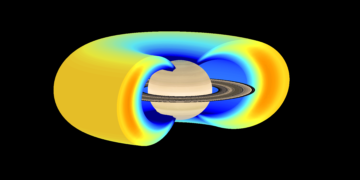
PlanetBelt3 will be looking at the radiation belts of Saturn in this project, to include important newly recognised transport processes.
The 40-year-old mystery of what causes Jupiter’s X-ray auroras has been solved. For the first time, scientists have seen the entire mechanism at work – and it could be a […]
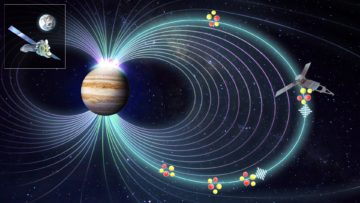
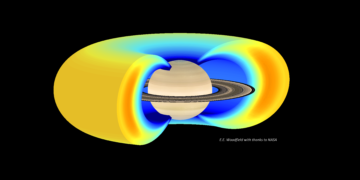
A team of international scientists from BAS, University of Iowa and GFZ German Research Centre for Geosciences has discovered a new method to explain how radiation belts are formed around […]