
WATEC
WATEC
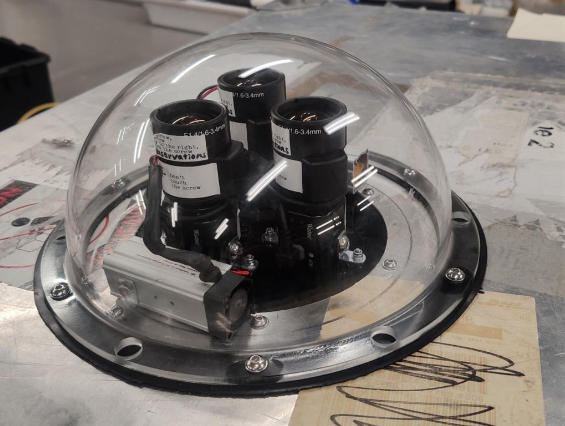
Three compact auroral cameras have been installed at Halley Research Station to support coordinated studies of auroral and wave phenomena. This system is owned and provided by the Institute for Space-Earth Environmental Research from Nagoya University, Japan.
The three cameras are used to observe three distinct types of auroral activity. First, isolated proton auroras are captured using H-beta and panchromatic cameras. These auroras are often associated with Pc1 geomagnetic pulsations, which are signatures of Electromagnetic Ion Cyclotron (EMIC) waves. Second, Subauroral Red (SAR) arcs are observed using a camera equipped with a 630.0 nm filter, allowing detection of faint red emissions caused by heat conduction from the magnetosphere. Third, ordinary auroras, including pulsating patches, are monitored using the panchromatic camera.
A complementary set of instruments have been deployed in Nain (56.0667°N, 61.0833°W), Canada, which is geomagnetic conjugate to Halley. These include an induction magnetometer, an ELF/VLF receiver, a riometer, and a KEO auroral camera capable of detecting emissions at 557.7 nm, 630.0 nm, and H-beta wavelengths.
Halley and Nain form the only known subauroral conjugate pair in the world, making them uniquely valuable for this research. By comparing Pc1 wave amplitude modulations and isolated proton auroras in both hemispheres, scientists can better understand the dominant mechanisms driving relativistic electron loss.