ANTARCTIC BLOG: Science from the air #3
One week on from departing Rothera into the field and the first leg of the PolarGAP survey at FD83 is almost over, I get to sit back, relax a bit […]
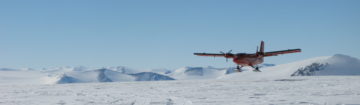

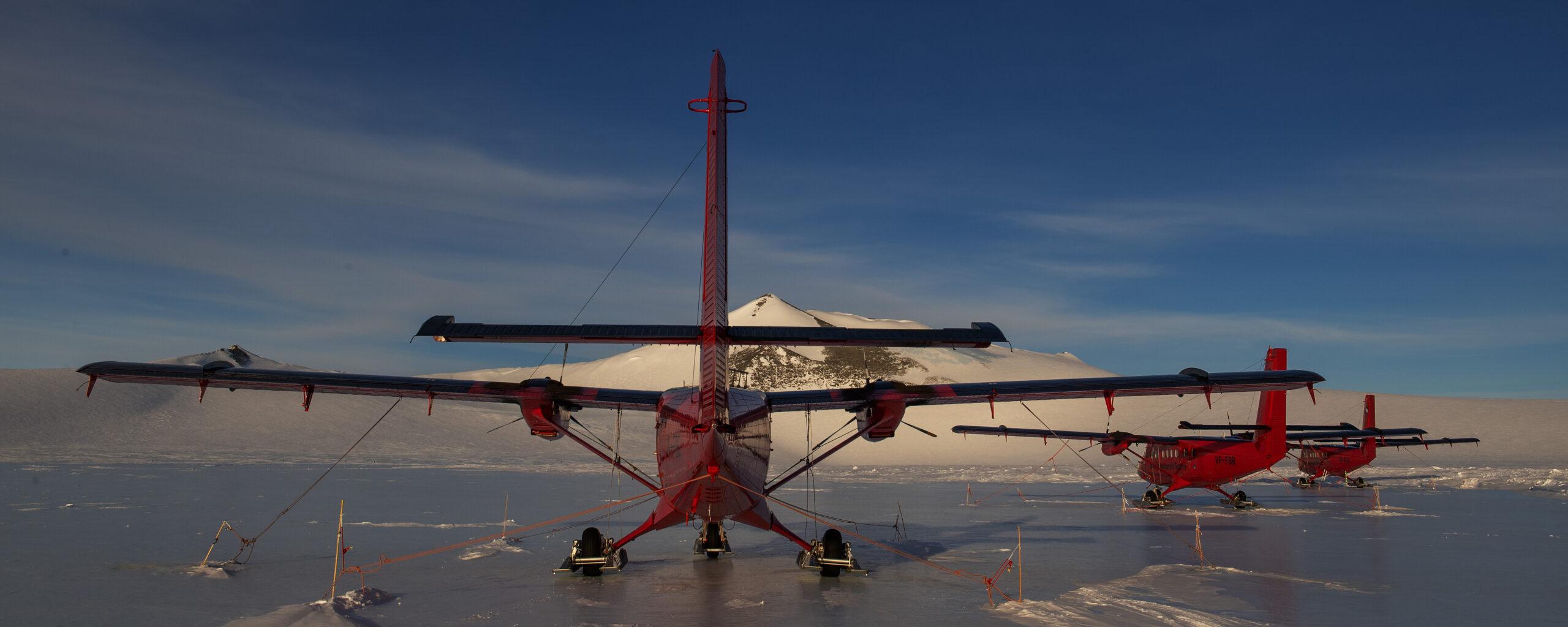
Sky-Blu Research Station is one of our most important logistics facilities, supporting our polar capabilities and deep-field operations in southern Palmer Land, Antarctica.
Sky-Blu has become vital to our work because of its groomed blue ice runway. This allows wheeled aircraft such as the four-engined Dash-7 to operate deep in the Antarctic interior.
The Dash-7’s greater freight capacity gives us clear fuel and load-carrying benefits compared with the smaller Twin Otter aircraft. They previously carried out most deep-field flights.
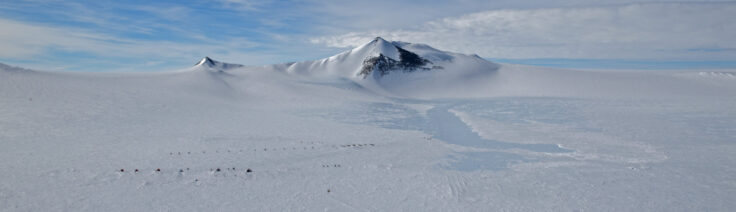
Sky Blu field station and blue ice runway
The runway is formed on naturally occurring blue ice. This is extremely hard and dense ice that has lost the air bubbles that normally cloud glacier ice. When conditions are right, the runway can be up to 1.2 kilometres long and 50 metres wide. It’s permanently marked with flags to help pilots judge distance and contrast during landings.
Sky-Blu is located on an area of blue ice close to the Sky-Hi Nunataks in southern Palmer Land. This setting makes it particularly well suited for use as an ice runway for larger wheeled aircraft operating far from the coast.
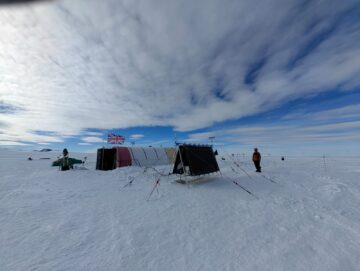
A year-round main camp supports the runway and sits approximately 1.5 kilometres south-west of the runway apron. The camp includes a distinctive red fibreglass melon hut for accommodation, along with pyramid tents, a garage, food depot, radio aerial and toilet facilities.
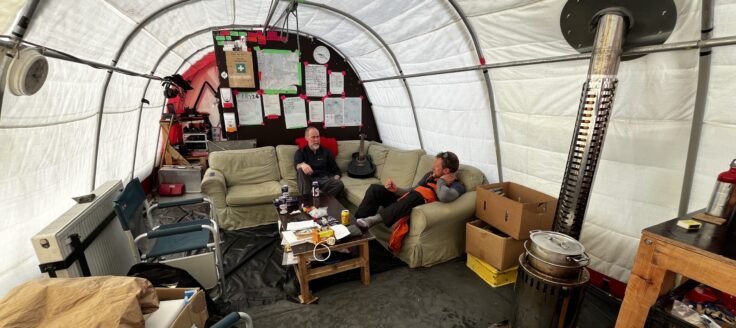
Sky Blu field station living space in the weather-haven tent
Life at Sky-Blu is simple and often demanding. Much of the day is spent clearing snow drifts from the runway using snow blowers, grooming the ice surface, and moving fuel drums and equipment. When the weather closes in, work shifts indoors. We pass time there reading, writing, chatting, or waiting for flying conditions to improve.
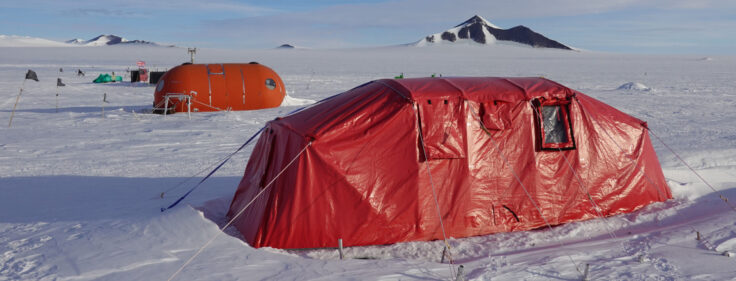
Sky Blu – accommodation tent and melon hut
We usually staff the camp with a small team of two or three people, including a mechanic. Although it is remote and austere, Sky-Blu plays a crucial role in helping us move people, equipment and fuel between Rothera Research Station and field sites across Antarctica.
We first identified Sky-Blu during the 1993-94 field season. It became fully operational as a logistics facility in 1997-98, replacing an earlier high-latitude depot at the Sky-Hi Nunataks, which we later decommissioned.
Since then, Sky-Blu has become an essential part of our logistics network, allowing us to fly larger aircraft further south and extend the reach of our science. Its role continues to grow as our deep-field research programmes expand.
Sky-Blu supports a wide range of scientific work by acting as a forward operating base for fuel storage, equipment handling and aircraft operations. By helping us reach remote regions reliably, the station underpins research into:
One week on from departing Rothera into the field and the first leg of the PolarGAP survey at FD83 is almost over, I get to sit back, relax a bit […]
Greetings from Marie Byrd Land! The waiting is over….we finally arrived at our field site on 11th December, after a 4 hour flight from Sky Blu one of BAS’s fuel […]

The British Antarctic Survey has installed and activated two solar photovoltaic and energy storage systems in Antarctica as part of our commitment to reach net zero by 2040.
The 2022/23 Antarctic field season has ended, marking the conclusion of another successful year of scientific exploration in one of the world’s most remote and challenging environments. This field season, […]

As spring returns to the southern hemisphere British Antarctic Survey (BAS) has started another research season which will take them over land, sea and ice in search of answers to […]