
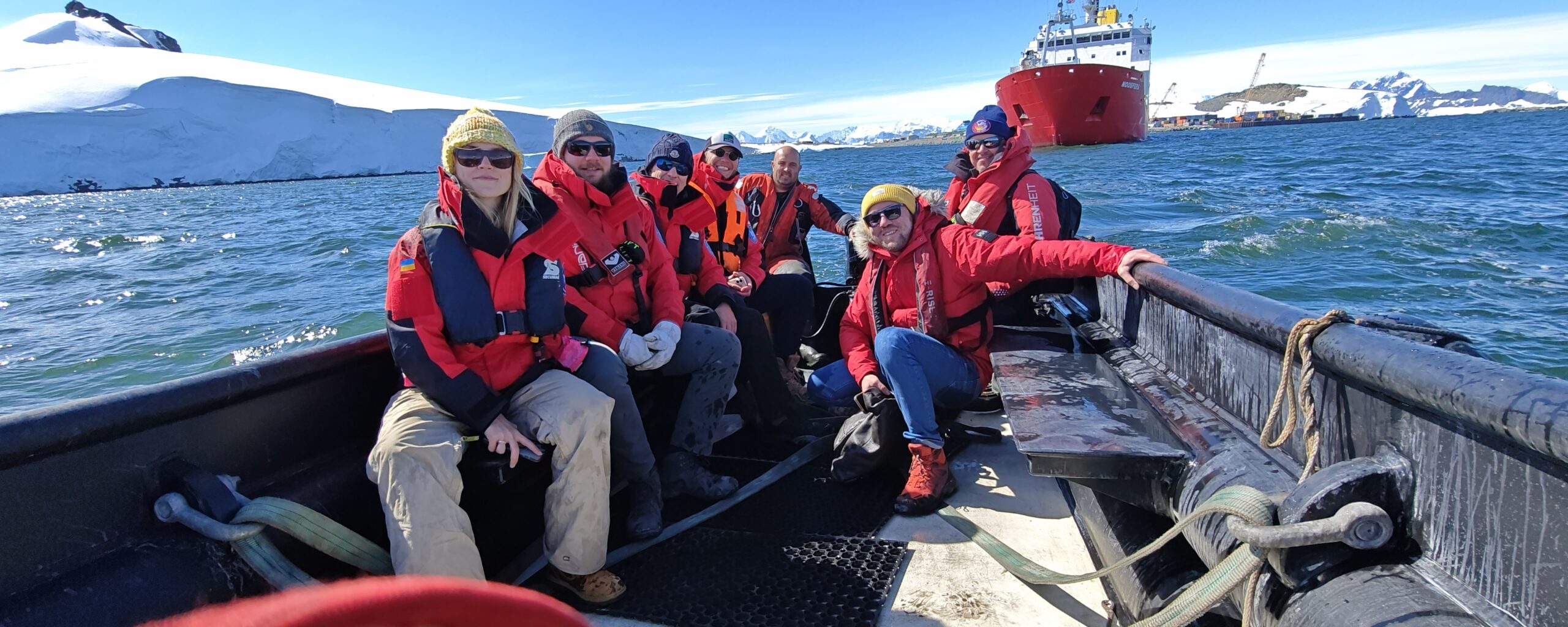
The British Antarctic Survey (BAS) and the National Antarctic Scientific Centre (NASC), Ukraine, collaborated to deliver essential logistics support to Rothera Research Station, Antarctica, and to study jointly the impact of climate change.
As part of the new collaboration, the Ukrainian research vessel Noosfera transported personnel and cargo to BAS’ largest research station at Rothera and back after it resupplied Ukraine’s Vernadsky Research Base. Vernadsky base is located around a day’s sailing from Rothera Research Station.
Joint scientific ventures
During this Antarctic summer season, Ukrainian scientists on the Noosfera worked together with the BAS marine team out of Rothera Research Station and scientists from the Natural Environmental Research Council (NERC) funded POLOMINTS project. They were carrying out CTD (conductivity, temperature and depth) oceanographic measurements and collecting seawater samples together. The measurements and analyses will be critical for our work in understanding the impact of climate change on coastal Antarctica. These are hoped to be the beginning of other marine science projects, bringing together skills and experience as well as opportunities for knowledge transfer and training for early career scientists from both countries.
Besides scientific research, a mutually beneficial logistical cooperation proved to be successful.
Ice class vessel
Noosfera is a symbolic name for the ice class vessel, as it comes from the works of Volodymyr Vernadsky, the world-renowned scientist after whom the Ukrainian Antarctic station is named. The vessel was acquired by NASC from BAS in 2021 and was formerly known as the RRS James Clark Ross. Noosfera is now the flagship of the Ukrainian research fleet and is a powerful symbol of the enduring partnership between the UK and Ukraine.
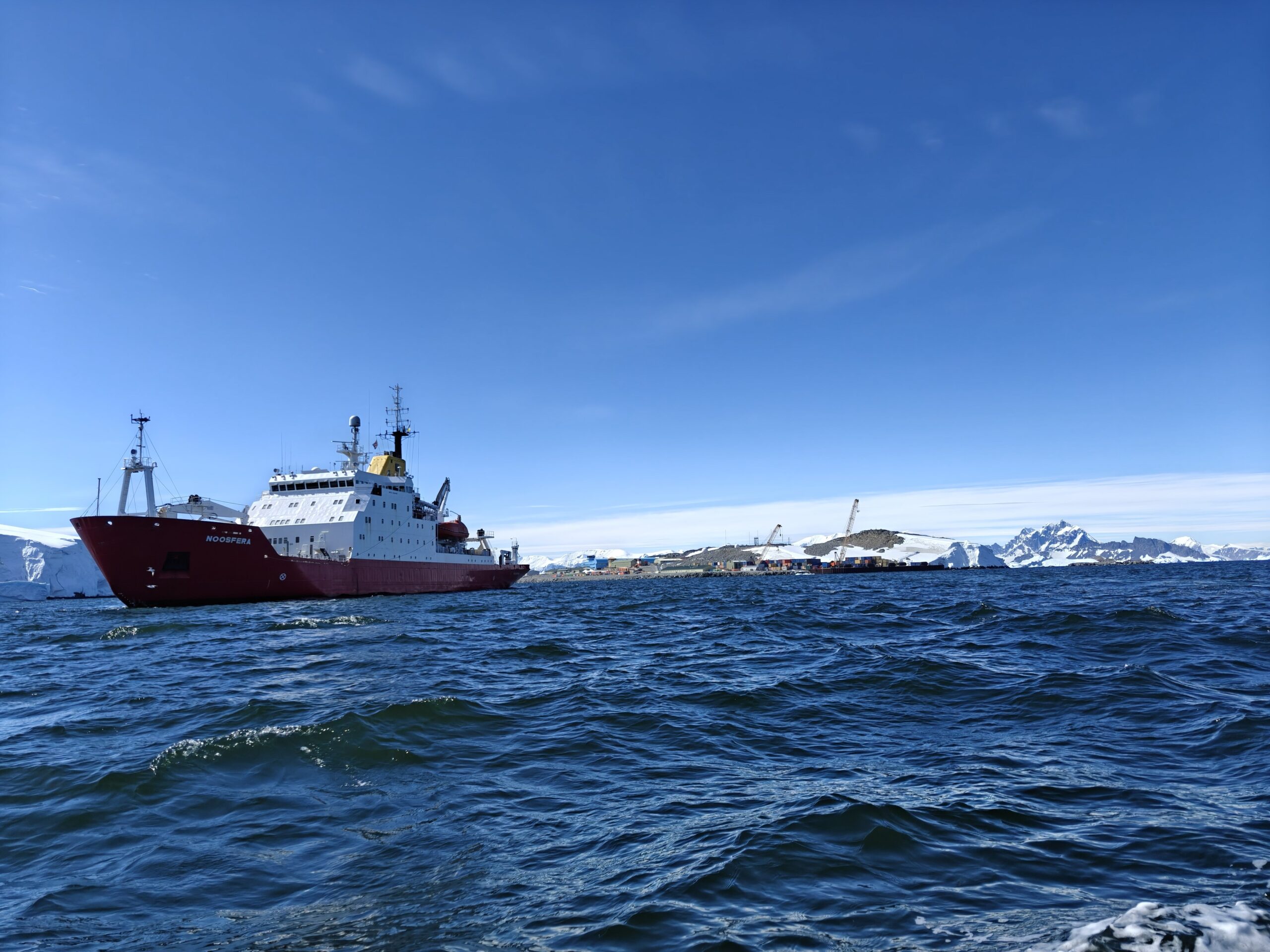
Noosfera ice-class research vessel, Credit: National Antarctic Scientific Centre (NASC), Ukraine
Research Station
Ukraine has run continuous year-round operations since taking over the UK’s former ‘Faraday’ Station in 1996, now known as Vernadsky Research Base. Ukraine’s ongoing contribution to global research, spanning atmospheric science, including both meteorology and geophysics, as well as biology, demonstrates the importance it places on international scientific collaboration.
Antarctic logistics
Both Rothera Research Station and Vernadsky Research Base are staffed all year round and has a reduced number of people working there from May to October, known as ‘winterers.
This March, before the start of the Antarctic winter, there was a need to rotate some specialists at Rothera and deliver important cargo. Using Noosfera, 7 specialists were brought to the station, and 35 people were transported away from Rothera to Chile.
This operational cooperation strengthens the relationship between BAS and NASC, demonstrating the value of shared infrastructure and mutual support among national Antarctic operators.
BAS teams in logistics and operations have worked closely with their Ukrainian counterparts to enable this collaboration. They were supported by the strong organisation and effective management of the managing company, Winot OU.
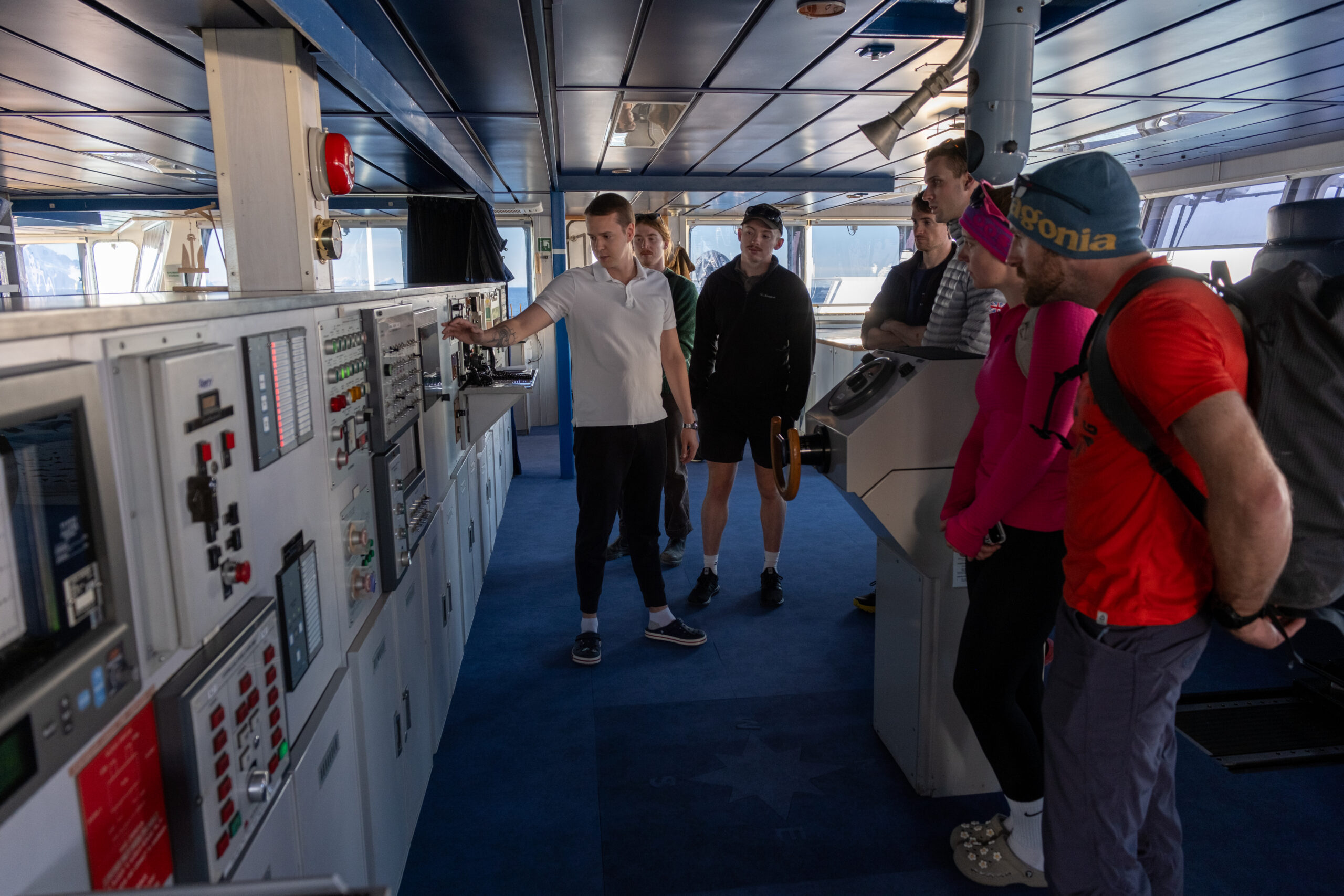
Credit: National Antarctic Scientific Centre, Ukraine
Oliver Darke, Director of Polar Operations, Engineering and Infrastructure (BAS), said:
“This collaboration highlights the strength of international partnerships in Antarctica. By working closely with the National Antarctic Scientific Centre, we are enhancing resilience, reducing environmental impact through shared logistics, and ensuring our teams can continue their vital scientific and operational work safely and efficiently”.
Evgen Dykyi, Director of the National Antarctic Scientific Centre, said:
“It is a particular pleasure for me to develop cooperation with the British Antarctic Survey, because 30 years ago, it was a generous gift from the United Kingdom – the transfer of the Faraday Station to Ukraine that launched our national Antarctic program. The RRS James Clark Ross delivered the first Ukrainian expedition to ‘Faraday/Vernadsky’, and now the same vessel, but under the name “Noosfera,” flying the Ukrainian flag and with a Ukrainian crew, supported the British expedition to Rothera. We learned a lot from our British colleagues in the past, and in addition to the station and the vessel, we adopted many best practices in organising Antarctic research. Therefore, we are very pleased to continue developing Ukrainian-British cooperation in Antarctica, now as a partner”.